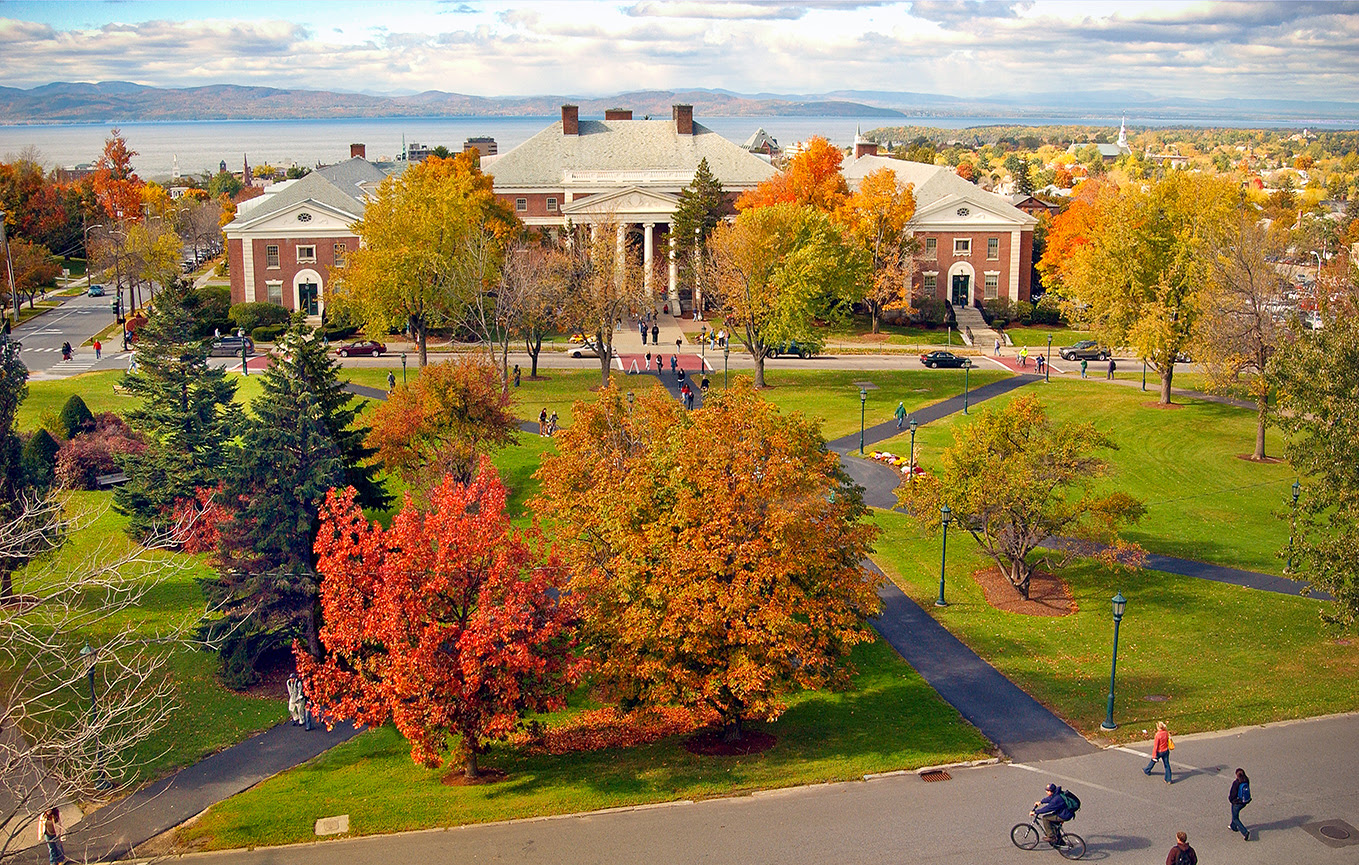
UVM Promise program expanded, tuition set in response to economic challenges including increased cost of health insurance. UVM photo by Sally McCay.
Fiscal Responsibility in Focus at UVM Board of Trustees’ Fall Meeting
Vermont Business Magazine The University of Vermont Board of Trustees set tuition for the 2024-25 academic year in conjunction with an expansion of the UVM Promise program as part of a focus on fiscal responsibility at its annual fall meeting Friday and Saturday at the Dudley H. Davis Center.
Acknowledging the importance of fiscal responsibility in the face of economic challenges including a budget gap of $10 million and ever-increasing health insurance costs (up 17% after increasing by 23.3% and 18.7% the two previous years), the Budget, Finance and Investment Committee set tuition set tuition to reflect a 4.5-percent increase for out-of-state students and a 2-percent increase for Vermonters, as well as a 3.5-percent increase for room and board, for the next academic year. Tuition was also set for the upcoming 2025 summer session. Fees in the College of Nursing, Grossman School of Business, and College of Engineering and Mathematical Sciences will go up by $1,000.
The Board was informed of the expansion of the UVM Promise program for Fall 2025. Under the new guidelines, students from Vermont households with a combined annual income up to $100,000 in adjusted gross income (AGI) will be allowed to attend the state’s flagship public university tuition-free. The 33-percent increase follows an upward adjustment of the program’s household income threshold by 25 percent for Fall 2024, as part of a continued emphasis on affordability for Vermont students.
The Board approved the formation of the Vermont Complex Systems Institute, a central university resource for collaboration in computation, artificial intelligence, complex systems, open source, and network science research. This new institute reflects the evolution of the existing Vermont Complex Systems Center in the College of Engineering and Mathematical Sciences to a university-wide institute reporting to the Office of the Vice President for Research.
The Board received an academic update from Vice President for Research and Economic Development Kirk Dombrowski on UVM’s gen-AI Task Force, a work group comprising 45 members from across the university including the Larner College of Medicine and administrative units such as Enrollment Management.
The Task Force examined how generative artificial intelligence is currently used across the university, with the goals of identifying resource, technological, information, and training needs arising from the encounter with AI across units/domains/areas; discussing needed policy and best practice statements development around the use of generative AI in university operations; and suggesting collaborative and university-wide opportunities for use of AI.
Interim President Patricia Prelock and Acting Provost Linda Schadler delivered their respective reports to the Board. Prelock shared news of UVM’s Planetary Health Initiative and briefed the board on the successful transition period underway in the first month of her appointment as interim president, outlining the administration’s important efforts to build and maintain strong campus and community relationships, address the budget pressure caused by rapidly healthcare costs, and focus on providing an excellent student experience. Schadler’s report included recaps of the Our Common Ground Symposium: Israel and Gaza, the Leahy Public Policy Forum and the Presidential Lecture Series, as well as additional details on the Planetary Health Initiative.
The Board received a presentation from Dean Leslie Parise on work being done within the College of Agriculture and Life Sciences. The presentation focused on research growth – from $22M to $45M – as well as research site developments including the acquisition of the 400-acre Nordic Farm agricultural facility in Charlotte and the hiring of Tim Rademacher as scientific director for the Proctor Maple Research Center. CALS also recently launched a Sustainable Development Policy, Economics and Governance (SDPEG) predoctoral program that saw more than 400 applicants for eight slots per year.
A summary of continued progress on the university’s athletic complex project was presented to the Board by Interim Director of Planning, Design and Construction David Blatchly.
Senior Coordinator of Presidential Events Kelly O’Malley presented to the Board a proposal of potential changes to the location and format of the university’s 2025 commencement ceremonies. O’Malley detailed how challenges to the existing format including weather volatility, accessibility challenges and capacity warrant a reimagining of those ceremonies.
In curriculum action items, the Board passed a resolution approving the creation of a Micro-Certificate of Graduate Study in Disability Studies in the Graduate College in conjunction with the College of Education and Social Services.
University of Vermont: For people and planet
Founded in 1791, UVM is the leading public research university where discovery, creativity, community, and action coalesce to secure a thriving future for people and planet. Vermont’s state flagship and land-grant university attracts $250 million annually in groundbreaking research and enrolls approximately 14,000 students from 50 states and 75 countries. At UVM, students, faculty, and staff work together in pursuit of a healthier, greener future. Learn more at uvm.edu.
Source: 10.26.2024. BURLINGTON – The University of Vermont
To support vital journalism, access our archives and get unique features like our award-winning profiles, Book of Lists & Business-to-Business Directory, subscribe HERE!