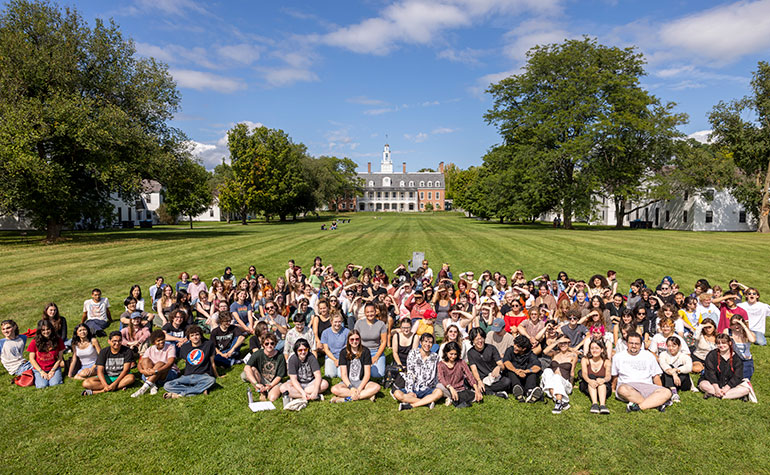
Photo: Bennington College first-year and transfer students gather on campus at the start of classes. Photo: Lorianna Weathers Photography.
Bennington County has arrived on a newer and bigger map.
by Olga Peters, Vermont Business Magazine Jonathan Cooper, community and economic development program manager at the Bennington County Regional Commission, said the new attention on the county is a surprising outcome of the pandemic.
“We’ve had a lot of fresh eyes take a look at us in the last couple of years,“ Cooper said. “That’s made a big difference in the kinds of projects we have in the pipeline. People are investing, realizing this is a great place to live and grow a business.“
Bennington County is within easy reach of major metropolitan areas like Albany, Saratoga, and even New York City, making it a popular choice for commuters. The North and South Shire see a steady flow of traffic throughout the day, and towns like Manchester experience a significant population surge on holiday weekends, as visitors flock to enjoy its attractions.
Tom Dee, CEO and president of Southwestern Vermont Health Center, acknowledged the economic challenges facing the county but emphasized that it has even more opportunities for growth and development. He sees various organizations and individuals actively working together on diverse projects, fostering a strong sense of community and shared purpose.
“Not only do they work together, they want to work together, and they realize they have to work together to be successful,“ he said.
Housing and workforce shortages continue to hamper area businesses as they grapple with the lingering effects of the COVID-19 pandemic.
Michele Hunter, regional leader for Vermont at Berkshire Bank, said the shortages are “creating a ripple effect that’s making it difficult to find qualified candidates to fill open jobs, particularly in the hospitality and retail sectors, which are critical to supporting the burgeoning resurgence in travel and tourism.
“We’re also seeing a trend of some individuals working two or sometimes three jobs to make ends meet, given continued higher prices for things like groceries, gas and rent,“ Hunter added.
Optimism and Exhaustion in State of Commerce Survey
In an email, Hunter wrote of Berkshire Bank’s experience in the county’s economy: “We are cautiously optimistic about the county’s economic prospects.“
“We’re encouraged by the drop in unemployment, which means most people who want to work are working, and that travel and tourism have rebounded to at, or close to, pre-pandemic levels,“ she added. “That said, inflation is still elevated and the high interest rate environment has dampened consumer spending. Because that kind of spending accounts for about two-thirds of our gross national product, economies down to the county and town level are under increased pressure.“
Matt Harrington, executive director of the Southwestern Vermont Chamber of Commerce, has the opportunity to experience the county from a broader perspective through meetings with community leaders, business owners and potential investors. This long view feeds his optimism.
“I actually see that we’re compounding on all the efforts over the last five years, especially in downtown Bennington and the whole Putnam project,“ Harrington said. “This may be the inside baseball that other people don’t see. So I’m very optimistic.“
While reviewing the 2024 State of the Commerce survey, Harrington said, “People in the business community are cautiously optimistic, although looking for the other shoe to fall.“
Staffing, financial stability and customer growth were mentioned as concerns. Managing fatigue and burnout was discussed more than in previous years.
Harrington wasn’t surprised that the business community feels stronger about the local county’s economy than the state-level economy. He said the greatest challenge facing the county is finding qualified workers to fill open positions.
When asked to name their greatest business challenge, survey respondents put workforce (42%), rising costs (25%) employee costs such as health care, benefits and insurance premiums (9%) and marketing and attracting customers (7%) at the top of the list.
“The cost of making a pizza today is drastically different from what it was in 2019,“ said Harrington, pointing to the soaring expenses of heating, energy and staffing as major burdens on businesses.
While the 2024 State of the Commerce survey showed a slight decline in positive responses compared to 2023, Harrington emphasized that the results were still largely favorable. For instance, despite a drop from 94% to 87%, the vast majority still believe Vermont is a good place to do business.
Harrington attributes some of the decreased optimism to the anxieties surrounding a presidential election year and a general sense of fatigue among business owners.
Harrington said small businesses have weathered one catastrophe after another for several years in a row, including the pandemic and summer floods.
“Looking ahead to 2024, we’re seeing a growing sense of fatigue,“ he said. “We’ve been talking about workforce, housing and child care for years, and people are tired of hearing the same issues without sufficient solutions. Business owners are exhausted from constantly dealing with challenges like losing key staff and not having enough employees to meet demand. We need to move beyond discussion and take concrete action to address these persistent problems.“
Harrington observes a significant increase in community diversity over the past nine years. This is reflected in the latest survey, where one-third of respondents identified as women business owners, and 5% as young professionals (under 40). Furthermore, a growing number of businesses are characterized as BIPOC-owned, LGBTQI+ owned, disabled-person-owned, and immigrant-owned, showcasing a richer and more inclusive business landscape.
“We’re still as heavily white in Bennington County as the rest of Vermont, but I find a huge transitioning happening,“ he said.
Vision 2027
Harrington explained that the chamber’s transformation began after the Manchester Chamber closed, prompting members from the North and South Shires to unite and forge a new strategic plan. This led to the 2020 announcement of the Southwestern Vermont Chamber of Commerce, a merged entity with a regional focus.
Despite the challenges posed by the pandemic, the newly unified chamber, with its refreshed name and brand, successfully pivoted to support businesses during this critical time. As 2024 unfolds, Harrington revealed that the board has embarked on an ambitious new initiative, Vision 2027, marking the next phase in the chamber’s evolution.
According to a chamber press release, Vision 2027 rests on three pillars: Promoting, Collaborating and Empowering. These areas of focus aim to:
-
Attract, grow and retain talent. Showcase the county’s appeal for living, working and playing, fostering accessible and connected communities that celebrate diversity. This includes leveraging initiatives like the state’s GROW Grant for relocation outreach.
-
Cultivate collective assets. Strengthen regional growth, inclusion and quality of life through a unified regional voice and strong partnerships.
-
Foster a thriving environment. Support businesses, organizations and individuals through strong leadership and effective advocacy. This involves informing and educating members, collaborating with other organizations to provide a business perspective on key issues, rather than direct lobbying.
The chamber officially adopted the 2027 strategic plan on July 18, and members are committed to working through its initiatives until the summer of 2027.

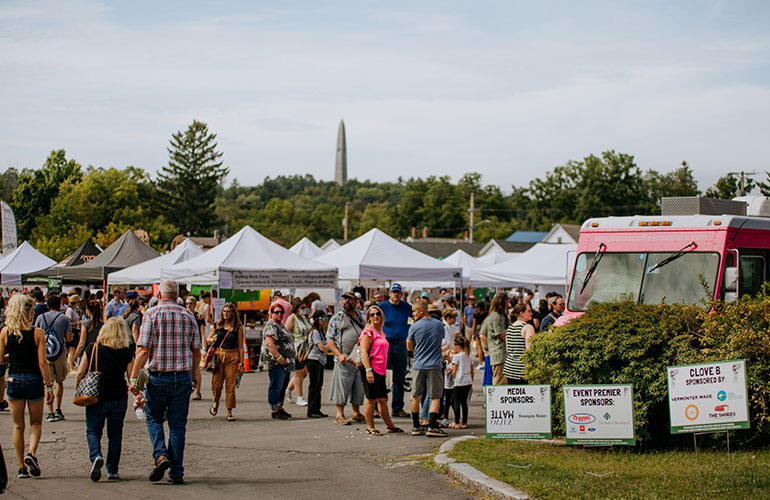
Photo: Bennington Garlic Festival. Photos courtesy of Southwestern Vermont Chamber.
Riding the Wave of Investment
According to the BCRC’s Cooper, Bennington County residents historically perceived a stark economic divide between the North and South Shires. However, Cooper observes a growing recognition of the interconnectedness of their economies.
He believes the county has been experiencing a surge of investment, even predating the pandemic, catalyzed by initiatives like Bennington’s opportunity zone and the Putnam Project.
Putnam Phase Two, the Mount Anthony House project, is currently finalizing its funding and anticipates breaking ground within the next 12 to 18 months. Upon completion, this substantial 90,000-square-foot building will house Southwestern Vermont Medical Center on the ground floor, with residential units occupying the upper levels.
Putnam Phase Three, a collaborative housing development between Shires Housing and Evernorth, is on the horizon. While investment initially stemmed from within the county, national businesses are now taking notice.
Cooper and Harrington have observed a growing interest from national franchises like Starbucks, Harbor Freight and Chipotle. Cooper explains that these brands typically require specific average wage and household income levels before considering expansion into a new area.
“I think the new franchises are a good example of how people are looking at southwestern Vermont with a new appreciation for what’s here, for who’s here and what could work,“ Cooper said.
Added Harrington, “I know people pooh-pooh the box stores, but I think the box stores are coming. And that’s a great economic indicator that maybe some other investors and some families will also want to move here.“
Cooper noted that downtown doesn’t have to suffer when commercial areas grow. Towns can have different areas that serve different needs throughout the day, and can all thrive.
Looking Towards the Future
Cooper appreciates the infrastructure investments communities, including Manchester, Dorset and Bennington, are making. These projects include a skate park, new parks and water system upgrades.
Towns have made meaningful investments in new forms of infrastructure and amenities. He credits the number of projects happening in the county to municipalities’ and organizations’ ability to attract federal dollars.
Manchester has proactively invested in infrastructure, upgrading its water and sewer systems to support development beyond the town center. Dorset has also made significant improvements to its water system, utilizing funding from the Northern Border Regional Commission’s Drinking Water Revolving Fund.
Additionally, the Bennington High School redevelopment project, bolstered by $1.5 million for brownfield mitigation and substantial funding from the Northern Border commission, is poised to revitalize downtown Bennington with dozens of new housing units upon completion.
Cooper also highlighted the contributions of the New American community, with individuals resettling in the county through organizations like the Ethiopian Community Development Council. He noted that these new residents are opening businesses, filling crucial job vacancies and actively engaging in civic life. This population growth significantly impacts a state reliant on property taxes, not only by increasing discretionary spending within the economy but also by broadening the tax base.
Cooper actively supports community projects that enhance quality of life, such as parks, recreational areas and local businesses. He believes these amenities play a crucial role in attracting and retaining residents.
“If a community has little to offer, it has fewer incentives for people to stay,“ he argues.
Cooper emphasizes the importance of population growth for Vermont’s community and economy. He points out that investments in amenities like new parks, playgrounds and swimming pools — features not typically found in small towns — make a community more appealing and demonstrate its commitment to providing a high quality of life.
Ultimately, Cooper believes these investments are not just about the immediate future but about ensuring the long-term sustainability and vibrancy of the community for generations to come. He warns that without such investments, people may feel compelled to leave or worry about their grandchildren’s ability to find homes and jobs in the future.
Cooper urges community members to envision the former glory of buildings showing signs of neglect. He reminds them that these structures were once vibrant spaces where families celebrated milestones and created cherished memories. They were not intended to fall into disrepair but to serve as homes and gathering places for the community.
Manchester has historically served as a designer outlet shopping destination. Yet, in the age of Amazon and online shopping, several outlets have closed, and the business community has sought new ways to attract customers.
Burnham and Black say there has been a shift from larger brands to smaller local brands intent on creating an experience for shoppers. Stores such as Simon Pearce, Danforth Pewter, and Vermont Flannel, as well as galleries and restaurants, have moved into downtown.
Black said, “We were always this outlet town, but I don’t think you’re seeing many stores that want to come in and have 6,000 square feet of space these days. So it’s smaller stores, grouping together like Vermont Flannel or Vermont Teddy Bear, in one of those buildings that used to be a single store. I think there’s more of the smaller, more like localized, niche franchises.“
Burnham added, “Again, looking at our website statistics from manchestervermont.com, one of the most-viewed categories is shopping, and that includes the designer outlets, that includes all of these unique art and artists and galleries, and stores, and Gordon [Black] is absolutely right. I think it’s all just smaller.“
A new group of travelers have discovered the North Shire thanks to COVID.
In 2021, fewer people hopped on planes and traveled by car instead. As a result, said Burnham, visitors from the southern part of the East Coast, such as Georgia and North Carolina rolled into town. Website data continues to receive clicks from people in states that passed Manchester by before the pandemic, Burnham said.
Black said a new “industry“ has developed in the area over the last five years: destination weddings. He said it’s not uncommon for places like the Equinox Resort or Hildene to host several weddings throughout the summer.
“I think somebody mentioned the other day that there were nine or 10 large destination weddings, just for one weekend,“ Black said.
Both men spoke enthusiastically about welcoming New Americans from countries such as Haiti, Afghanistan, and Venezuela to Manchester and they praised the local refugee resettlement program.
They said it’s great because these new community members are working at local businesses, which helps with local workforce issues.
One economic indicator that both men point to as a sign of a strong economy is a regular flow of new businesses opening in the town. Burnham said he believes this demonstrates the strength of Manchester and the surrounding communities as places where people succeed in business.
A Decade of Transformation
Three years after breaking ground, the Southwestern Vermont Medical Center’s staff hosted the grand opening of its $31 million Kendall Emergency Department.
Dee described the new emergency department as the centerpiece of the hospital’s Vision 2020 and a decade of transformation.
Dee said this transformation is actually for the whole of SVMC’s health care system, which is being retooled for the future.
Bennington’s hospital is one of the oldest in the state, and leadership has spent the past decade planning how to reinvest and revamp many of its physical spaces, including the emergency department.
The emergency department is one of the hospital’s busiest, with approximately 25,000 patient visits annually.
“We’ve been recognized for the type of care we provide, but we’ve always been handicapped by some of the physical space restrictions and constraints,“ Dee said. “So this was an effort over a three year period of time to address it and to really open up a new emergency room, which doubles the size of it and our service, and is state of the art.“
Trauma services, a fast-track system, and mental health services are within the new emergency department’s footprint. Dee said SVMC staff are happy with the project, and the community’s response has been outstanding.
Last month, the hospital was recognized nationally by the Emergency Nurses Association’s 2024 Lantern Award. This designation highlights hospitals that have demonstrated exceptional nursing and clinical services within their emergency departments. According to Dee, there are only 95 designated hospitals around the country, and Bennington is the first in Vermont.
In the last two years, the hospital has recruited over 40 providers, which Dee takes as a litmus test of the number of people excited to work and live in the region.
The hospital is fully integrated with Dartmouth Hitchcock Medical Center in New Hampshire. Dee said DHMC provides financial and intellectual capital. As the hospital continues to work with DHMC, it hopes to become a regional referral hospital and expand the population it serves from around 75,000 to 125,000.
The hospital’s next project is to construct a cancer center on its campus. The new center will double the footprint of the current center and be under the clinical and administrative management of Dartmouth Hitchcock.
Dee said the hospital still needs final approval from the Green Mountain Care Board, but it hopes to start construction in the summer of 2025.
SVMC is also embarking on a significant expansion of its primary care services. Dee said the new primary care center will be located within the medical office building. The project is likely to start renovations in the late spring of 2025.
The hospital is in the middle of doubling its pain management services. Dee anticipates these expansions will be done by January 2025.
Dee said SVMC, in concert with Dartmouth, will soon unveil a new cardiovascular service. Right now, many local patients travel to other areas, such as Albany.
“The more we can keep business local and keep caring for our community, that’s a win-win for everybody,“ Dee said.
Pending state approval, SVMC plans to open an inpatient adolescent mental health service for kids ages 12 to 17.
“These projects are transformational, and they don’t happen overnight. It’s an endurance test, to be honest,“ Dee said. “It’s going to take a lot of planning and hard work and grit to get through it, but we are getting there.“
Like many in healthcare, the hospital faces challenges including rebuilding finances after COVID-19. SVMC also struggles to find workers, and its workers struggle to find housing.
All in all, Dee is proud of the community support the hospital has received.
“The fact that we were able to raise over $29 million for our reinvestments in our Vision 2020, I think, is pretty remarkable, and we’re very appreciative of the people and the outpouring of support we’ve received,“ he said.
Dee said the hospital will announce project updates this autumn regarding the redevelopment of the 371-acre former Southern Vermont College campus. SVHC purchased the campus in late December 2020.
“Our vision statement for our health system is really to become a premier rural health care system known for exceptional care,“ Dee said. “And I think people understand that some special things are happening here, and I think it’s the same for Bennington,“ Dee said.
Community Participation, in More Ways Than One
Vermont was in COVID lockdown when Laura Walker toured Bennington College.
As a resident of New York, where the virus levels were high, she wasn’t allowed to get out of her car. Literally.
Still, her prominent memory of that tour is driving up the hill to the Bennington College campus.
“I saw and felt that this most amazing place was both an oasis as well as a really vibrant, creative community,“ recalls Bennington College President Laura Walker. “There’s no place like it.“
The college believes in participating in the community.
Bennington College was one of the early organizations that signed on to the Putnam Project. The college maintains several apartments in the Putnam Block for staff, and its finance and human resources offices are located there.
Walker said the college supports the Bennington Community Market. She added that Susan Sgorbati, director of the college’s Center for the Advancement of Public Action and market board member, has been involved in every step of the market.
Walker feels Bennington College is part of the community, not just as an employer or as an educator, but for the many alums who start businesses. Some local businesses with connections to Bennington College alums include The Blue Benn Diner, W. Collective, Pangaea and Prospect Street Writers House.
Walker said that each year, students attend college and are required to participate in an internship program. Through these internships, students can interact with the community. Often, students will join those organizations or businesses after graduation.
According to Walker, for this academic year, Bennington College received its highest number of applications.
Bennington College has proactively enhanced its enrollment strategy, exemplified by a recent partnership with the University of the Arts in Philadelphia. Following the university’s abrupt closure, Bennington welcomed a number of its BFA and MFA students to its campus. While these students are expected to eventually return to Philadelphia, Bennington remains committed to providing them with a supportive academic environment in the interim.
“Colleges have to work together, especially here in Vermont,“ said Walker, referencing the number of recent college closures such as Marlboro College and Goddard College. “It’s sad. Vermont needs to stand up for these colleges and universities because it’s such an important part of the economy and Vermont’s values.“
Walker noted that while the Scott administration works to attract more young people to Vermont, colleges like Bennington also contribute to that effort.
Walker took the helm at the college during the pandemic and has never experienced a pre-COVID campus. She has noticed how hungry students are for community and want to experience events together.
Like many employers, Bennington has challenges around faculty and student housing. She expects the college won’t grow its student body much more unless it adds more on-campus housing.
Walker encourages more community members to come to campus. Most of the college’s performances and events are open to the public and posted on its website.
Some of Bennington’s programs, such as “Public Policy Forum: Saving Democracy Together,“ sponsored by the Center for the Advancement of Public Action, can be viewed via Zoom as well as on campus. The seminar focuses on how communities work on democracy together rather than in partisan groups, fiefdoms or silos.
Another event, scheduled for October, is a podcast festival with visiting faculty member Andrea Bernstein, an NPR journalist. Bernstein co-hosted the podcast “Trump Inc.,“ a co-production with ProPublica. She also worked at New York Public Radio, where Walker served as CEO.
“Now I’m a New Yorker, right? It’s so beautiful and such a great place,“ Walker said. “People want to be in Bennington. They want to be in Vermont.“
Walker paused and asked her colleague, Director of Communications Ashley Brenon Jowett, about her experience living in Bennington.
“What I say about the community in Bennington is that everybody knows everybody six ways,“ Jowett said. “The server that works at the Blue Benn went to high school with my husband, and she worked with me at the hospital. Her son goes to school with my son.
“So when you hear, ’Everybody seems so connected,’ we really are. Going to the Blue Benn isn’t just going to the Blue Benn and seeing somebody. You’re never dealing with a stranger across the counter.“
Back at the chamber, Harrington remained focused on opportunities despite the community’s struggles.
“From my perch, I get to look at the whole region and go, I think we’re coming out of a couple of catastrophes. I think we’re going to have a presidential election, one way or the other, and I think 2025 will look really good,“ he said. “We have a plan, so even if a good opportunity comes by, we can take advantage of it.“
Olga Peters is a freelance writer from Windham County.
To support vital journalism, access our archives and get unique features like our award-winning profiles, Book of Lists & Business-to-Business Directory, subscribe HERE!