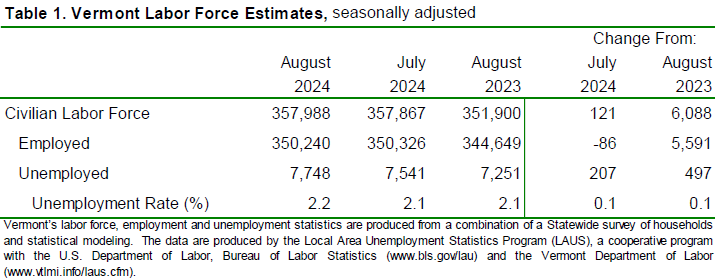
by Timothy McQuiston, Vermont Business Magazine Today, the Vermont Department of Labor reported that the seasonally adjusted statewide unemployment rate for August was 2.2 percent. This reflects an increase of one-tenth of one percentage point from the prior month’s revised estimate. There were only marginal changes in the major metrics. However, the increase in the number of unemployed outpaced both employment and the labor force. Vermont still has the second lowest jobless rate in the nation, behind South Dakota (2.0%). Nevada is highest at 5.5%. The civilian labor force participation rate was 65.7 percent in August, no change from the prior month’s revised estimate.
Labor Commissioner Michael Harrington said: “The new monthly data for August shows little movement in Vermont’s labor market. Even with a slight uptick in the unemployment rate, August’s rate is still at a near-historic low. With the end of summer, many seasonal businesses start slowing down while industries like education start ramping up. To support this migration, the Department hosts multiple job fairs connecting Vermonters looking for new opportunities with Vermont businesses needing talent. Recent job fairs in Rutland and Bennington yielded positive results for both workers and employers and coming up, the Department will be in Lyndon Center on September 27th and White River Junction on October 3rd. To learn more about these events, visit: https://labor.vermont.gov/pressrelease/ vermont-department-labor-kicks-annual-fall-job-fest-series .”
The comparable United States rate in August was 4.2 percent, a decrease of one-tenth of one percentage point from the revised July estimate. The seasonally adjusted Vermont data for August show the Vermont civilian labor force increased by 121 from the prior month’s revised estimate (see Table 1). The number of employed persons decreased by 86 and the number of unemployed persons increased by 207.
None of the changes were statistically significant in the seasonally adjusted series.
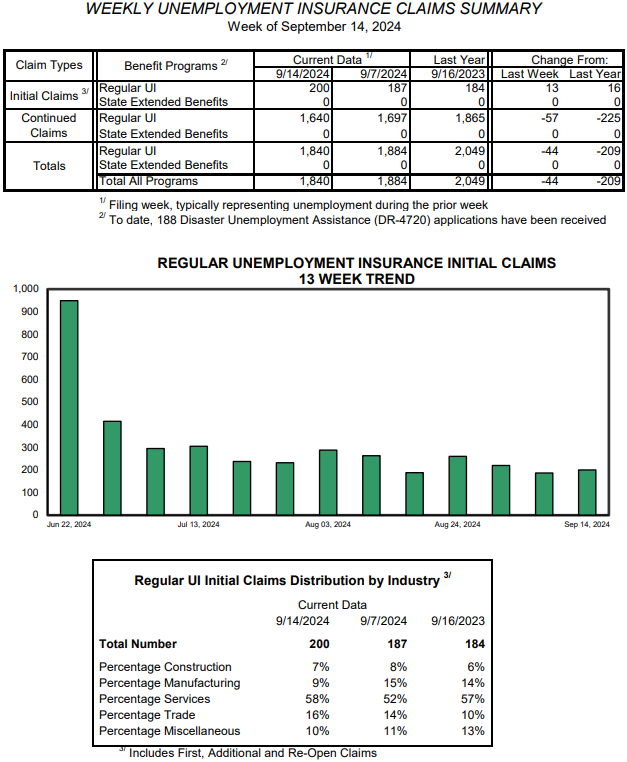
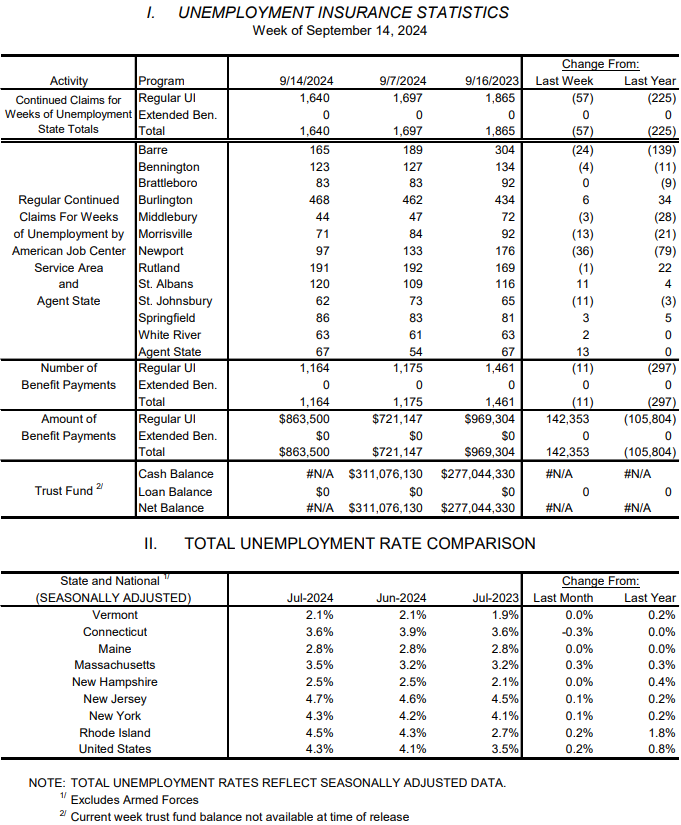
Weekly unemployment claims in Vermont increased slightly by 13 from last week and by 16 from last year to 200, which is a very low number. Ongoing claims were 1,840, down 44 from last week and 209 fewer than last year.
Meanwhile, US jobless claims hit a four-month low, as initial claims for unemployment insurance were down 12,000 to 219,000, showing continued economic strength.
The Vermont Unemployment Trust Fund is well capitalized. As of the previous week, there was $311.1 million in the Trust Fund, down $570,000 for the week (as claims are paid out on one side, employers are contributing to the fund on the other). The pre-pandemic Trust Fund balance on March 1, 2020, was $506.2 million.
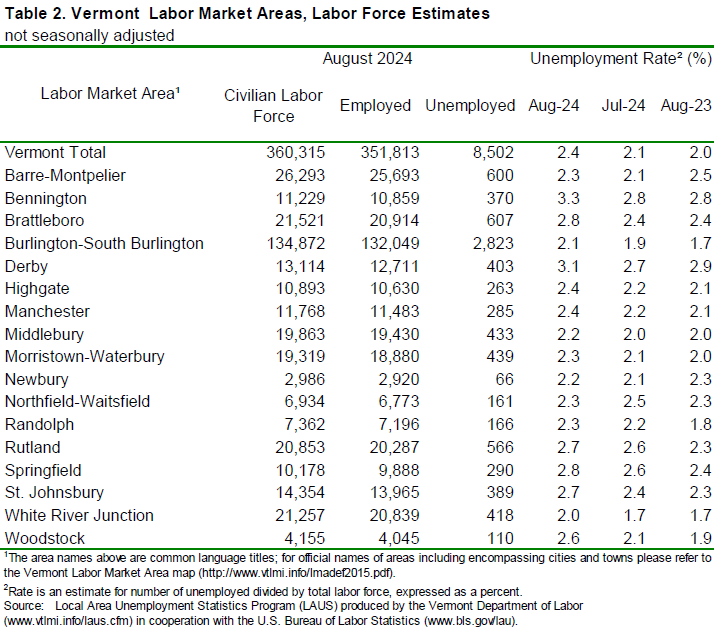
The August unemployment rates for Vermont’s 17 labor market areas ranged from 2.0 percent in White River Junction to 3.3 percent in Bennington (note: local labor market area unemployment rates are not seasonally-adjusted – see Table 2). For comparison, the August unadjusted unemployment rate for Vermont was 2.4 percent, an increase of three-tenths of one percentage point from the revised unadjusted July level and an increase of four-tenths of one percentage point from a year ago.
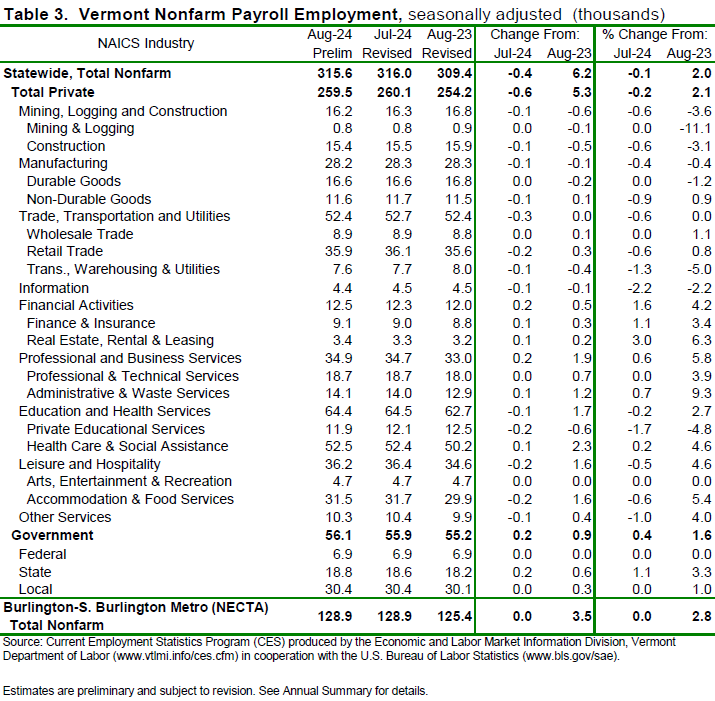
Seasonally Adjusted (Table 3)
The seasonally adjusted data for August reported a decrease of 400 jobs from the revised July data. There was a decrease of 400 jobs between the preliminary and the revised July estimates due to the inclusion of more data. The seasonally adjusted over-the-month changes in August varied at the industry level. The industry with a notable increase was State Government (+200 jobs or +1.1%). The industry with a notable decrease was Private Educational Services (-200 jobs or -1.7%).
Not-Seasonally-Adjusted (Table 4)
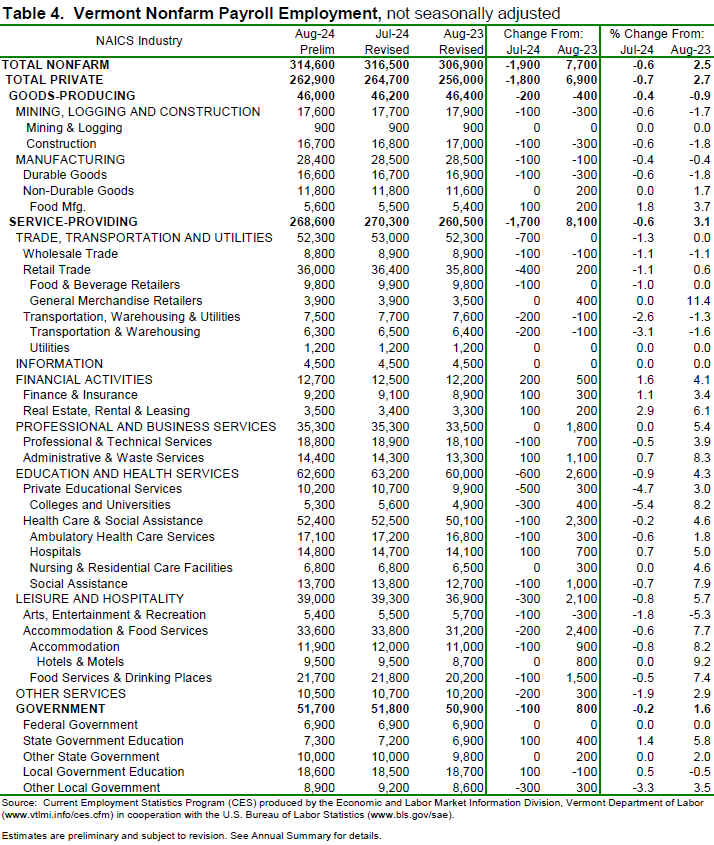
The preliminary ‘not-seasonally-adjusted’ jobs estimates for August showed a decrease of 1,900 jobs when compared to the revised July numbers. As with the seasonally adjusted data, this over-the- month change is from the revised July numbers which experienced a decrease of 400 jobs from the preliminary estimates. The broader economic picture can be seen by focusing on the over-the-year changes in this data series. As detailed in the preliminary not-seasonally-adjusted August data, Total Private industries increased by 6,900 jobs (+2.7%) over the year and Government (including public education) employment increased by 800 jobs (+1.6%) in the past year.
| State | August 2024(p) rate |
Rank |
|---|---|---|
|
South Dakota |
2.0 | 1 |
|
Vermont |
2.2 | 2 |
|
North Dakota |
2.3 | 3 |
|
New Hampshire |
2.6 | 4 |
|
Mississippi |
2.7 | 5 |
|
Nebraska |
2.7 | 5 |
|
Alabama |
2.8 | 7 |
|
Maine |
2.8 | 7 |
|
Virginia |
2.8 | 7 |
|
Hawaii |
2.9 | 10 |
|
Iowa |
2.9 | 10 |
|
Maryland |
2.9 | 10 |
|
Wisconsin |
2.9 | 10 |
|
Wyoming |
3.0 | 14 |
|
Tennessee |
3.1 | 15 |
|
Montana |
3.2 | 16 |
|
Arkansas |
3.3 | 17 |
|
Florida |
3.3 | 17 |
|
Kansas |
3.3 | 17 |
|
Minnesota |
3.3 | 17 |
|
Utah |
3.3 | 17 |
|
Arizona |
3.4 | 22 |
|
Connecticut |
3.4 | 22 |
|
Oklahoma |
3.4 | 22 |
|
Pennsylvania |
3.4 | 22 |
|
Idaho |
3.5 | 26 |
|
Georgia |
3.6 | 27 |
|
Massachusetts |
3.7 | 28 |
|
North Carolina |
3.8 | 29 |
|
Louisiana |
3.9 | 30 |
|
Missouri |
3.9 | 30 |
|
Colorado |
4.0 | 32 |
|
Oregon |
4.0 | 32 |
|
New Mexico |
4.1 | 34 |
|
Texas |
4.1 | 34 |
|
Delaware |
4.2 | 36 |
|
Indiana |
4.2 | 36 |
|
West Virginia |
4.2 | 36 |
|
South Carolina |
4.3 | 39 |
|
New York |
4.4 | 40 |
|
Michigan |
4.5 | 41 |
|
Ohio |
4.5 | 41 |
|
Alaska |
4.6 | 43 |
|
Rhode Island |
4.6 | 43 |
|
Kentucky |
4.8 | 45 |
|
New Jersey |
4.8 | 45 |
|
Washington |
4.8 | 45 |
|
California |
5.3 | 48 |
|
Illinois |
5.3 | 48 |
|
Nevada |
5.5 | 50 |
|
District of Columbia |
5.7 | 51 |
|
Footnotes |
||
|
Note: Rates shown are a percentage of the labor force. Data refer to place of residence. Estimates for the current month are subject to revision the following month. |
||
Last Modified Date: September 20, 2024
The Unemployment and Jobs Report for September is scheduled to be released on Tuesday, October 22, 2024 at 10:00 a.m.
To support vital journalism, access our archives and get unique features like our award-winning profiles, Book of Lists & Business-to-Business Directory, subscribe HERE!