by Timothy McQuiston, Vermont Business Magazine Vermont Auditor of Accounts Douglas R Hoffer released today a largely negative account of the state’s Remote Worker Grant Program. The program, which always had a limited scope with limited funding, received national publicity, whose branding value the auditor did not address. Hoffer notes that this is a report not a traditional audit.
CNN, the New York Times and CNBC did pieces on it. The Wall Street Journal wrote a dismissive editorial. But separately one of its reporters said that it makes sense for states and cities to try a modern approach to recruitment, especially in light of those same entities giving corporations millions in taxpayer recruitment dollars or tax breaks in order to lure them to a region. Slate echoed that thought.
Comments on the street (and its digital equivalent Twitter) noted that workers already here were getting nothing (Alaska pays current residents $2,000 a year out of oil drilling-related funds). But, of course, such is always the case with any recruitment effort in any endeavor.
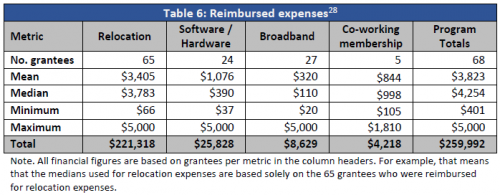
Hoffer’s report said the average benefit was under $4,000, even though the program allows for up to $10,000 for each individual with a total limit of $500,000, as budgeted by the Legislature and signed into law by Governor Scott May 30, 2018, and begun January 1, 2019.
 Hoffer said in the report: “This report addresses the administration of the Remote Worker Grant Program (Program) by the Agency of Commerce and Community Development (Agency). We found numerous questionable choices that resulted, in part, from efforts by the Agency to adhere to the Legislature’s intent (i.e., keep it simple and get the money out the door). Unfortunately, haste can lead to poor judgment and procedures that overlook important details, which can result in the inefficient and ineffective use of taxpayer dollars.
“Although not part of our objectives for this inquiry, I feel obligated to comment briefly about the value of the Program as an economic development tool. As we explain in the report, the Program’s cost-effectiveness cannot be determined for several reasons. Most importantly, we cannot know with certainty that grantees moved to Vermont because of the Program. Indeed, there is a serious structural flaw in the Program since it requires applicants to prove residency before applying. Therefore, applicants must make financial and major life commitments before knowing if they will receive grant funds. That means they had the will and the means to relocate without the program.
“The inability to measure the State’s return on investment is a problem we discussed in a July 2018 report on Economic Development.1 As that report noted:
‘Part of the State Auditor’s mission is to conduct performance audits and provide management and legislators with information useful for strategic planning and policymaking. There are some policy areas, however, that present challenges. For example, there is little reliable performance data about some of the State’s largest economic development programs, which makes it difficult to conduct performance audits.’
“Spending taxpayer funds on programs of questionable value is bad enough. But the problem is compounded by the opportunity costs of not spending that money on programs with demonstrable and quantifiable long-term benefits. Therefore, when considering funding for Vermont’s economic development programs, we strongly encourage decision makers to take an evidence-based approach.”
 This new report by the auditor is a “non-audit report.” A non-audit report is a tool used to inform citizens and management of issues that may need attention. It is not an audit and is not conducted under generally accepted government auditing standards.
A non-audit report has a substantially smaller scope of work than an audit. Therefore, its conclusions are more limited, and it does not contain recommendations. Instead, the report includes information and possible risk-mitigation strategies relevant to the entity that is the object of the inquiry.
According to the report’s executive summary: “The Legislature created the Remote Worker Grant Program (Program) in 2018 to encourage remote workers who work from their computers to move to Vermont.
“The Program uses grants to reimburse four types of expenses: relocation, computer hardware and software, broadband access and upgrades, and co-working space memberships. The Agency of Commerce and Community Development (Agency) administers the grants according to criteria established in Act 197 of 2018 and Act 80 of 2019.
“The State Auditor’s Office (SAO) evaluated the Agency’s compliance with the statutes and guidelines of the Program. The SAO identified the following compliance and judgment issues:
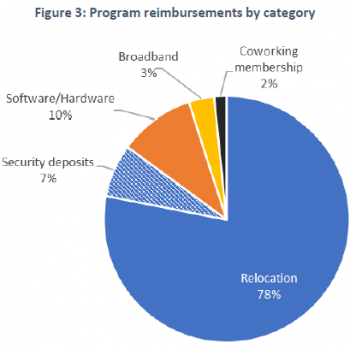
1. The Program used seven percent of its funds ($18,120) to reimburse grantees for security deposits, which are expenses that are also assets temporarily withheld and then returned by landlords if certain conditions are met. The Agency has no mechanism to recover these funds when grantees move and retrieve their deposits.
2. The Agency did not establish guidelines or caps for certain types of reimbursements. For example, one grantee enjoyed a prepaid year of high-speed internet. Another grantee received $5,000 for a 100-yard underground conduit for broadband cables, which adds value to the property and will not be recovered by the State at resale.
3. The Agency reimbursed some grantees for storage of possessions in Vermont covering storage periods prior to grant approval.
4. The Agency did not verify the actual costs necessary for grantees to perform their jobs or whether such expenses were job-related.
5. The Agency did not always exercise due diligence when verifying grantee claims. For example, the Agency permitted one grantee to sign as employee and employer, and it approved another grantee with inconsistent employer data.
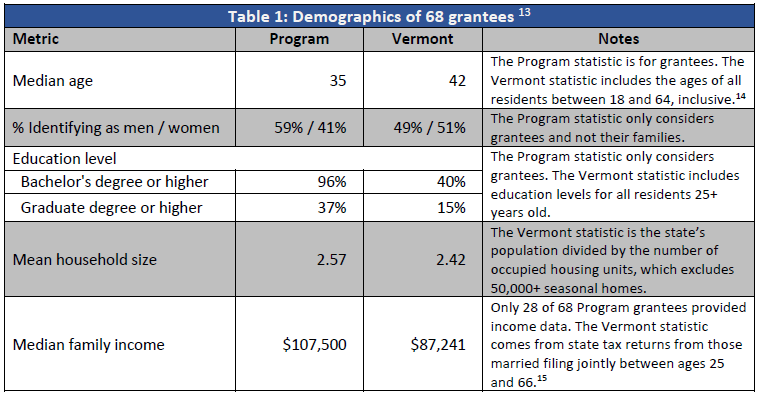
“To conduct this evaluation, the SAO examined data from 68 grantees approved as of mid-August 2019. Compared to Vermonters at large, grantees were younger, more affluent, and more likely to be male. A greater percentage of grantees had college degrees than adult Vermonters on average, which is not surprising since remote work requires both computer and subject area skills. The average Program grant totaled $3,823, most of which went to relocation expenses.
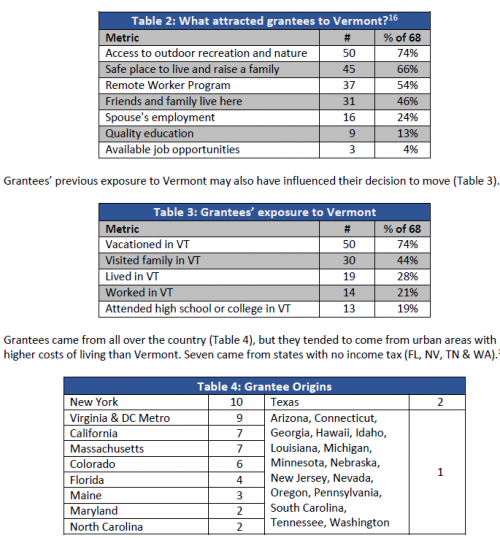
 “Neither the cost-effectiveness of the Program nor whether it produces a net gain for the State can be determined at this time. The statute does not require the Agency to ascertain the reason(s) for the grantee’s move, although survey responses suggested motives in some cases.
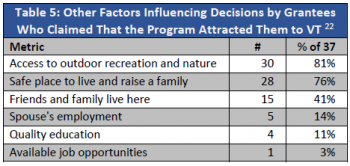
“For example, 16 grantees had spouses whose Vermont-based job plans may have influenced their decision to move here. More importantly, however, the application requires applicants to provide evidence of residency. Therefore, all applicants had already made their decisions to move to Vermont prior to applying for the grants."
The state has initiated a new, $1.2 million program for from-awayers who relocate to existing Vermont companies. The current remote worker grant program has spent about $400,000 on 110 workers. Vermont separately has a "Stay-to-Stay" program in which tourists are feted and introduced to local employers through a Tourism Department program that encourages them to move here and work.
 The Remote Worker Grant Program (Program) was created by the Legislature in 2018 and is intended to attract new residents to Vermont.It targets remote workers, a growing share of America’s workforce who can work from their computers without a brick-and-mortar office.Program applicants must qualify as “new remote workers” according to the following criteria:
1.They must move to Vermont on or after January 1, 2019;
2.They must be full-time employees of an out of state business, amended to also include Vermont businesses starting July 1, 2019;and
3.They must perform at least 50%of their employment duties remotely from a home office or Vermont co-working space.
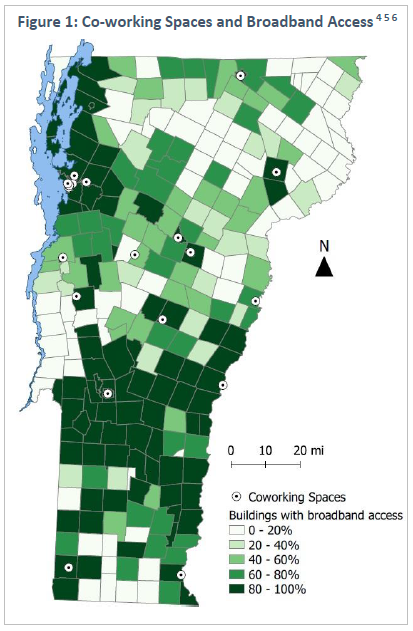
The Program attempts to incentivize remote workers to move to Vermont by reimbursing four types of expenses:relocation costs, computer software and hardware, broadband access or upgrades, and membership in one of the state’s co-working spaces.3Legislators did not define these categories and left their interpretation to the Vermont Agency of Commerce and Community Development(Agency), which administers the Program.
The applicant submits an application and supporting documents. The application includes an “Employee” section and an “Employer” section. Supporting documents include expense receipts and proof of Vermont residency. The Agency confirms that the submitted materials are complete and free of errors. The applicant completes a demographics survey and submits a W-9. Agency staff approve or deny the applicant and authorize expense reimbursement based on eligibility and the availability of Program funds. The applicant signs a Grant Agreement, which is then signed by the Agency’s Commissioner of the Department of Economic Development. The Agency sends a check to the grantee’s address. Successful applicants can receive up to $5,000. Grants are awarded on a first-come, first-served basis.
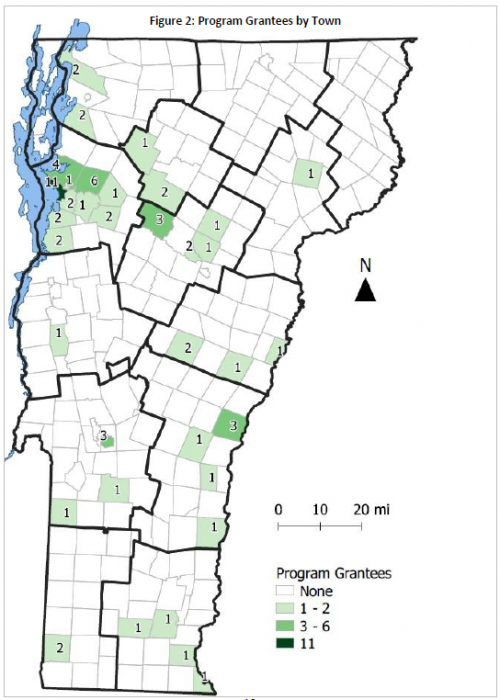
The Legislature initially allocated $500,000 over three years for the grants, but subsequent legislation removed annual limits. As of July 1, 2019, the Agency allocated grants as quickly as it could process applicants. Act 80 simply states the Agency “shall award grants... subject to available funding.” This report examines all funds awarded according to the initial program guidelines (33 applicants, $125,000 awarded) and a sample of later applications(35applicants, approximately $135,000 awarded), which the Agency continues to process on a rolling basis.
1 “Making Economic Development Policy: Anecdotes or Peer-Reviewed Literature.” Office of the State Auditor. https://auditor.vermont.gov/sites/auditor/files/documents/Economic%20Development%20Report%20-%20Final.pdf