

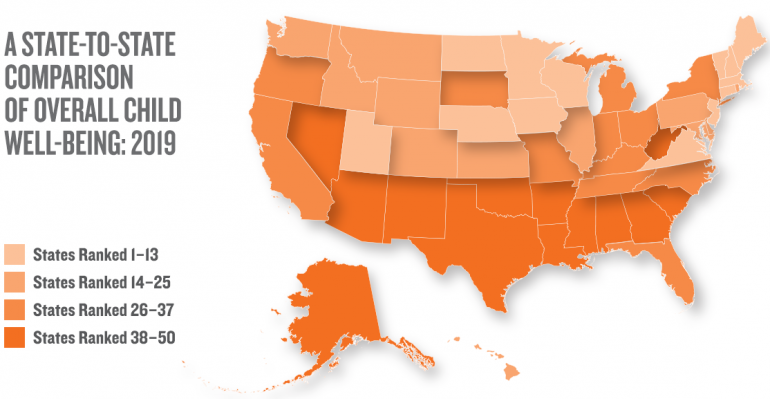
Vermont Business Magazine Six of the top 10 states in overall child well-being — including New Hampshire (1) and Massachusetts (2) — call the Northeast home, according to the Annie E Casey Foundation's 2019 KIDS COUNT Data Book. Vermont ranked 6th overall. States in Appalachia, the South and Southwest populate the bottom of this year's overall rankings. In fact, save for California and Alaska, these regions claim 18 of the lowest-ranked states, including Mississippi (48), Louisiana (49) and New Mexico (50).
In the separate categories, Vermont did well in Education (5), Health (9) and Community (3), but was 17th in Economic Well-Being. In the Health category, Vermont was worse than the US average in alcohol use among youth. In the Economic category, Vermont was worse in parental job security and housing costs.
The 30th edition of the Annie E. Casey Foundation’s KIDS COUNT Data Book begins by exploring how America’s child population — and the American childhood experience — has changed since 1990.
And there’s some good news to share: Of the 16 areas of child well-being tracked across four domains — health, education, family and community and economic well-being — 11 have improved since the Foundation published its first Data Book 30 editions ago.
The rest of the 2019 Data Book — including the latest national trends and state rankings — rely on a shorter review window: 2010 to 2017.
The data reveal, in the United States today, more parents are financially stable and living without burdensome housing costs. More teens are graduating from high school and delaying parenthood. And access to children’s health insurance has increased compared to just seven years ago.
But it is not all good news. The risk of babies being born at a low weight continues to rise, racial inequities remain systemic and stubbornly persistent and 12% of kids across the country are still growing up in areas of concentrated poverty.


2019 State Data Profiles on Kids Well-Being
View the national data profile (also available in Spanish) or download your state's data profile as a PDF below:
- Alabama
- Alaska
- Arizona
- Arkansas
- California
- Colorado
- Connecticut
- Delaware
- District of Columbia
- Florida
- Georgia
- Hawaii
- Idaho
- Illinois
- Indiana
- Iowa
- Kansas
- Kentucky
- Louisiana
- Maine
- Maryland
- Massachusetts
- Michigan
- Minnesota
- Mississippi
- Missouri
- Montana
- Nebraska
- Nevada
- New Hampshire
- New Jersey
- New Mexico
- New York
- North Carolina
- North Dakota
- Ohio
- Oklahoma
- Oregon
- Pennsylvania
- Puerto Rico
- Puerto Rico (Spanish)
- Rhode Island
- South Carolina
- South Dakota
- Tennessee
- Texas
- Utah
- Vermont
- Virginia
- Washington
- West Virginia
- Wisconsin
- Wyoming