

by Brandon Arcari, Vermont Business Magazine The Green Mountain Care Board has approved Fiscal Year 2020 budgets for Vermont’s 14 regulated hospitals.
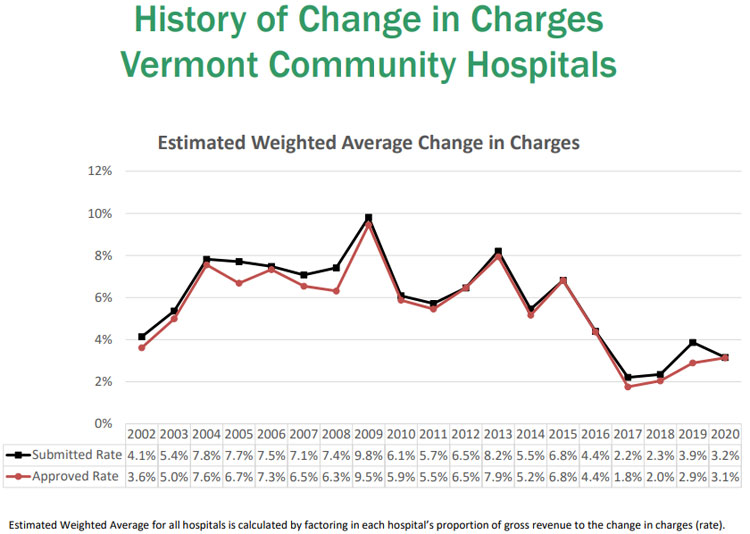
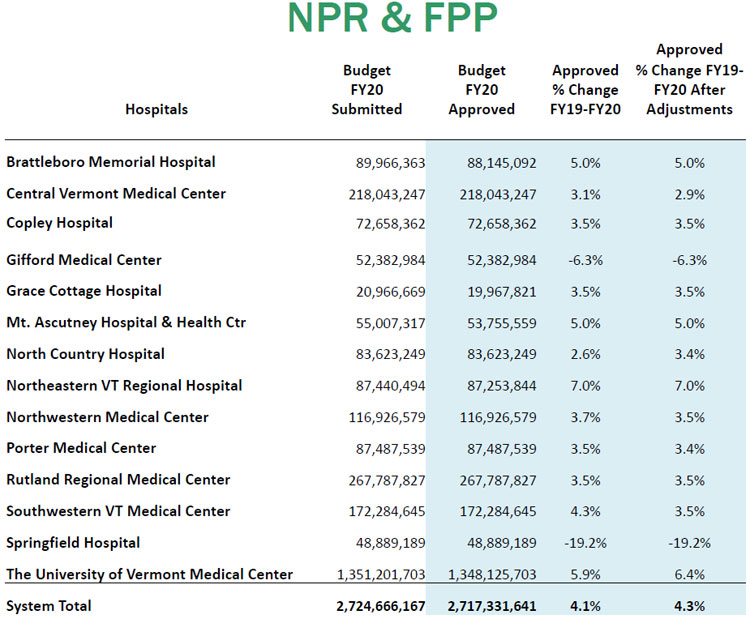
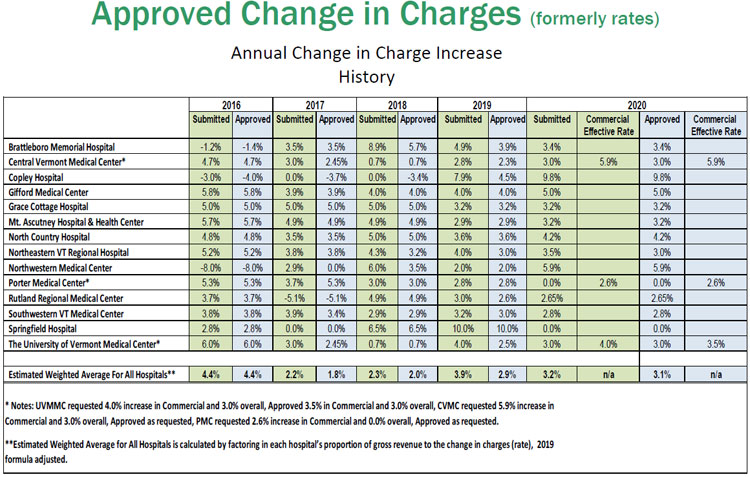
The FY 2020 changes include a targeted 3.5 percent growth in net patient revenue over the previous year, and a weighted average increase in hospital charges by 3.1 percent. The GMCB ultimately approved a cut to the increase in system-wide net patient revenue from 4.6 to 4.3 percent, or $7.3 million less than the hospitals cumulatively requested but above the 3.5 percent goal.
Vermont’s hospital budgets, which have been subject to state review since 1983, have been regulated by the GMCB since FY 2013, which began on October 1, 2012.
The allowance for exceeding the 3.5 percent goal including tight costs cited by the hospitals as utilization has increased at a time when government sponsored reimbursements (Medicare and Medicaid) have not kept up with cost of service.
The hospital in Springfield even went to the extreme measure earlier this year of filing for bankruptcy protection and closing its birthing center.
According to a GMCB statement, six of the hospitals reported a negative operating margin for FY 2019, citing aging demographics with more costly healthcare needs, reliance on temporary workers to offset a lack of local permanent workers, an increase in costs related to un- and underinsured patients, increases in prescription drug prices, and an increased reliance on government funded payment plans.
They were: Copley Hospital (-1.8%); Gifford Medical Center (-0.8%); Grace Cottage Hospital (-6.1%); Mt Ascutney Hospital & Health Ctr (-0.7%); Northwestern Medical Center (-6.0%); and Springfield Hospital (-12.8%).
Based on resubmitted hospital filings, only three hospitals are projected to have negative operating margins in FY20: Grace Cottage (-1.2%); Northwestern (-0.2%); and Springfield (-2.0%). For all hospitals, the increase is projected to be 2.5% for FY20.
“With the closure of 113 rural hospitals nationally since 2010, the rural health care crisis continues,” said GMCB Chair Kevin Mullin in the statement. “This, paired with workforce shortages, aging demographics, and skyrocketing costs of prescription drugs, drives up the cost of health care in Vermont.”
“The Board will continue to monitor total costs of care at the hospitals and press these institutions to improve efficiencies and coordinate care to reduce costs for Vermonters,” Mullin said. “The Board is committed to limiting growth in hospitals’ costs while ensuring access to high quality health care for all Vermonters.”
Basically, the revenues include all funding sources, of which there are many, and the charges refer to the rates for services, meds and procedures like surgeries.
The hospitals generally argue that the increases allowed by the GMCB can be smaller than the costs to them. This is common with the prices set by pharmaceutical manufacturers.
Brattleboro Memorial Hospital
Brattleboro Memorial Hospital sought a 7.2 percent revenue increase, totaling $89,966,363, and a 3.4 percent increase in overall average charges, attributing the former to increases in utilization resulting from successful practitioner recruiting and the closure of Springfield Hospital’s maternity ward, and increased utilization of the BMH wound care center.
The board found inadequate justification for the budgetary increase, and approved a reduced amount of a 5 percent increase over FY19, totaling $88,145,92, noting that Brattleboro was not complying with the 3.5 percent growth limit in the board’s FY20 Guidance.
“We are concerned about NPR/FPP forecasts that are not supported by utilization and result in corresponding expenses budgeted to meet their NPR/FPP forecasts,” the board wrote in their conclusions. “When hospitals fall short of NPR/FPP targets and are unable to adjust expenses in a timely manner, lower and, at times, negative operating margins are often the result.”
The board did approve BMH’s request for the 3.4 percent rate increase, setting that as the not-to-exceed cap, in an attempt to support BMH in rebuilding its operating margins.
Central Vermont Medical Center
Central Vermont Medical Center in Berlin requested an effective increase of 2 percent, including three provider transfer adjustments and two accounting adjustments. Dermatology and pulmonology provider transfers were approved, whereas oncology was not. The board approved an effective 2.9 percent increase for FY20.
The board noted that “though CVMC’s request triggers the 5.0% cap established in FY20 Guidance, we conclude that its requested NPR/FPP increase is realistic and justified in light of CVMC’s increased utilization.”
It also found CVMC’s overall rate increase of 3 percent reasonable, and approved a commercial effective rate increase of 5.9 percent, which CVMC had also requested.
In a note at the end of its findings, it reminded CVMC that hospitals are required to timely report any event that could materially change the approved budget, including accounting changes, in a monthly monitoring report, and expects CVMC to do so in the future.
CVMC is also expected to work with GMCB staff to prepare and submit a sustainability plan, according to the report.
Copley Hospital
Copley Hospital in Morrisville requested the biggest increase in net patient revenue (9.8 percent, or $3.3 million). The GMCB approved this charge rate increase, citing their five-year average change in charge of -1.3%, approving the increase as a “one-time correction,” but setting the maximum at 9.8 percent.
“We have concerns about Copley’s financial health and whether it will be able to keep expenses below revenue and generate a positive operating margin in FY20,” the board wrote in its conclusions report. “We also expect Copley to continue its strategic sustainability planning and work with GMCB staff to prepare a long-term plan for the Board.”
Copley’s FY20 budget was approved at its requested percent 3.5 percent increase over FY19, at $72,658,362, with the board saying “we believe it may be attainable given its rate increase and its projected utilization.”
Copley also was uncertain whether it would participate in the OneCare Vermont ACO Medicaid program because of the cost, the dues of which would be $195,000.
Copley said in its filings: "Historically, we have been prudent stewards of our limited financial resources and have shown a commitment to strategic cost reduction and efficient operations. We are at a point financially where we believe our rates have been cut too far and need the GMCB's help, by approving our FY20 budget as proposed, in order to generate a positive operating margin to fund necessary investments in capital equipment, technology, and infrastructure."
Gifford Medical Center
Gifford Medical Center in Randolph decreased its budget request at 6.3 percent over FY19, at $52,382,984, and requested an overall charge increase at 5 percent, both of which were approved by the board.
“Gifford’s FY20 budget and NPR/FPP request are reasonable and realistic in light of its circumstances and financial performance in prior years,” the board wrote. “Its request represents a 2.2% increase in NPR/FPP over its FY19 projections, which we believe is attainable in light of its utilization trends.”
The charge increase was approved as reasonable in light of Gifford’s financial circumstances and efforts to reduce costs and stabilize its operating margin, according to the report.
The increase was also approved “in tandem with efforts to improve the overall health of the community and address some of the long-term drivers of increased health care spending, such as readmissions, substance abuse disorders, and education about healthy lifestyle choices,” the board wrote.
Gifford is also expected to work with GMCB staff to prepare and submit a sustainability plan.
Grace Cottage Hospital
Grace Cottage Hospital in Townshend requested an 8.7 percent budget increase at $20,966,66 and a 3.2 percent increase to charges. The board cited the 8.7 percent increase for exceeding both the 3.5 percent cap established by the board, and the 5 percent variance from the FY19 budget-to-projection variance.
“Grace Cottage requested an 8.7% increase in NPR/FPP over its FY19 approved budget, which is a 12.3% increase over its FY19 projections,” the board wrote. “This request does not comply with the financial caps we established in our FY20 Guidance.
The board approved a 3.5 percent increase over the FY19 budget, which is 6.8 percent over the FY19 projection, and said that it expected the hospital to make appropriate reductions in operating expenses.
The board approved Grace Cottage’s request for the 3.2 percent charge increase, setting a limit of a 5 percent increase.
It also noted that Grace Cottage is uniquely not required to establish a sustainability plan as it does not offer surgeries or elective procedures, but encouraged the hospital to examine sustainability practices through balanced operating budgets without community donations.
Mt Ascutney Hospital and Health Center
Mt. Ascutney Hospital and Health Center requested a 7.4 percent budgetary increase, at $55,007,317, and a 3.2 percent charge increase. The board cited the 7.4 percent increase as exceeding the board’s target of 3.5 percent, and being 6.5 percent above its FY19 projections.
The board approved a reduced 5 percent budget increase, totaling $53,755,559. and the 3.2 percent charge increase, noting that even with Mt Ascutney’s increased utilization due to its Dartmouth-Hitchcock Health network affiliation.
It wrote that it expects the hospital to make appropriate reductions in operating expenses based on “this more modest, and more realistic” increase, in order to “meet or come close to its targeted operating margin.”
The 3.2 percent charge increase was also set as the not-to-exceed cap.
North Country Hospital
North Country Hospital in Newport requested an effective 3.4 percent increase for its FY20 budget, totaling $83,623,249, which the board approved.
“[The increase] will work to support the hospital’s efforts to address workforce challenges, invest in population health initiatives, and provide access to health care services in a rural Vermont region.”
The board also approved North Country’s request for a 4.25 percent charge increase, though noted that North Country’s five-year average of approve charges is the highest in Vermont, though the 4.25 percent request is below its five-year average. The 4.25 percent increase was also set as the not-to-exceed cap.
“We also note North Country’s regulatory submissions have historically been late and inaccurate, resulting in delayed systemwide analyses and avoidable administrative efforts,” the board wrote. “We expect that North Country will address this problem in the coming months.”
GMCB also expects North Country to prepare and submit a sustainability plan.
Northeastern Vermont Regional Hospital
Northeastern Vermont Regional Hospital in St Johnsbury requested a 7.2 percent budget increase over FY19, at $87,440,494, and a 3.5 percent charge increase.
The GMCB noted that the budget increase does not comply with the board’s 2.5 percent growth limit. The board cited NVRH’s utilization increases, due to “from successful physician recruitment in several key departments, the community’s regained confidence in the hospital, and an increase in out-of-state patients.”
However, the board wrote that it was concerned by increases in projected emergency department utilization, approving a 7 percent increase and a reduced 3 percent increase in charges, noting that 3 percent was set as the not-to-exceed cap.
Northwestern Medical Center
Northwestern Medical Center in St Albans requested an effective 3.5 percent budgetary increase, including requested provider transfer adjustments, and a 5.9 percent increase in charges.
The GMCB approved NMC’s provider transfer adjustments, and noted that while NMC’s charge increase is larger than most hospitals requested for FY20, NMC’s five-year average approved charge was the second lowest in Vermont at 0.8 percent.
While NMC’s increase triggers the 5 percent variance cap, the board concluded that NMC’s increase is realistic, “because the majority of NMC’s FY19 revenue challenges stem from implementation and integration of its new EHR system, which should not reoccur in FY20.”
The board approved both NMC’s budget request as submitted, as well as its overall charge increase, noting that 5.9 percent was the not-to-exceed cap. It also wrote that NMC was expected to prepare and submit a sustainability plan.
Porter Medical Center
Porter Medical Center in Middlebury requested a 3.4 percent budgetary increase and a 0 percent overall change in charges, with a 2.6 percent increase to its effective commercial rate.
The board approved Porter’s effective 3.4 percent increase, noting it was in compliance with GMCB’s FY20 Guidance. It also approved the 0 percent charge increase and the 2.6 percent increase to its commercial rate.
“In approving this request, we acknowledge that Porter, through ongoing organization-wide efforts, and its affiliation with UVMHN, has improved its financial health during the past several years,” the board wrote. “Additionally, Porter’s requested increase will help to address annual medical inflation, some of which is beyond the control of a particular hospital, and help Porter maintain positive operating margins.”
The board set 0 percent and 2.6 percent as the not-to-exceed caps on the charge and commercial rate increases.
Rutland Regional Medical Center
Rutland Regional Medical Center requested a 3.5 percent budgetary increase at $267,787,827, and a 2.65 percent increase in average charges.
The board found the budget increase both reasonable in light of the hospital’s needs and within FY20 Guidance limits. It also found the average charge increase reasonable and relatively low to other Vermont hospital requests.
The board approved both the 3.5 percent budgetary increase and the 2.65 percent increase in average charges, setting 2.65 as the not-to-exceed cap.
Southwestern Vermont Medical Center
Southwestern Vermont Medical Center in Bennington requested a 3.5 percent budgetary increase, including a provider transfer adjustment, at $172,284,645, and an average charge increase of 2.8 percent.
SVMC is finalizing its affiliation with the Dartmouth-Hitchcock Health network, though it has collaborated with DH-H for five years, according to the report.
The board approved SVMC’s 3.5 percent increase in compliance with FY20 Guidance and said it supported SVMC’s tele-health initiatives, population health investments, infrastructure improvements and participation in all three OneCare programs. The board also approved SVMC’s 2.8 percent overall average charge increase, citing it as relatively low in comparison to requests from other Vermont hospitals and reasonable for SVMC’s circumstances.
The board set 2.8 percent as the not-to-exceed cap on charge increases.
Springfield Hospital
Springfield Hospital decreased its budgetary request by 19.2 percent at $48,889,189, and asked for a 0 percent increase in its charges.
In its findings, the GMCB wrote that Springfield is “experiencing financial crisis,” as brought to the board’s attention in the first quarter of FY19, and so its current FY20 budget proposal is “transitional” given the changes that might occur as part of a pending bankruptcy case.
For FY20, Springfield has budgeted an operating margin of -$985,156, or approximately -2.0%, and a total margin of -2.0%. Springfield projects a -12.8% operating margin and a total margin of -36.2% in FY19.
Springfield has faced major financial challenges in the past year. In response, Springfield’s leaders have implemented operational changes to reduce the hospital’s expenses and stabilize its financial situation, including the closure of the hospital’s birthing center.
Additionally, the hospital has sought to restructure its debt by filing for bankruptcy. In a statement, the hospital said, “We recognize that these efforts, while necessary, involve very difficult decisions for the hospital, its employees, and the community it serves.
“While we remain concerned about Springfield’s future and will continue to monitor its financial health closely, we recognize that Springfield’s future organizational sustainability is largely under the jurisdiction of the US Bankruptcy Court and the restructuring plans that result from Springfield’s Chapter 11 filing.
“Accordingly, we recognize that Springfield’s FY20 budget is transitional and may be revised as the bankruptcy case moves forward. As part of Springfield’s monthly check-ins with Board leadership, we expect to receive updated information regarding the bankruptcy’s impact on Springfield’s approved FY20 budget.”
Springfield Hospital, which filed for Chapter 11 bankruptcy last June, after suffering a $11.9 million shortfall in projected NPR in FY2019 and announced last March it would eliminate its birthing center.
Its overall net patient revenue presentation for FY20 indicates a reduction of 22 percent. Springfield noted in its bankruptcy announcement that in 2018 over half of Vermont's community hospitals lost money.
Springfield Hospital said in its filing: "In FY 2020 Springfield Hospital plans to improve areas that are currently not meeting expectations in FY19. Access to the appropriate care in the appropriate setting for all residents of our service area remains paramount in our planning and our day-to-day operations. Given our difficult payer mix, challenging demographics, economic outlook, the comparatively poor health status of our residents and the ever increasing social challenges (Poverty, low educational attainment, drug use, crime, etc), this represents a formidable challenge."
University of Vermont Medical Center
The University of Vermont Medical Center in Burlington is also the principal hospital of the group (UVMMC, CVMC, Porter). It had requested a 6.6 percent budgetary increase, including an accounting adjustment, at $1,351,201,703, a 3 percent increase in average charges, and a 4 percent increase in the commercial effective rate.
The board noted UVM’s increase does not comply with its 3.5 percent growth Guidance, but states that “however, the overage is smaller than it might otherwise appear when one considers the hospital’s historical operating performance.”
It found UVMMC’s justification credible under the circumstances, noting that UVMMC is the only tertiary care hospital and academic medical center.
Still, the board decreased both the budgetary increase to 6.4 percent and the commercial rate increase to 3.5 percent.
Total
“The hospitals requested a systemwide NPR/FPP increase of 4.5% over the systemwide FY19 budgeted NPR/FPP, after considering provider transfers and accounting adjustments After considering presentations from and discussions with hospital leadership, analysis prepared by GMCB staff, and input from the HCA and the public, we establish an actual systemwide NPR/FPP growth rate for FY20 of 4.3% over the approved systemwide FY19 NPR/FPP (total budgeted approval of $2.72 billion).
“Taking into consideration all adjustments, we reduce the estimated system weighted overall average change in charges from the requested 3.2% to 3.1%.”
Brandon Arcari is a freelance writer from Burlington.