

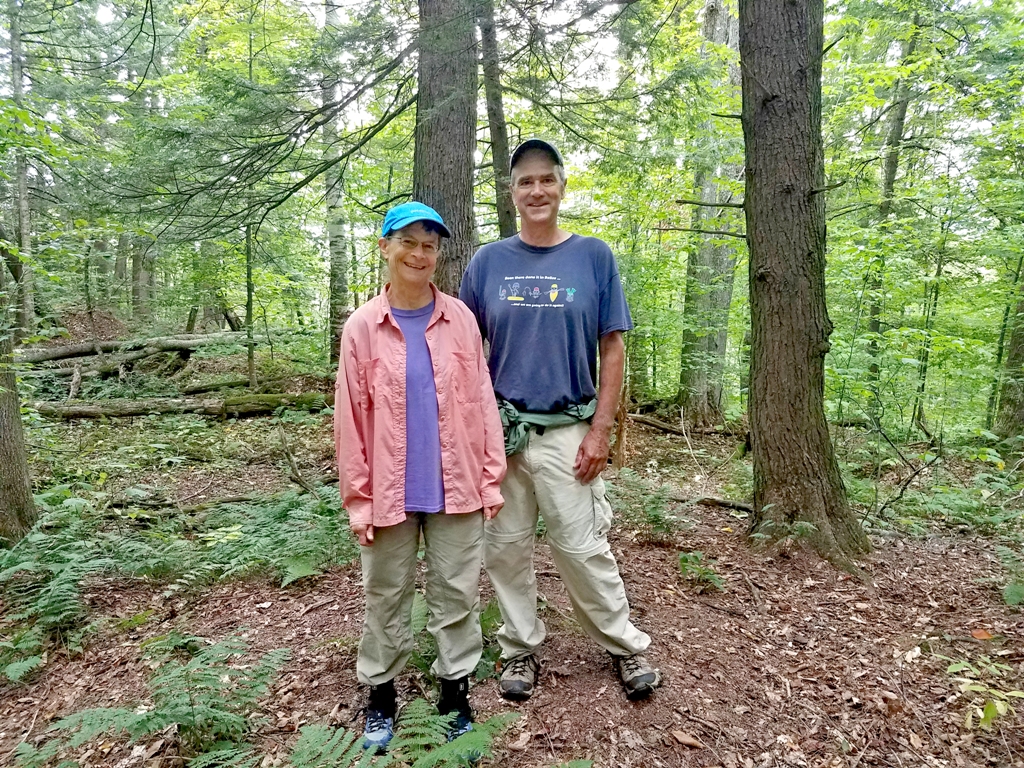
Eric and Dale Smeltzer, conservation easement donors
Vermont Business Magazine The Route 100 scenic byway connects visitors and residents to some of Vermont’s most beautiful landscapes. It also bisects a forested landscape that animals such as bear, moose and bobcat need to thrive. Concern for the future of these animals led a partnership of community members, municipalities, conservation groups, and state agencies to protect the last remaining forested corridor connecting the Green Mountains and Worcester Range.
The “Shutesville Hill Wildlife Corridor” crosses Route 100 on the Waterbury–Stowe town line and is the only viable connection between the Green Mountains and Worcester Range. It is one of the five most important wildlife crossings in the state and a critical part of an international network of connected forest habitats in the northeast.
Three of the partnership’s members—Stowe Land Trust, The Nature Conservancy, and Vermont Land Trust— along with dedicated community members have raised $500,000 to cover the costs of permanently protecting three to five key properties in this critical area.
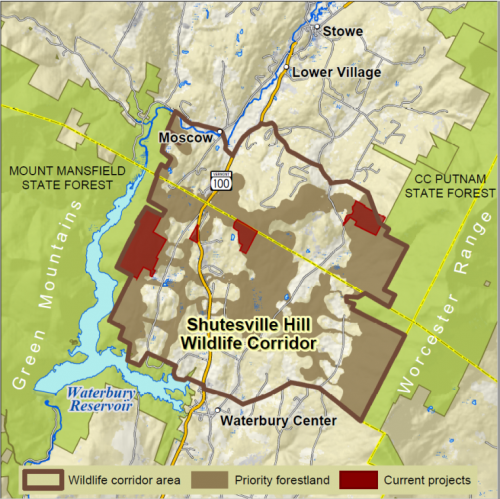
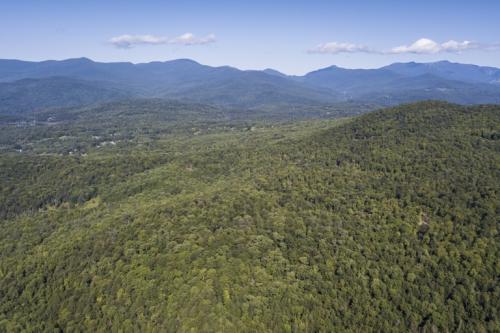 North Hill and Shutesville Hill Wildlife Corridor
“It has been fantastic to see the initial enthusiasm and support from landowners, as well as our local and regional communities, for protecting this wildlife corridor,” said Kristen Sharpless, executive director of Stowe Land Trust. “We hope that the success of this kick-off effort will be an inspirational catalyst for additional conservation work that is needed to protect this critical area.”
The Nature Conservancy (TNC) Purchases 10-Acre Lackey Parcel
The first project to launch the collaborative effort was the purchase of a 10-acre parcel whose significance is measured by geography rather than size. The Lackey tract is one of the few remaining undeveloped parcels with frontage on highly traveled and fast developing Route 100 and was sold to TNC for under appraised value.
“Conservation science shows that species are moving an average of 11 miles north and 30 feet in elevation in response to a changing climate. Wildlife does not adhere to borders, so TNC is working here at this location, throughout Vermont, New England, and across the Canadian border, to ensure that wildlife pathways are secured in a shifting landscape,” said Jim Shallow, director of conservation for TNC.
Vermont Land Trust (VLT) Secures Two Conservation Easements totaling 350 Acres
Chris Curtis and Tari Swenson conserved 63 centrally located acres in the corridor, ensuring the land will remain undeveloped and continue to have visitors like the mother bear and her two cubs that were spotted on a recent visit. They sold a conservation easement far below appraised value.
Eric and Dale Smeltzer donated a conservation easement on 287 acres that abut Mt. Mansfield State Forest and are host to several headwater streams and wetlands.
The properties were protected by conservation easements, which restrict development and subdivision. The land is still privately owned, and the landowners will continue to pay taxes on the land.
“Conserving these properties was only possible due to generous landowners who are protecting their forestland and wildlife habitat,” said Bob Heiser, regional director for VLT. “We hope that protecting these key properties will inspire others to consider doing the same.”
Stowe Land Trust (SLT) Poised to Conserve 109-Acre Parcel
The Stowe Land Trust is actively working with the Trust for Public Land on the Hunger Mountain Headwaters project to conserve a 109-acre property nestled up against the Worcester Range in Stowe, and an additional 1,800 acres in Middlesex and Worcester. Both properties will be added to the adjacent CC Putnam State Forest and will add quality forested habitat on the eastern edge of the wildlife corridor.
The Power of Partnership and Science
The Shutesville Wildlife Corridor Partnership consists of the Waterbury Conservation Commission, Stowe Conservation Commission, Stowe Land Trust, Vermont Land Trust, The Nature Conservancy, Vermont Fish and Wildlife Department, Vermont Department of Forests, Parks, and Recreation, Vermont Agency of Transportation, two regional planning commissions, and many community volunteers.
“Conserving these lands is such a gift to our community and wildlife,” said Allan Thompson, of the Waterbury Conservation Commission. “What started as a local education initiative was bolstered by state wildlife science, propelled by the support of land trusts and conservation organizations, and developed into a productive relationship between diverse conservation partners. I am thankful for the community’s support of wildlife and of this partnership.”
The collaborative efforts to better connect landscapes for wildlife and people, stands on the shoulders of sound conservation science that shines a spotlight on Vermont’s outsized regional role in protecting biodiversity. The state is at the center of the largest remaining block of deciduous temperate forest in the world and the state’s geography places it at the crossroads of six critical wildlife corridors.
Learn More
Community members are invited to join the partnership at an upcoming event.
Wildlife Workshop and Cell Phone Photo Contest – Sept. 29, 1-4 pm at 1601 Barnes Hill Road, Waterbury Center, VT
Managing Your Land for Wildlife, a presentation by Andrea Shortsleeve – Oct. 15, 7-8 pm at the Green Mountain Club Visitor Center in Waterbury Center, VT
Moose Status in the Northeast, a presentation by Elias Rosenblatt – Dec. 5, 7-9 pm at the Green Mountain Club Visitor Center in Waterbury Center, VT
More information available online at www.stowelandtrust.org/events
About Stowe Land Trust
Stowe Land Trust is a local, member-supported, non-profit 501(c)(3) land conservation organization operating in Stowe, Vermont. Stowe Land Trust is dedicated to the conservation of scenic, recreational, and productive farm and forest lands for the benefit of the greater Stowe community. Together with the community, partners, and supporters, Stowe Land Trust has protected 4,300 acres of land since 1987. Learn more and become a member at www.stowelandtrust.org
About The Nature Conservancy
The Nature Conservancy is a global conservation organization dedicated to conserving the lands and waters on which all life depends. Guided by science, TNC creates innovative, on-the-ground solutions to the world's toughest environmental challenges so that both nature and people can thrive. TNC has worked in Vermont for 60 years and has conserved over 300,000 acres of land, 1,500 miles of shoreline, and manages and maintains 58 natural areas that are open to the public for hiking, paddling, and hunting. To learn more visit: www.nature.org/vermont
About the Vermont Land Trust
The Vermont Land Trust is a statewide, member-supported, nonprofit land conservation organization. Since 1977, the Vermont Land Trust has protected nearly 2,000 parcels of land covering more than 593,000 acres, or 10 percent of the state. This includes more than 900 working farms and farmland parcels, hundreds of thousands of acres of productive forestland, and numerous parcels of community lands. For more information or to become a member, visit www.vlt.org
Source: September 26, 2019, Stowe -- The Nature Conservancy