

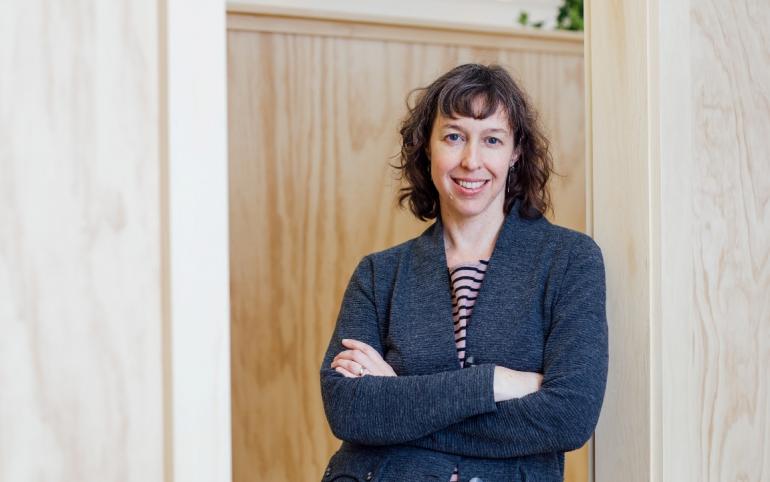
Sarah Kaeck, CEO of Bee's Wrap.
by Joyce Marcel, Vermont Business Magazine
In a little building by the train tracks in Middlebury, the war against plastics is being profitably waged, one hunk of beeswax at a time.
Plastics, as we now recognize, are devastating to the environment.
“Studies have detected plastic fibers everywhere—in the stomachs of sperm whales, in tap water and in table salt,” said a recent story in the Irish Times, although it could have appeared anywhere. (Google “plastics” and get about 4,290,000,000 results in 0.71 seconds) “A researcher in Britain says plastic may help define the most recent layer of the earth’s crust because it takes so long to break down and there is so much of it.”
Vermont is fighting back, and hard. The town of Brattleboro has banned supermarket-style plastic bags for two years now, and the State of Vermont recently joined the growing list of states legislating against single-use plastics (shopping bags, straws, drink stirrers and foam food packaging, for example). The new law will take effect in July of 2020.
If Vermont had a sea, as it did at the end of the Ice Age, its sea turtles would be cheering right now.
Which brings me back to the Vermont entrepreneur who has been taking major steps to eliminate at least one kind of plastic: the kind in which we wrap our leftovers.
Meet Sarah Kaeck, 44, a tall, slender, bubbly, breathless and instantly likable woman who has a great smile; she is the founder and CEO of Bee's Wrap.
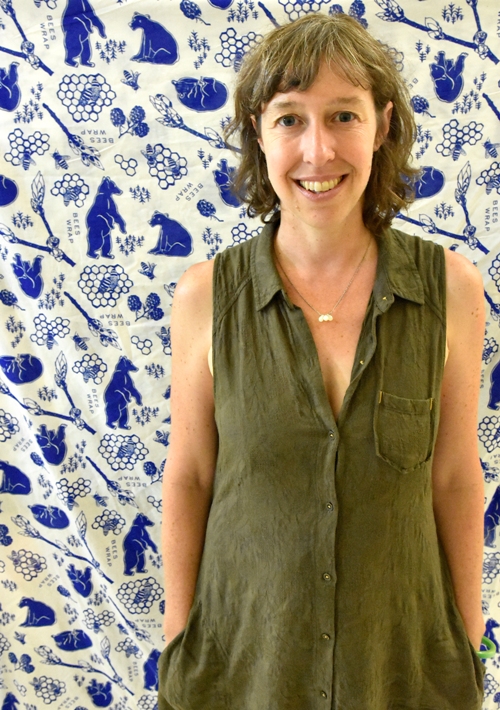 Sarah Kaeck, CEO of Bee's Wrap. Photo by Randolph T. Holhut.
Kaeck uses bespoke machines to infuse an elegantly printed organic cotton cloth from Indonesia with just the right amount of beeswax, tree resin and jojoba oil to make it safe and pliable.
Sold as “sustainable food storage,” the large wraps, printed with the company's honeycomb pattern trademark, keep bread crusty and fresh for a week; smaller ones, decorated with happily swimming turtles and blue bears, cover leftovers.
“We wanted to reduce the amount of plastic we use in the kitchen for food storage, for the health of our family and the environment,” Kaeck said.
Because the product was new to the public, its name was of primary importance.
“It took a lot of educating to get people to understand what this wax wrap was for,” Kaeck said. “And to explain why you would use this instead of plastic wrap. I felt like I needed a name that was in some way descriptive, and something that everyone could relate to. Hence Bee's Wrap.”
The wraps are pretty, reusable, compostable, biodegradable, waterproof, airtight, and hand-washable. They fold flat and are long-lasting. They are endorsed by Rachel Ray and sealed by the warmth of your hand.
Kaeck, who lives on a farm in New Haven with her husband and three children, cooked up the Bee's Wrap idea in her kitchen and started selling it online through blogs in 2011.
Talk about hitting the zeitgeist! Zing! The company has grown over 80 percent in the past two years. Bee's Wrap, a B Corporation, now employs 40 people; in the next few months Kaeck is bringing in two upper management professionals to help her further grow the company.
“We're bringing on a CFO who starts on Monday,” Kaeck said. “And we're bringing on a director of marketing and commerce. She starts a week from Monday. So we're bringing in some senior leadership right now which is super exciting. It's a big change.”
At its start, the company had help from the Vermont Small Business Development Center.
“I first met Sarah Kaeck in January of 2013,” said VtSBDC's statewide advisor, Sarah Kearns. “It was clear from the very start that she was creative, hard-working and really smart. She saw a solution to a problem and even in the early years, I think she knew it could have huge potential. She was a wonderful client for us, as she was always open to ideas and very thoughtful about her next steps. VtSBDC feels a tremendous sense of pride for our small part in her success. She has always embodied her brand and she is doing her part to solve a huge problem. She is a change-maker for sure. I will never forget those first meetings in her kitchen, when her shop was in her garage! She is a true Vermont story that we can all feel good about.”
Bee's Wrap products are sold in more than 3,000 stores in the US, including Amazon, of course, and natural food chains like Natural Grocers, national home stores like Anthropologie, and big kitchen chains like Sur La Table, as well as in 41 countries in Europe, South America and Asia.
How did a tiny company located in the middle of Vermont reach markets in Europe and Asia?
“Well, I had distributors,” Kaeck said. “Two women, one in Norway and one in the Netherlands, reached out to me separately to ask if they could distribute these wraps in their countries. They were just starting, like I was just starting. So I said, 'Sure, let's give it a shot.' And they've grown their companies as I've grown mine. We've developed great relationships. And from there we've expanded to other places. We did a trade show in London a few years ago and took on a partnership with a distributor there. So by doing some of these overseas trade shows we've made connections in South Africa, South America and Asia.”
While Kaeck said she was uncomfortable providing a sales figure, she acknowledged that yearly revenue now falls between $5 million and $10 million. This winter, to keep up with demand, the company moved from a small manufacturing plant in Bristol to a 12,000-square-foot industrial space in Middlebury.
The company has partnership arrangements with National Geographic and Patagonia.
“We do a co-branding partnership with National Geographic,” Kaeck said. “This was for the launch of their Plastic Awareness Campaign a little over a year ago. They brought on some supporting products to help people attain that plastic-free kitchen on the go, and Bee's Wrap is one of those products. We're pretty psyched to be a part of that company. We also do a co-branding partnership with Patagonia Provisions, which is part of Patagonia. They sell a number of different products based around food, like smoked salmon and muesli for backpacking. The wraps are great for backpacking and it's zero waste. My husband likes them for hunting because it has a natural scent and it doesn't make noise when you open it.”
Bee's Wrap also makes a great fire starter. Trimmings from the manufacturing process are regularly put out back of the plant for local people to use as starters for campfires and wood stoves.
Bee's Wraps aren't cheap; a single sandwich wrap costs $11 and the one large enough to keep a loaf of good bread fresh costs $15. But they are reusable for at least a year — and probably much longer.
Bee's Wrap products have been featured in a multitude of magazines, including The Boston Globe, Cooks, HuffPo, O, Eating Well, Real Simple and Fox News.
The on-line news service BuzzFeed did a video about Bee's Wrap, calling it “an eco-alternative to plastic wraps.” The video (beeswrap.com/pages/press) went viral.
Kaeck has built her company without investors and cannot imagine taking it public.
“We've grown organically the whole way,” Kaeck said. “No outside funding. Never.”
But the company does have a line of credit from the National Bank of Middlebury. When Kaeck won the US Small Business Administration Award for Vermont's Woman-Owned Business of the Year in 2017, her bank proudly posted congratulations on its web site:
“Back in 2007, Sarah opened personal deposit accounts with NBM,” the bank said. “Shortly after she opened her business Bee’s Wrap, she established a business checking account and an operating line of credit. NBM is very happy to be part of Sarah’s highly successful, innovative business. As this wonderful company has grown, we have been able to support Sarah’s borrowing needs and to provide electronic banking services like eCorp to assist in management areas.”
This year the company won Green America's People and Planet Award. Green America “provides the economic strategies, organizing power and practical tools for businesses and individuals to solve today's social and environmental problems,” according to its web site.
Early Years
Kaeck comes by her entrepreneurial genes naturally. She grew up in Lancaster, PA, where her father makes and distributes big compost tumblers. Her mother sold a line of high-end clothing.
“She sold them out of the house in the beginning, and then she had a studio,” Kaeck said. “So I grew up around that atmosphere.”
The entrepreneurial instinct displayed itself early.
“My younger brother did the paper route, and I babysat,” Kaeck said. “Then I was a waitress. I worked in a small shop in town. In college I worked at the Apple store.”
Kaeck went to American University in Washington, DC, where she took a degree in women's studies and art. After college she decided to travel. She went out West, moved to Seattle and ended up in Alaska.
“I spent a few years there, and that's where I met my husband,” Kaeck said. “I was working in an art gallery and then on an organic farm. We had our first two kids there. And then my husband and I moved back to Montana.”
Kaeck's husband, Brian Kaeck, a contractor, sells and sets tiles. He also helps with Bee's Wrap’s trade shows.
“He is also a trained chef, and we've always raised a good portion of our food,” Kaeck said. “He hunts deer and elk. And in Montana he foraged for mushrooms. At one point, when we lived in Montana, he purchased and sold wild mushrooms to the East Coast. Mushrooms are the most perishable thing, so shipping them long distance was pretty stressful. Food has been always been a big part of our lives.”
The family moved to Vermont 13 years ago.
“Vermont was a way to get back East, closer to my family,” Kaeck said. “And we could still be in the mountains so we could ski and do the other things we like to do. And at that time I was staying home with my two children. Then I had a third child, a few years after we moved here.”
Her children are now nine, 13 and 16.
“So when we moved back East to Vermont, we had some land,” Kaeck said. “We raised all kinds of animals. We had pigs and sheep and chickens for both eggs and meat and we had goats. We didn't have the goats for too long. But I did milk them and make cheese. We grew a lot of our vegetables. I canned and froze them. We still do grow vegetables, but we've pared way back with both of us being busy in our work and our kids getting bigger and doing things.”
The Big Idea
Even though she was busy being a mother and a farmer, Kaeck's entrepreneurial nerves were twitching. She started doing email marketing for her father's business. Then she began a blog. She did some sewing, mainly making aprons to sell at local farmers' markets.
Then her cousins told her about using waxed fabric for food storage.
“They really encouraged me to try it, thinking that it fit in well with my lifestyle,” Kaeck said. “I bake all of our bread, and anyone who makes bread knows that it's hard to store it. Plastic bags don't keep the crust nice. And if you don't eat it right away, you know you've got to figure out a way to keep it fresh. So this seems like a great solution.”
Environmental consciousness is a big part of Kaeck's family's life.
“Both my husband and I spend a lot of time outdoors and in the woods,” Kaeck said. “So not using plastics was important to us. I started playing around with wax and cotton. Then I figured out a way to make a really nice waxed wrap which worked really well for storing bread. It worked well for covering a bowl. it worked well for everything — veggies and sandwiches and cheese. So I thought I would try selling it. I made a web site, made the honeycomb logo, figured out some packaging and started making wraps.”
She launched the company in October of 2011.
“Then I started reaching out to different blogs with the new idea,” Kaeck said. “People were interested in it because it was new and different and interesting. It was something they could write about. I sent them photos and it just started to take off.”
Soon Kaeck needed help, so she asked a friend to work with her making the wraps.
“We worked in a little studio space off our kitchen,” Kaeck said. “She's a farmer, so she was free in the winter. Then it grew and I hired another friend. And these were all moms from my community. They were my social network. Then, after the first eight months, it necessitated a bigger space.”
With her husband's help, she turned her basement — it had an outdoor entrance — into a workable manufacturing space; she started production there.
“And it grew and grew, so that I had sometimes six or eight women working in that space to produce enough wraps for the demand,” Kaeck said. “So we started selling wholesale, to retailers. Early on we had some great enquiries. Williams-Sonoma was one of our first big customers. We had inquiries from Patagonia. It was super exciting.”
All About Bees
From the beginning, sustainability has been a vital part of the enterprise. Kaeck was drawn to beeswax because it's renewable, fully biodegradable, and has natural antibacterial properties, which makes it ideal for keeping food fresh.
Bees exist in all types of climates around the world. Their products have ancient uses; honey, for example, has a long history as a medicine used for burns and other skin diseases. A mixture of honey, beeswax and olive oil inhibits the growth of Staphylococcus, for example.
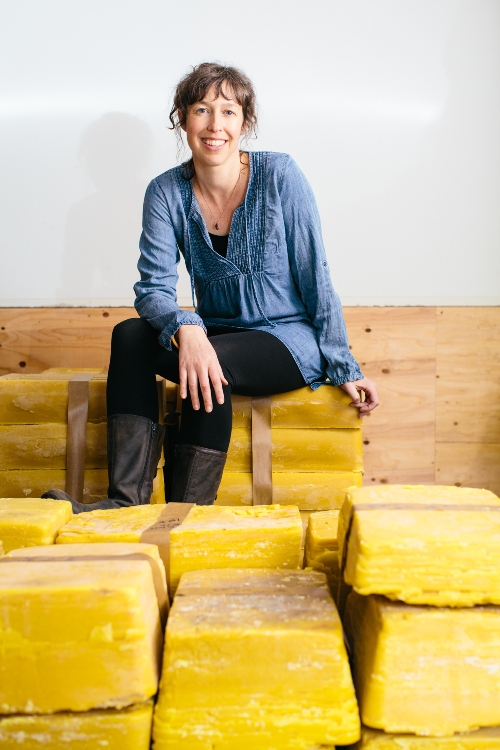 Sarah Kaeck with a whole bunch of bee's wax.
“Beeswax is the substance that forms the structure of a honeycomb; the bees secrete wax to build the honeycombs to store honey,” wrote three Italian scientists in a paper reviewed on PubMed. (www.ncbi.nlm.nih.gov/pubmed/27633295(link is external))
“Thanks to its rich hydrophobic protective properties, the beeswax is in fact present within cosmetics and body products. Also, beeswax is used in the food industry: as a film to wrap cheese for maturing or as a food additive (E901) to give shine to the products. Exactly as the honey which it contains, beeswax is also characterized by several therapeutic properties of great interest to us; it is thought to be particularly effective in healing bruises, inflammation and burns. Recently, the interest of researchers has moved even on antimicrobial properties of beeswax... the few studies showed an anti-microbic effectiveness of beeswax against overall Staphylococcus aureus, Salmonella enterica, Candida albicans and Aspergillus niger; these inhibitory effects are enhanced synergistically with other natural products such as honey or olive oil.”
In recent years, we have learned much about the fragility of bee colonies and the mysterious disease called colony collapse disorder. On average, the national decline in bee population is figured at between 30 and 40 percent.
For Kaeck, Bee's Wrap is a way to support pollinators and responsible beekeepers. One way she does this is by partnering with an educational nonprofit in Charlestown, SC, called Bee Cause.
Tami Enright is the executive director of the Bee Cause project, which provides $2,000 grants for bee education and hives to schools, libraries, 4-H clubs and other environmentally aware organizations — usually by getting kids “up close and personal with a hive of honeybees,” she said.
“When kids start learning and taking care of the hive, they start caring about the bees,” Enright said. “We want to connect those kids back to the natural world. We want them to know where their food comes from, how their own actions can support or hurt pollinators. We have 500 schools now that we've donated these grants to, and each has started a different conversation and launch some kind of environmental program and raised awareness. ”
Kaeck contributes both money and products to the project. Bee's Wrap’s primary contribution, Enright said, is making a statement that bees are important.
It turns out, Enright said, that no one actually knows why hives collapse, but scientists think it's a combination of pesticides, habitat decrease and lack of diversity in the bees' diet.
“Scientists have figured out that it's everything, like the cancer in the human body,” Enright said. “We don't know why it happens. We're mowing everything down, landscaping lawns, getting rid of all of the natural habitat. We're also putting chemicals on our lawns that can lessen bee's immune systems. It really is a combination of a lot of different factors.”
Kaeck is a natural partner for Bee Cause.
“We're both telling a story about the importance of honeybees,” Enright said. “Sarah's able to sell her Bee's Wrap and not only talk about the bee's story but the plastic pollution story. She donates her Bee's Wraps to all the schools that get our grant. She sponsors several schools every year. She and I are kindred spirits. She wanted to make the world a better place for her children and put her money where her mouth is. She's walking the walk. We're both carrying a message to the next generation in the hope we can strengthen the connection between our kids and the natural world.”
The grant process begins again this month, and Kaeck will be sponsoring more schools in Vermont. To learn how to apply for a grant, go to www.thebeecause.org/index.php/about-us(link is external)
Mind Your Beeswax
Another way Kaeck helps the bees is by ensuring that the beeswax she uses is sourced responsibly.
The company works hard to ensure that beekeepers keep their hives away from areas of high pesticide use, like golf courses or non-organic farms; this helps prevent the accumulation of pesticides and herbicides in the wax, while also protecting the bees from the dangers of pesticides and herbicides.
The company also works with beekeepers who leave enough honey in the hives to allow bees to overwinter comfortably.
Beeswax comes with its own problems, though.
“It's what we expect to smell, a very sweet scent,” Kaeck said. “In the beginning, we were sourcing all of our beeswax in the US. We still source a lot of it in the US and we're very particular about the beekeepers that we source from. We have a criteria that they practice sustainable beekeeping practices. That the bees aren't traveling back and forth across the US. That there aren't pesticides used in the hives. We have a lengthy list of requirements. That was what we sourced on.”
However, at first they didn't source on scent.
“We brought in a ton of wax and started using it, and it had an incredibly strong scent — which I loved,” Kaeck said. “It came from the Southwest and it had a very resin-y, piney scent. And our customers did not like it. But by the time that product was made, was on the shelf and shipped to the customers, time had passed. We had made a lot of it. We ended up catching it fairly early on, but there were a lot of complaints about the smell. People would say, 'I don't like the scent.' Or, 'I've bought your product before. It smells so lovely. I don't like this.' Then we realized it was the wax we were using.”
Kaeck was able to return some of that particular wax to the supplier.
“But that took some pivoting on the customer service end,” she said. “And making sure our customers were happy by sending them product that didn't have a strong scent.”
The Fabric
Sourcing the cotton fabric received the same kind of care as sourcing the wax. It's woven specifically for the company.
“Another piece of this puzzle was to figure out the perfect fabric for our product,” Kaeck said. “We started off with muslin, which worked great in the beginning. But then we developed something that worked even better for us. We found someone in the US who sourced organic, GOTS (global organic textile standard) certified fabric from Indonesia.”
The GOTS certification covers everything from the way the cotton is being grown to the workplace environment and wages, safety at the mills and the dye houses — all the way from the fabric coming to the US.
“It's the highest standard for organic cotton in the world,” Kaeck said. “So that was really important to me. It was great to find it.”
Bee's Wrap brings over several container loads of fabric a year.
To develop the designs for the fabric, Kaeck worked with an artist friend.
“She's a fabric designer,” Kaeck said. “We pulled our first print from the logo, which was hand drawn by me. Then she developed this beautiful, beautiful honeycomb print. All of our prints have some sort of nature represented, and some sort of ecosystem, so the clover and the oceans and the bees and bears have an ecosystem. In Vermont, we use the maple buds, the honeycomb, the black raspberries. We work very closely on the prints.”
Usually, Kaeck comes up with the ideas.
“Then the artist goes back and puts a print together,” Kaeck said. “Then we have brainstorming sessions together. We usually have a couple of those before the piece is finalized, and then we choose the colors. We work very well, very collaboratively and it is an amazing process. It's really one of the most fun parts of my job.”
The Machine
The first Bee's Wraps were made with melted wax on a skillet in the Kaeck family kitchen. But scaling up the business meant finding a way to mechanize production.
“Doing it by hand was not sustainable for growth,” Kaeck said. “We pulled together resources. We had a local engineer. My father helped. The person who is my production manager now, helped. So did my assistant production manager. We all pooled ideas and worked on developing this piece of machinery that could wax whole rolls of fabric.”
Engineering experts studied how fabric rollers work. Experts in wax melting were called in.
“Then we had to bring those ideas together,” Kaeck said. “Our first machine worked great to start, and then we had to tweak things to get it to work right. There have been a lot of iterations along the way. And we had to build a custom tank for melting the wax. The first time we put the machine all together, we really had our fingers crossed that it was going to work. And it did!”
There exist machines that apply paraffin to cloth, but not this type of cloth, with this type of printing design.
“There's nothing exactly like this,” Kaeck said. “This we really had to come up with on our own because of these wax designs.”
The end result is a machine with rollers that pull the printed cotton through a well of melted wax. Kaeck actually has two of the machines now, but has not yet sought a patent.
Growing
When the company outgrew Kaeck's basement, it moved to Bristol.
“We moved there four years ago,” Kaeck said. “To a cool old building that has a great history. Vermont Coffee started there. It was a great incubator space for us.”
Growth came quickly after BuzzFeed (no pun intended) entered the picture.
“That gave us a big boost,” Kaeck said. “Two years ago BuzzFeed reached out to us and wanted to do something. They put together this cute little video and launched it. Within a couple days it had over 60 million views, and now it's at 80 million or 90 million. We were completely sold out of everything. So we had to ramp up.”
New employees were hired. Systems were changed so that the large influx of new orders could be handled efficiently.
“We had to bring in new wax melters,” Kaeck said. “We had shipping stations all over the place, trying to get product out. It was quite an experience. We pulled it off, which was a great feat for everyone who jumped on board. Everyone in the company and people in our community came to help. And so we've been building steadily off of that.”
Last September, Kaeck moved production to Middlebury; the offices followed in January of 2019.
Kaeck has competition. Bee's Wrap is not the only company making and selling beeswax-infused cloths for food storage.
“It's becoming very, very popular,” Kaeck said. “We're trying to stay very true to our brand and to our product.”
Growing as fast as this presents its own set of problems.
“At the same time we put the machine together we had new fabric and new print and new packaging,” Kaeck said. “We had to bring it all together in the fall, before our busy season. We get very busy in October, November and December because people like to give Bee's Wraps as holiday gifts. And it was a circus here. We got everything in-house. We have the photographs done. We launched the new look. We launched the new product. Things were working, and it sold and we ran completely out of packaging. And you can't turnaround packaging as quickly as we would have liked, because we were sourcing it from Georgia. It was far away. It was really challenging.”
The company went back to its original method of packaging to keep up with orders.
“We just pivoted,” Kaeck said. “We didn't go back to the old way of making the product, because our machine was working and we were able to keep it moving. But we were hand rolling and trying to keep customers happy. That was a customer service thing, and we had to keep on our toes.”
The Future
Kaeck is committed to growing the business and taking it in new directions. Up next, for example, is a vegan line of Bee's Wraps using a plant-based wax instead of beeswax.
“There are a number of different plants that give wax,” Kaeck said. “One example is palm wax. That's most likely not what we'll be using, but our recipe is not developed yet.”
Another avenue for growth is developing products that support the wraps.
“We're coming out with a drying rack for these wraps and we're pretty excited about that,” Kaeck said. “It's a rack used for drying, because Bee's Wrap is washed by hand in cool water so you don't melt the wax. And then you hang it to dry. People who use the wraps as a complete replacement for plastic wrap in their kitchens often have three or four wraps that need to dry at one time. This will make that easy to do.”
Kaeck is learning as she goes.
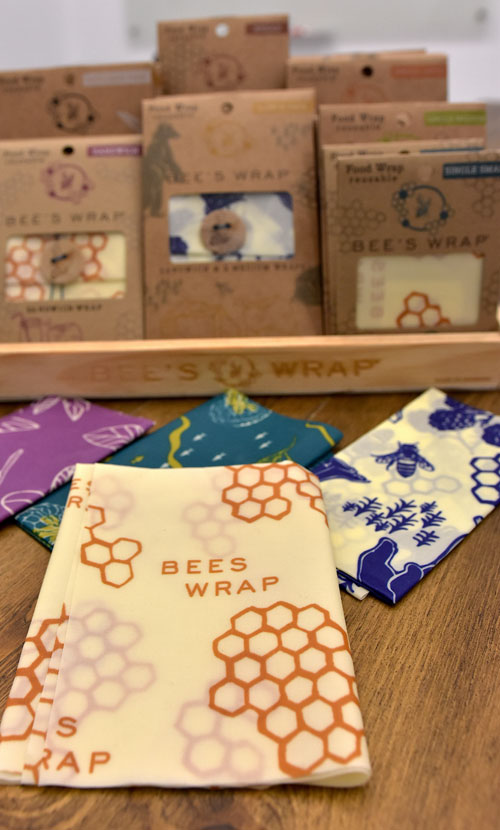 Final Bee's Wrap product. Photo by Randolph T. Holhut.
“With a quickly growing company, we've had to scale quickly over from the beginning, Kaeck said. “We started so small and so hands-on. It's about figuring out how to grow the company in the way that I like to work. But a company needs to have structure. So I envisioned — and I still envision — creating a very open and engaged workplace where different departments work together. But I'm also putting in structure where needed, to keep things fair for all employees. To be able to put into place things like health care and workplace safety — those require a structure, so we're making sure that we have these things in place, and at the same time being able to keep a very open, engaged, fun, great place to work.”
One way Kaeck is doing this is by working with Let's Grow Kids, a Vermont nonprofit working to ensure that every family has access to high quality childcare. The organization is helping Kaeck figure out the best way to provide her employees with childcare.
“Childcare is a fundamental support,” said Emily Blistein, the business strategy director of Let's Grow Kids. “I'm working with employers to make them champions of childcare. We want to help them look at their benefits and practices and how they can use benefits around childcare to help find and retain a productive workforce.”
Perhaps because Kaeck studied women's studies in college, or because she started her company by employing her social network, women dominate the Bee's Wrap work force. That makes a commitment to childcare a singularly important benefit.
“One of the things that interested me, going to school, was the balance of family and work life,” Kaeck said. “It's very much a challenge for women and it's a challenge for women here at Bees Wrap too. So we feel strongly here about creating a family-friendly workplace. We've put into place flexible work hours to make sure that women who need to be home after school can be there. One thing we're working for is childcare subsidies for employees. Our next step in that process is putting together a committee of employees to figure out, pin down exactly what those family-friendly benefits will be. The next step will be implementation.”
Blistein first met Kaeck when she was starting Bee's Wrap.
“I think Sarah is phenomenal,” Blistein said. “She started her business as a mom of three, and she has a commitment to the women in the community. She's worked hard so she can give them a good employment. She's incredibly committed to creating a sustainable product. She's been an incredible steward of community programs. She's committed to keeping her business in Vermont and growing it here. I think she's done a remarkable job.”
At the new facility, production happens in a large, light-filled room with friendly people working at their stations, but also chatting, joking, sharing food and giving each other back rubs. People bring their pets. Snacks are always available in the lunchroom. The day I visited was Taco Day. There's also a Salad Day every Wednesday.
“The Middlebury co-op makes salads in our reusable lunch containers,” Kaeck said. “So we take our lunch containers over on Tuesday. They make salads for us and bring them back.”
Kaeck said she feels her business, which is exploding, is just the tip of the iceberg.
“In terms of awareness of this type of product and our consumers, we feel like we have a ways to go — still,” Kaeck said. “Between the growth of the company and the awareness of the product, we've come a long way. But there is a lot more that can be done. So we're excited about that.”
Joyce Marcel is a journalist in southern Vermont. In 2017 she was named the best business magazine profile writer in the country by the Alliance of Area Business Publications. She is married to Randy Holhut, the photographer who took the photos for this story. He is also the news editor/acting operations manager of The Commons, a weekly newspaper in Brattleboro. The couple have been living in a Windham and Windsor Housing Trust shared equity home for more than 22 years.