

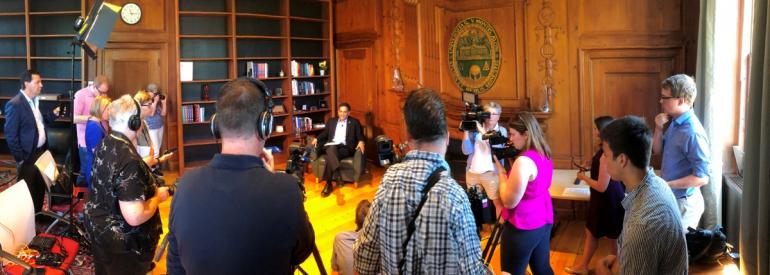
Photo: UVM President, Dr Suresh Garimella. VBM photo.
by Brandon Arcari, Vermont Business Magazine UVM President Suresh Garimella Q&A from his first press conference on July 1 conducted in his office in the Waterman Building.
It has been edited for clarity. The unedited video is available online HERE.
Suresh Garimella: Welcome to my new office. It's a very meaningful day here for me today. As you know I've been looking forward to it for a long time; it was announced a few months ago. I wanted to invite you into my office to share in this important day. So just a few comments upfront. I have been studying UVM and spent a lot of time talking to folks here, our friends and alumni around the world. And it's clear that UVM has had stable, successful leadership now for years. And great stewardship from the board of trustees. And so really, my sense is UVM is a great place, upward trajectory, and, there is just great potential and opportunity. I'm just very optimistic about UVM. I guess what I'm committing to is that I will work tirelessly to take UVM to an even better place working with all of the folks here. While I've met quite a few people, there are many many more people I'd like to meet here on campus and all of our friends. And there's a lot to learn. I have some ideas about some of the things that are going on here but, I need to learn a lot more. So you know I wanted to comment also that colleges and universities across the nation are facing a lot of challenges. And UVM is not an exception. But I also think that our assets, UVM's assets, are strong. And that we will be able to weather these challenges. And so again my first day here I wanted to share this moment with you. I'm barely moving all the boxes outside as you walked in, I'm sure. So be many opportunities to connect one on one with each of you and learn from you. And talk to you, of course. But hopefully, there are a few questions that you have now that I mentioned.
Q: Can you talk about some of those challenges that UVM is possibly facing. As in declining enrollment and on the shift in the demographics in the Northeast?
SG: Yes. So you know it's interesting you bring up enrollment. So my understanding is that UVM is doing very well in enrollment and in fact, while we don't have final numbers, our enrollment has exceeded its target. So we're actually doing very well, and it's not just numbers, it's the quality of the students, it's the diversity of the students. It's the attributes that they're bringing. And so the enrollment story is quite good at UVM, so I'm quite optimistic about that, but of course, I think it's hard to read any article about education today without hearing about you know the overall demographic challenges in terms of fewer students to graduate high school and so on. And certainly, the New England region is even more prone to these demographic challenges. And so you know I believe that these will need to be dealt with, we're not the only university that is facing these. But we're a public land grant university that comes with a mission. I'm very optimistic that we can meet these challenges just because of our great students and faculty and staff and our friends. You know there's a lot of people outside of UVM in our community that are willing to help. And I think we'll certainly have to count on them to help with resources and such as well.
Q: You mentioned a vision for the college. How does your vision for you both parallel and deviate from the established vision that has been ongoing here at UVM?
SG: Yes. So you know I mean I look at the written mission statement goals things like that, and they're all you know, it's hard to disagree with them. I would say that my focus will be on student success. We wouldn't be a university if we weren't focused on our students' success and the quality education that they get. So I think we have to continually be looking at how to improve the offerings that we have and keep up with new areas and new experiences that we need to give them. And so obviously top priority has to be student success. And you know there are things like affordability, I mean, student debt is second only to health care costs in terms of financial concerns. So we need to be very prudent and think about how to make higher education more accessible, more affordable for students. I'm sure you know that 40 percent of Vermont students that attend UVM pay no tuition. So I think the university's done well the tuition increases have been kept fairly low, historically. But we need to do more. And then research that we've got a great liberal arts tradition in humanities and so on, our STEM programs and growing the medical school, which is a great asset of course. How do we take those assets and contribute to society, to intellectual capital, social capital, and such is what we continue to look for. So you know obviously that would be a more comprehensive plan that comes out but not today.
Q: What is your top priority as a president coming in? What are your top goals?
SG: Yeah. So I know I will almost just repeat what I said. Students I think had to be the center of our lives, of our thought, of everything we do. It's got to be about the student, about their safety, their security, their mental well-being. But also to expose them to things that they deserve to be exposed to, so experiential learning, more studying abroad or engaging in internships. UVM has a very good record in those kinds of areas. We cannot be teaching our students what we learned only. There's much more, that's changing, and so, it has to be a new focus. And as president, I also need to be cognizant of and very careful about the financial picture, of fiscal prudence, fiscal responsibility. Essentially there's a lot to be cheering about, so I'll be the number one cheerleader for UVM here on campus, across the state, across the region, across the world.
Q: Looking at that financial picture and talking about how there has been an increase in tuition, but it's been relatively low historically. However, in the grand scheme of things Vermont has, on average, some of the highest in-state and out-of-state tuitions for public colleges. Are you concerned that burden could continue to rise for students at UVM?
SG: So I am concerned about keeping higher education affordable. And we will do all we can to make that among our top priorities. There's no magic bullet to this. We want to do more. We want to educate in newer ways. Our state support is what our state support is, and so I think that one of the silver linings to that is potentially that we have so many happy alumni that are doing well and friends that seem anxious to support the next generation of education for new students. It's hard to set quantitative goals at this point, but that will be a very important priority for me to not only ensure higher education is affordable but also accessible to a broad diversity of students.
Q: And so then more on the alumni donations that kind of what I'm hearing as well as the strategy?
SG: You heard that yes. There are many strategies so that it's one of several.
Q: So how do you strike a balance between keeping students happy that are currently here and the alumni that maybe see that UVM is just transforming over time and diverting from what it was like when they were here.
SG: I don't see a dichotomy there. I think that our alumni will be very happy to see us educate our students learn things that they may not have learned while they were in college. But the world's changed. And fields have changed. New degrees, new disciplines. I don't see an issue there.
Q: What about the social climate at the university? How do you still strike that balance between the climates that students want, and the alumni want?
SG: The university is the place that students come to explore, to grow, to be exposed to lots and lots of different kinds of ideas. I'm hoping that there are great visitors that come to campus and challenge us here in new ways. And one of the things that attracted me about UVM and about Burlington, Vermont is that you have a very engaged community. You'll see me use the word engage a lot. I used to lead the office of engagement at Purdue. So I see that as a plus. I think that could be far more boring if nobody cared. You can make a lot out of that student-faculty community engagement. And I'm hoping that we can constructively, collaboratively have many many conversations that get us to a place where our students have the best education experience.
Q: You jumped the gun on one of my questions there, a two-part question. One of them is you were a very high-level administrator at Purdue, which is, not to put UVM down or anything, a very high-level university. So what was it about UVM that attracted you here.
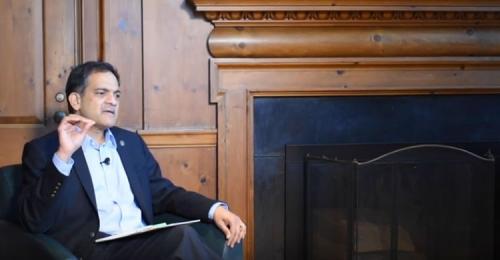 SG: I go to places, and I stick there for a while, so I was at Purdue for 20 years, I was at the University of Wisconsin before that for 10 years. I had been at Purdue for a long time. And I learned a lot there. So fundamentally I'm an educator, a professor, a researcher. That's what I was known for, but I've had the opportunity of being exposed to great opportunities in university administration and in Washington D.C. during Secretary Clinton's time I was spending a period there as a science fellow where I was advising the government, and now I'm on the National Science Board. Why UVM? I think I'd tell you that the fact that it's a land-grant university is a very big plus. It's hard to say that I'd not have come if UVM was not a land-grant, I don't know but certainly I came in large part because there's this very nice, sort of coexistence and I think one feeds the other at UVM of a strong private liberal arts tradition where it started and a land grant mission and an ag school, the medical school, engineering, etc. So I think it's nice to have all of that. I think that the students are very good. Like I said, I see that as a plus, the faculty are very engaged, it's an active community. There's great research being done, great strength in sustainability and in medicine, and so on. So I think the future is very bright. There's much we can do. And as I said, our alumni are very excited and happy. And of course, you know look around, you know Burlington, I'm told it's always like this outside, the setting is great. I don't know if you saw my message I just wrote to the campus this morning and I talked about what I had heard about, what is this Vermont mystique. And you know you have to sort of experience it, it's hard to be told what it is. My son and my daughter, my wife and I landed on the first day of summer, and it was just a very nice day. So there's just a lot to like. Again, I feel very optimistic. I think the people here have also given me a sense of being optimistic and looking to make greater contributions.
Q: About connecting with students, what are some of the things that you want to tell the students about yourself. Interesting facts, hose types of things to connect and engage with your students.
SG: I am very anxious to get to know the students better, during my visits I've had lunch with some of them et cetera et cetera. So I'm hoping that I can show up at the dorm and one of the cafeterias and people can sit around and tell me about their experiences and such. I actually reached out to some students who were here who graduated etc. to learn more. But you know in terms the facts are the 65 page CV that was uploaded on my website. I would like the students to feel like they have access to me. You know just to me in some ways it's personal. I mean my daughter and son are both going to college. When we think about security and safety and mental well-being and all these things I mean, it's something I'm worried about for my children, and so I hope that they see that they can approach me anytime that they see me around campus and. You know there are a lot of responsibilities to balance this job, and there's a lot that you are called on to do. But if someone in my role doesn't make themselves available to the students, then you're missing out on something. So I'm hoping to learn a lot from them and be available. And I'm hoping that I can contribute in my small way to making more opportunities for them.
Q: So in the past few years there have been pretty major protests on campus. Any thoughts on how to make UVM a more welcoming place for students of color?
SG: It seems to me that there is a lot of conversation on campus already. From the events that I think that you speak of, my sense is that a fair amount of change has been brought about. It's social justice; the work of social justice is never done. And so we continue to work on it. I think to understand more you know in some of my lunches I was trying to probe a little more about it. What is the actual challenge at the core of it? And so I need to understand more of it. But diversity leads to excellence. It's very very clear to me that that is the case and so by diversifying the population is one thing, but also in passivity. Those that are here, everyone should feel welcome and valued. Notwithstanding what end of whatever spectrum they come from. And so I hope that words also translate into actions. And I need to learn more. So that certainly is a very big priority, and I know it's important for the community.
Q: What appeals to you about the land grant? What appeals to you about that?
SG: Oh yes. Right. We could talk about that for a long time. I think that just what President Lincoln did, and that whole concept to me is it's just extremely aligned with how I think about higher education. I'm a product of public schooling. I don't come from means. And so the fact that I'm here today, I think that everyone should have that opportunity. And so, what I think of as being a land-grant mission is that at least the version for what it would mean to UVM is that all of our assets should be brought to bear on the well-being of the community. Now whether you define the community as the university, the city, the region, the globe. And so there are things that you do that I think you want to do good. And the land grand-mission is quite centrally about that. It's about access that anyone should be able to access higher education. It's about being useful to the community if you will. So I just think it's a beautiful concept. And you know it has morphed over time. There are some universities that have embraced that mission and have you known it has blossomed. I would say that at Purdue, my experience is indeed of a land grant that is very deeply engaged across the state and across the nation. So I again I think it means it comes with the same responsibility and I take that seriously.
Q: Well, you mentioned your schooling. Where did you go to school?? Elementary, high school. What did your parents do?
SG: I changed seven schools through high school, so I won't count through all of that. So I went to school in India. I got a bachelors at IIT Madras. I went to Ohio State for a Masters, and then I went to Berkeley for Ph.D. I taught at Wisconsin for about ten years. Actually, you know Burlington reminds me a little bit of Berkeley, a little cleaner than Berkeley. My dad's an engineer. Mom stayed home and took care of us and a lot of what I am today, a lot of what my brother and sister are today, we owe to them and their attention to us. Nothing was more important to them than our family. They could not at least in those days dream of leaving us any fortune, and therefore, the fortune they left us was a good education. And it really goes back to what I was saying earlier about being a product of public schools. I fondly remember teachers I had in school my first-grade teacher and all these folks that I don't know I mean I don't know if it still happens but. My first-grade teacher number instilled in me this thing about you could do anything you want to do. And it was just great. From then on to have that kind of you know confidence building.
Q: You're arriving at UVM after a major construction boom, we still have a major construction project over at Gutterson which is you know primarily sports-driven. How do you square the expenditure on that conflicting with the high cost of tuition and this being an academic institution?
SG: It's a great question, and really I'm really glad you asked it. So you know athletics at a university like UVM, I think plays a very important and very key role in expanding the opportunities that our students have. You know it's not a university that's driven by a football game or so, and therefore I really think you know Jeff Schulman, the AD, I've had some great conversations with him. My understanding and again this preceded me, but my understanding of the new multipurpose center is that it was very centrally targeted at giving our students better spaces just to work out in, etc. I mean wellness is a very big part of UVM's ethos it seems. I mean the Wellness Environment and things like that dorm and such. But I think this is part of that to make more, newer facilities available. I do think it helps in recruiting and such. So there's a lot of positives that come about from an investment like that. And obviously you know there have been some key alums that have been very supportive of that, and I hope they will continue to do that. So I think that as long as we focus on the integrity and academic excellence as well of our students. But you talked about buildings. Yes, there's been some wonderful work on campus around buildings that people will need to continue to examine our priorities and really see what the needs are and what will serve our students best and what will help us continue to enhance our land-grant mission the best, and that's what we would focus on. And if that means more along those lines, so be it. But if there are other ways we should be spending our resources, then we shouldn't.
Q: So about the new provost, the previous provost left, gave you a blank slate. What's that process, and who are you thinking of?
SG: I love Patty Prelock. Write that down. I am very pleased with how well the transition has gone. I would say the transition is complete today. Tom Sullivan, my predecessor -- it's really been a very good transition process for me. He included me in all that I needed to participate in. I felt like I had a very good understanding of where the university was going, and therefore I can tell you that the provost selection, we had a faculty committee, et cetera, but I also interviewed all the candidates, and I was very pleased with all the candidates we had some amazing internal candidates that stepped up. And Patty just brings so much experience at UVM. And so I had the right feeling about it when we named her provost and every day, every hour since then. Patty has done a fantastic job you know transitions are always somewhat kind of anxiety-causing, but I think she's managed it very well. Very soon, I think you'll see a seamless leadership presence. And so I just couldn't be happier with my first hire.
Q: So some of the faculty prior to you being hired felt like they didn't get to know you well enough and they didn't, weren't involved in the process. What have you been doing since to bridge the gap between the faculty that felt like they should have been included earlier and now of course, with you being on the job?
SG: I feel like I've met a lot of them even before I was announced and in fact, I'll tell you that search committee was a very large search committee. You know I'm a little surprised because you know that for a very short time I met with the search committee with an hour and 15 minute window and the sense I got from talking to those staff on their students on their core members, faculty etc. was just one of great optimism and great sort of can-do and where are we going to go kind of thing which is what led me to come in the first place. And since then I've met many many faculty members. I get lots of e-mails, and I respond. So now that I'm here, I intend to walk about and invite them over to the home that the university provided us, and there'll be many opportunities that students faculty staff-- I want to learn as much as I can as quickly as I can. Certainly, the weather is slightly more conducive to writing about now than it'll be soon. I love the faculty; I've been a faculty member all my life. I believe I know the experiences. Yes, in my field not necessarily, I come from engineering. So I definitely look forward to it more, and I think you'll find, I hope they'll all find that soon they do know me well. So I'll do what I can.
Q: How do you find your engineering background influences your leadership style, in the way you look at a problem?
SG: I don't know what it does, but it's hard for me to say. I've been an engineering professor for 30 years. I'm pretty sure I wasn't hired here because I'm an engineer and I think it's all about people it's all about relationships, it's about trust. And again I think my past experiences in sort of global affairs and engagement and in research and in u know lots of hiring in other area, faculty and student, administration I think it's positioned me well at Purdue I had a great liberal arts college that I worked very closely with as I did with the Bethany Madison pharmacy etc. etc. So I think that you know if people see me as an engineer somehow looking to solve things. Yes, sure I'm proud of that. I mean, I think you know analyzing something and looking for solutions in a way that is inclusive, that you can solve a lot of problems.