

by Olga Peters, Vermont Business Magazine On a muggy evening in July, the leadership of Springfield Medical Care Systems and Springfield Hospital sat with community members and explained what comes next for the financially beleaguered health provider. The Charlestown, NH, meeting held at the Senior Citizens Center on July 18 was the fifth meeting that Joshua Dufresne, Acting Chief Executive Officer of SMCS and Halstead have held in the SMCS coverage area.
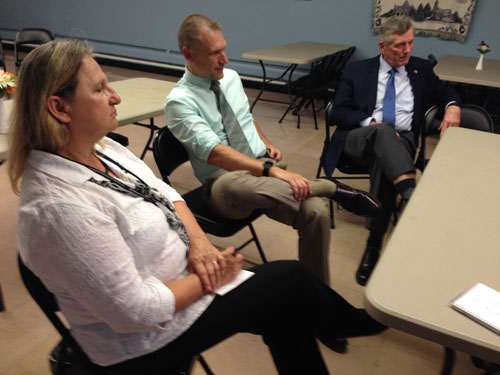 From left: Anna Smith, Chief of Marketing and Corporate communications at SMCS, Joshua Dufresne, Acting Chief Executive Officer of SMCS and Mike Halstead, interim CEO of Springfield Hospital. Courtesy photo.
“Well, we can't keep doing the same thing that we've done because that's the definition of insanity,” said Mike Halstead, interim CEO of Springfield Hospital.
Springfield Medical Care Systems (SMCS) operates nine federally qualified health centers, including two dental clinics and a vision center. It also owns the Springfield Hospital. SMCS serves southeastern Vermont and southwestern New Hampshire.
On June 26, 2019, the two entities filed for Chapter 11 – Reorganization. This move will allow the organizations to remain open and providing care during the reorganization process. And then on August 14 former CEO Tim Ford sued the hospital, who claims he was forced to resign last December.
Dufresne and Halstead said that the Chapter 11 process would likely last a year depending on how the process unfolds. They told the small audience that patients should experience few changes to care — or access to care — during the reorganization.
RELATED STORY: SMCS and Springfield Hospital file Chapter 11 bankruptcy reorganization
“We are working every day with our vendors and mainly keeping the health care as it always was and offering the very best care,” Dufresne said in his opening comments.
“There's a lot of… I would say positive morale from this,” he continued. “People are excited to see a direction and people are excited to see the opportunity for a reorganization.”
Halstead added that he views the Chapter 11 process as phase two of a three-phase plan.
The first phase started in February, according to Halstead.
This phase included reducing expenses to balance out with the two organizations’ revenues.
“Because for several years prior to January of 2019, the hospital as well as the clinic — they are two separate organizations — both organizations were spending more money than we were bringing in,” he said.
That balance sheet phase took a few months to complete, but the two organizations feel like they have a better handle on their bottom lines.
Filing a petition for reorganization with the US bankruptcy court represents phase two.
“What we need the courts to help us to address,” said Halstead. “Is what I’m going to call legacy debt that's built up over the last couple of years.”
This is the money the two entities owe to lenders and vendors and other people who have provided services or products.
“To put some dollars and cents on it,” he said. “The hospital owes about $6 million and the clinics owe about a million, million and a half.”
Or about $7 to $8 million combined. Also combined, the two organizations do approximately $60 million in net revenue each year, he said.
And then Halstead carefully dropped the big news of phase three: In order to stay financially viable, SMCS and the hospital plans to join another health care organization. Right now, Dartmouth-Hitchcock Health System in the Upper Valley is the likely candidate.
According to Halstead, in phase three, the organizations will redefine how they operate and what kind of services they will provide. This is what Halstead said the organizations are calling their Chapter 11 “exit plan.”
Halstead made it clear that joining another network of hospitals appears to be Springfield’s only option. It just doesn’t have the revenues to remain a stand-alone rural community hospital.
At this early phase, SMCS and the hospital have discussed the situation with several networks in Vermont and the surrounding area. At this time, Dartmouth-Hitchcock’s network is the contender.
One possibility is to create relationships with two neighboring hospitals also in D-H’s network and share services.
D-H is already involved with Valley Regional Hospital in Claremont, NH, and Mt Ascutney Hospital in Windsor, according to Halstead.
Dufresne said that a partnership between the three neighbors — while under the umbrella of D-H - could mean that each hospital would provide a portion of services rather than all three offering all services.
“Orthopedics is a great example,” said Halstead. “Does it make sense to have orthopedics in all three locations or does it make sense to have it in one of the facilities?”
Residents in all three towns could get the care they needed, they just might need to travel to different buildings to get that care, he said.
Dufresne said that in the past, Springfield has tried to operate under a growth strategy and expand services. Unfortunately, it did not weather the transition period between investment and return very well.
“There has been a lot of advice reported over the years to stop being a small hospital that does everything for everyone,” Dufresne said. “And I think Springfield was a hospital that did that in a sense.”
Dufresne and Halstead agreed that this arrangement might lead to residents traveling farther for their care.
It’s one of the challenges of rural medicine, they said.
One audience member urged Dufresne and Halstead to find any other hospital network than D-H.
“They don't give a s*** about Vermont,” said Kurt Shaffert, M.Div who is also an artist. “They're in New Hampshire. They look east. They don't give a s*** about Vermont other than just knocking places out.”
“Yeah, this is a hard-headed Vermonter thing,” Shaffert continued. “But I've worked at major hospitals and you know there is something about large corporate health care that doesn't give a s*** about rural life because it's not where the money is.”
Dufresne and Halstead listened but added that financially, going it alone would not work for Springfield.
“And so you're asking, what's the solution?” said Halstead. “The solution is: The system has to change.”
“I just don't know whether some of the hospitals in Vermont have the time to stay alive long enough for the system to change,” Halstead said.
According to numbers from the National Rural Health Association, nationwide, 673 rural hospitals are financially stressed enough that they could close. Since 2010, 106 rural hospitals have closed.
Dufresne and Halstead outlined several of the stressors to SMCS and the hospital. These included serving a community with high financial need, fewer patients with commercial insurance, and a reimbursement structure under Medicare and Medicaid that reimburses less than the cost of doing business.
It’s easy to focus on Springfield’s crisis, but how much is Springfield’s situation unique?
“There's a little bit of a feeling of Springfield being a canary in the coal mine,” Dufresne said. “And there are other hospitals in the state of Vermont that are in trouble. Some of those hospitals have larger investments or endowments that they can help with subsidizing those losses. We did not.”
Olga Peters is a freelance writer from Southern Vermont and contributor to The Commons, a weekly newspaper based in Brattleboro.