

by C.B. Hall, Vermont Business Magazine In July 2018 the Rutland Southwest and Rutland Central supervisory unions merged, becoming the Greater Rutland County Supervisory Union under the terms of Act 46, which mandated school district mergers across the state. Since then the GRCSU's teachers have been working under the terms of expired contracts with the defunct supervisory unions – contracts that are far from comparable in their conditions.
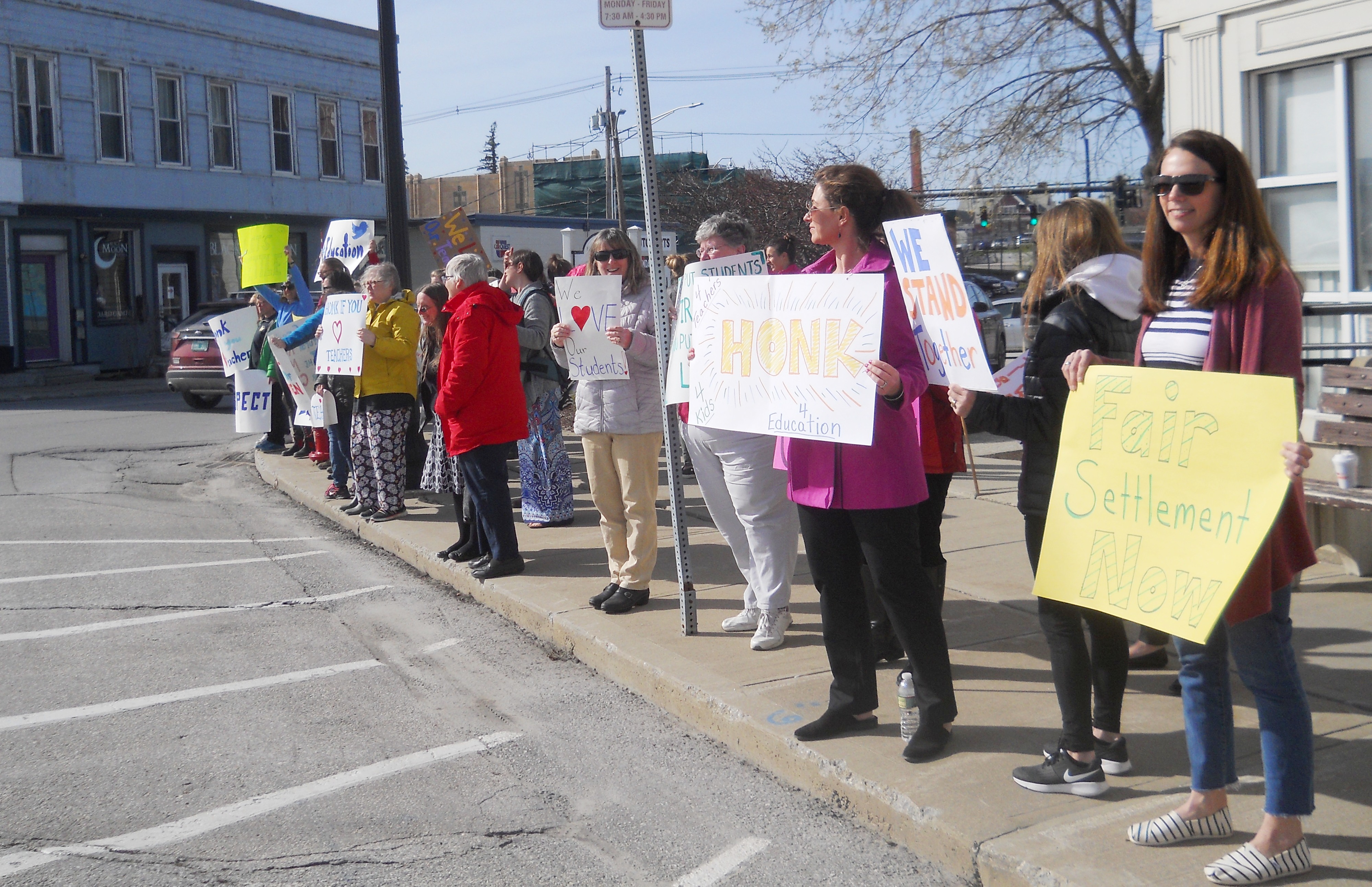
Frustrated with that arrangement, some 35 of those teachers held an informational picket outside the GRCSU offices on Rutland's Evelyn Street during the afternoon rush hour Tuesday, April 30, to demand a contract.
Organized as the Greater Rutland County Education Association (GRCEA), the teachers are seeking a resolution to snail-paced negotiations aimed at such a contract, which would remove the current situation's inequities. On March 21, both the teachers and the GRCSU declared an impasse in their direct negotiations. That meant bringing in a mediator to assist in reaching an agreement. Tuesday's streetside demonstration coincided with the first such mediation session, taking place inside the supervisory union's offices.
“It's time to get it done,” said Jodi Manning, speech and language teacher at Rutland Town School, as she displayed a placard reading “Fair Settlement Now” to the passing traffic.
GRCEA president April Morse, a kindergarten teacher at Poultney Elementary School, told VBM that the teachers' “first and foremost” objective was simply uniformity in the contractual terms – pay, benefits, days worked, and the like – under which teachers work in the merged supervisory union.
“We just want to make sure we get a fair settlement, that we don't lose any of those pieces” that the area's teachers have negotiated historically, she said. The interim contracts, she said, “are not equal across the board.”
Asked to address skeptics who say that teachers should be satisfied with what they've already got, she pointed to how schools are increasingly becoming magnets for social services other than education.
“Education nowadays is more than just teaching reading, writing and arithmetic. We are also social workers and nurses and parents. We're there for the children, doing an awful lot more than we used to do. There are a lot more expectations than there used to be. And with the mergers, there's a lot more expectations still.”
“Obviously this has been complicated by the Act 46 merger that we had to endure. We're frustrated that it's now been over 300 days without a contract.”
Teacher contracts normally begin on July 1 and end on June 30.
Other signs at the high-spirited demonstration carried messages such as “Respect” or “Peace Love and CONTRACT,” or exhorted passing motorists to honk in support – which many of them did.
Contrary to what its name suggests, the GRCSU does not include Rutland City or the even majority of Rutland County. It serves only the eight public schools in Middletown Springs, Poultney, Proctor, Rutland Town, Wells and West Rutland. While it is a member of the SU, the tiny town of Ira, just outside Rutland, tuitions its 45 students to out-of-town schools and thus is not a party to the contract talks, according to GRCSU superintendent Debra Taylor.
A press release issued by GRCSU on Tuesday noted that 16 negotiating sessions had taken place over the last 14 months. In an interview with VBM, Taylor said her organization had first approached the teachers about contract negotiations in the fall of 2017.
Participants in Tuesday's mediation included nine negotiators for the teachers and five members of the supervisory union's negotiating committee. Taylor declined to share details of the discussions, but did say that progress was made.
“We're working on resolving outstanding issues in the short term,” she said. She noted that GRCSU had recently concluded a master agreement for support staff across the new supervisory union. That agreement mandates a three-percent annual wage increase for two years.
According to the supervisory union's release, “unified contract language for all districts in the supervisory union remains a goal” in the talks with teachers.
The sticking points, however, have persisted. “We have been working on this quite a while,” Taylor conceded. Referring to Act 46, she added, “The unification of the school systems, which required negotiation of new contracts, was a complex matter.”
Asked for her view of the Act 46 process, Morse laughed lightly and said, “Can we just say no to the mergers?”
A second mediation will take place at the GRCSU office on May 7. “We're hopeful that we could have a contract before the school year is out,” Morse said.
Manning said she expected she and her colleagues would be back on Evelyn Street next Tuesday, too, in support of their negotiators.