

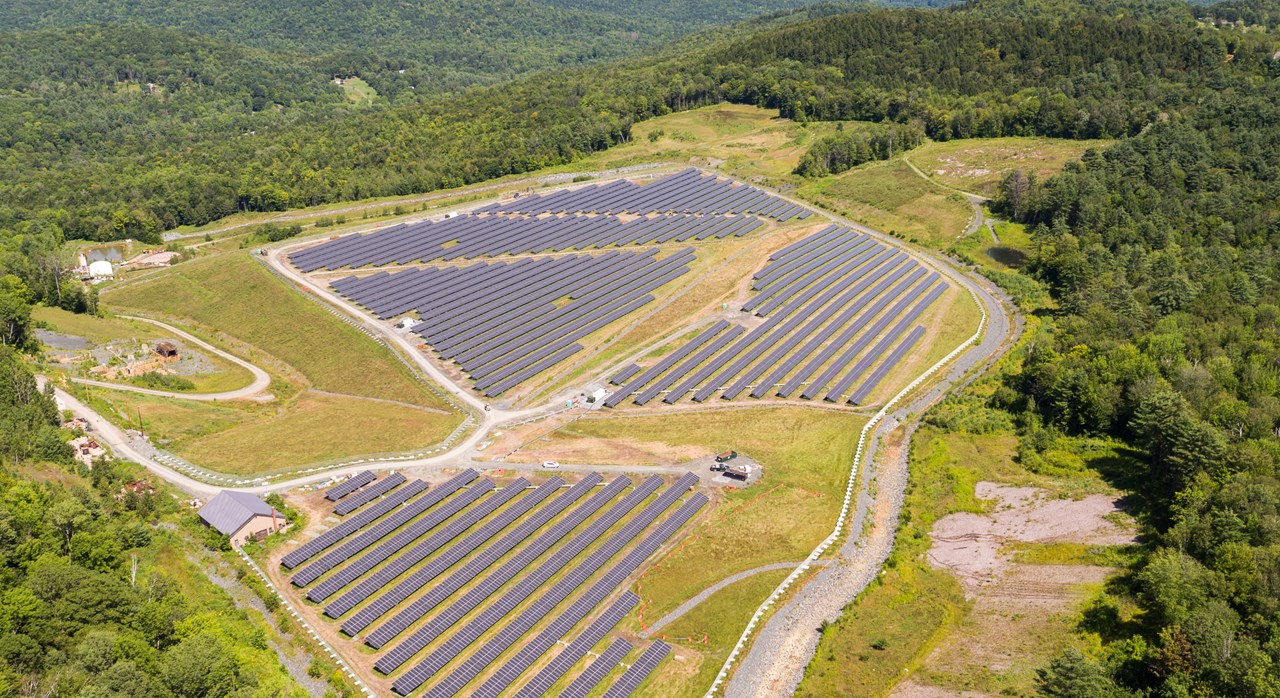
Part of the Elizabeth Mine site in Strafford has been re-purposed as a solar energy facility. The 4.99 megawatt solar project, one of the state's largest, went online in September 2017. Greenwood Energy photo.
Vermont Business Magazine The US Environmental Protection Agency (EPA) plans to conduct comprehensive reviews of site cleanups at six National Priorities List (NPL) Superfund sites in Vermont by performing required Five-Year Reviews of sites. The sites under review are the Bennington Municipal Sanitary Landfill; BFI Sanitary Landfill, Rockingham; Elizabeth Mine, Strafford; Parker Sanitary Landfill, Lyndon; Pownal Tannery; and Tansitor Electronics Inc, Bennington.
“It is a priority for EPA to make progress cleaning up NPL Superfund sites across the region,” said EPA New England Acting Regional Administrator Deb Szaro in a press release Thursday. “Once a site or part of a site is cleaned up, it is important for EPA to conduct regular reviews of the cleanup to ensure that it remains protective of human health and the environment.”
“The Five-Year Reviews are an important part of the site rehabilitation process because they help make sure remedies are still protective,” said Vermont Department of Environmental Conservation Commissioner Emily Boedecker. “Vermonters benefit greatly from the full restoration of Superfund sites, which can become valuable parts of the community landscape.”
The Superfund program, a federal program established by Congress in 1980, investigates and cleans up the most complex, uncontrolled or abandoned hazardous waste sites in the country and endeavors to facilitate activities to return them to productive use.
Under the Trump Administration, the Superfund program has reemerged as a priority to fulfill EPA’s core mission of protecting human health and the environment.
EPA is actively involved in Superfund studies and cleanups at 14 sites in Vermont. There are many phases of the Superfund cleanup process including considering future use and redevelopment at sites and conducting post-cleanup monitoring of sites. EPA must ensure remedies are protective of public health and the environment and any redevelopment will not compromise the protectiveness of completed remedies.
The NPL Superfund site where EPA will begin work on Five-Year Reviews in 2019 are listed below. Please note, the web links listed below provide detailed information on site status and past assessment and cleanup activity. Once the Five-Year Review is complete, a report of its findings will be posted to these websites. The web link also provides contact information for the EPA project manager and community involvement coordinator at each site. Community members and local officials are invited to contact EPA with any comments or concerns about a Superfund site.
Five-Year Reviews beginning in 2019
Bennington Municipal Sanitary Landfill, Bennington, VT
www.epa.gov/superfund/bennington
The Bennington Landfill Superfund Site (Site), located off Houghton Lane in Bennington, VT is a 15-acre municipal sanitary landfill. The Site was placed on EPA's National Priority List (NPL) on March 31,1989. The areas to the north and east of the Site are former borrow pits. The area directly east of the Site is wetland/woodland. The other areas surrounding the Site are residential. The Site is bordered by wetlands serving as headwaters for Hewitt Brook to the east, a residential area to the south, and U.S. Route 7 to the west. The Town of Bennington (Town) purchased the Site in 1985. Several Bennington industries dumped liquid wastes into an unlined lagoon on the Site from 1969 to 1975. Town records indicate that polychlorinated biphenyls (PCBs), volatile organic compounds (VOCs) (i.e. solvents), and lead were disposed of at the Site. The lagoon was closed in 1975 after attempts by workers failed to dry it up by landfilling it. An underground drainage system built in 1976 was designed to lower the groundwater level below the landfill waste. The system discharged through a culvert into an unlined, ponded area. In 1986, the Vermont Department of Environmental Conservation (VT DEC) detected contaminants in the groundwater discharging from the culvert into the ponded area. Approximately 2,200 residents located within 3 miles of the Site use private wells. The area surrounding the Site is mainly rural residential. Morgan Spring, a bedrock water source located 3 miles south of the landfill, is used regularly to supplement the Bennington water system.
BFI Sanitary Landfill, Rockingham, VT
http://www.epa.gov/superfund/bfi
In the early 1960s, the 17-acre BFI Sanitary Landfill (Rockingham) site served as a borrow area for the construction of Interstate 91. In 1973, Browning-Ferris Industries, Inc. (BFI) bought the landfill from an individual who had started operations in 1968. State files indicate that industrial wastes, including heavy metals, bases, pesticides, and volatile organic compounds (VOCs) were deposited in the unlined disposal area from 1968 to 1979. In 1983, Vermont licensed the site as a municipal landfill certified to accept hazardous waste from small quantity generators. The landfill was closed in 1991. In 1979, the Vermont Department of Environmental Conservation (VT DEC) reported that nearby residential and monitoring wells downgradient of the site were contaminated. The contaminated residential wells are no longer in use. There were two leachate collection ponds on site. A tar cap covered a portion of the landfill to prevent the infiltration of rainwater; however, cracks in the cap have been observed, and it was covered with new refuse. Approximately 2,700 people live within 1 mile of the site, and 6,400 residents live within 3 miles. Three homes near the site are supplied water from a water supply line provided by BFI. The Connecticut River is located 560 feet to the east, along the drainage route of surface water leaving the site.
Elizabeth Mine, Strafford, VT
www.epa.gov/superfund/elizmine
The Elizabeth Mine is an abandoned copper mine located on Mine Road in the village of South Strafford, which is part of the town of Strafford in Orange County, Vermont. The area consists of two mine tailings piles, one area of waste rock and heap leach piles, two open-cut mines, several adits (horizontal mine entrances), underground shafts and tunnels, ventilation shafts, and several former ore processing buildings as well as other on-site structures. Following site investigations, cleanup and environmental monitoring are ongoing. Deposits at the Elizabeth Mine were discovered in 1793. The mine operated from the early 1800s until its closure in 1958. The ore was initially valued for its iron content, and then its pyrrhotite content from which copperas (iron sulfate) was produced. Circa 1830, the deposit was primarily exploited for its copper content based upon the recognition that a significant amount of chalcopyrite (copper iron sulfide) was disseminated in the pyrrhotite. For nearly a century, intermittent production came from the open-cut mine as underground work did not begin until 1886. During early mining operations, several copper smelters were built on the site. Between 1830 and 1930, about 250,000 tons of ore were mined, from which about 10.5 million pounds of copper were produced. From 1943 to 1958, three million tons of ore were mined, producing more than 90 million pounds of copper. All mining operations ceased in February 1958.
Parker Sanitary Landfill, Lyndon, VT
www.epa.gov/superfund/parker
The Parker Sanitary Landfill site is located in Lyndonville, Vermont. A solid waste landfill operated on site from 1972 until 1992. Before 1983, a large amount of hazardous waste (liquids and sludges) was disposed of at this location and were poured/placed directly onto the ground. These activities led to groundwater contamination and affected private wells in the area. Following construction of the site’s remedy, operation and maintenance activities and groundwater treatment and monitoring are ongoing. A solid waste landfill operated on site from 1972 until 1992. Before 1983, about a million gallons of liquid wastes and 760 tons of solid or semi-solid wastes including metal plating wash waters, waste oils, electroplating sludges, paint sludges, chlorinated solvent sludges, caustic cleaners and metallic salts were disposed of in at least three areas of the landfill. Liquid and sludge wastes were poured directly onto the ground or into unlined pits and lagoons. During a site inspection in 1984, the state detected contaminants in a stream bordering the landfill, in groundwater at the landfill and in four private wells near the landfill. The site is located in a residential area, and an estimated 3,200 people get drinking water from a municipal well field located within approximately two miles from the landfill. In addition, 124 private wells are located within three miles of the Site.
Pownal Tannery, Pownal, VT
www.epa.gov/superfund/pownal
The Pownal Tannery site is located between Route 346 and the Hoosic River in Pownal, Vermont. A former hide tanning and finishing facility owned by the Pownal Tanning Co, Inc. was located at the 28-acre area. From about 1937 until 1962, untreated wastewater from the tanning process was directly discharged into the Hoosic River. A lagoon system of six lagoons was constructed in several stages between 1962 and 1971 to receive tannery wastewater. In 1982, a state-permitted lined landfill was constructed to receive sludge dredged from a portion of the lagoons. The tannery landfill sits on land across from the Hoosic River and southwest of the tannery building complex. In 1987, two-thirds of the landfill was covered and closed. It has been inactive since 1988 when the company declared bankruptcy. The remaining area remained uncovered until 2001. Contamination came from the tannery building complex, a lagoon system and the tannery's sludge landfill. EPA placed the site on the Superfund program’s National Priorities List (NPL) in January 1999.
Tansitor Electronics Inc., Bennington, VT
www.epa.gov/superfund/tansitor
The 36-acre Transitor Electronics, Inc. site is located in Bennington, Vermont. Tansitor Electronics, Inc. manufactures electronic capacitors on site in a predominantly rural area of Bennington. According to the Vermont Department of Environmental Conservation (VT DEC), Tansitor disposed of the equivalent of 115 drums of process wastes directly into an unnamed stream or onto the ground. An estimated 1,500 residents of Vermont and New York get drinking water from private wells within three miles of the site. The site was added to the National Priorities List (NPL) in October 1989. After cleanup, EPA took the site off the Superfund program’s National Priorities List (NPL) in 1999. Groundwater monitoring is ongoing.