

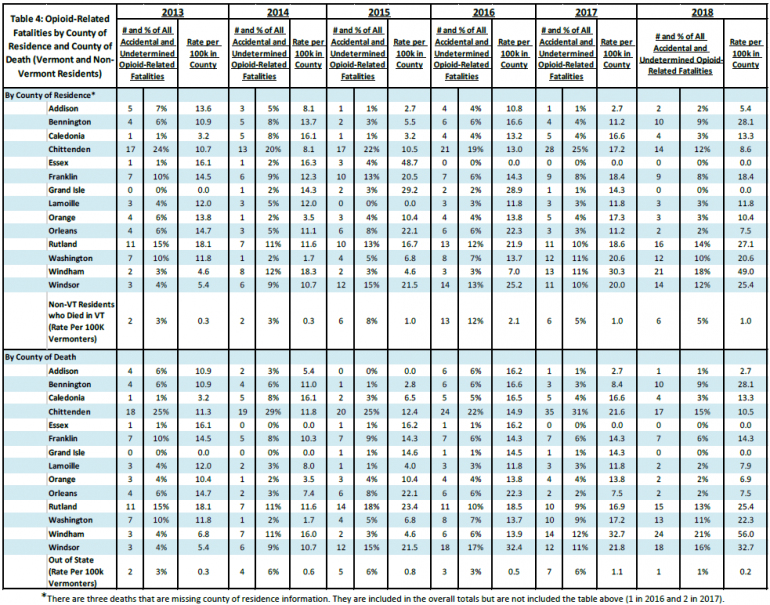
Vermont Business Magazine Preliminary data for 2018 currently shows that nearly all opioid-related fatalities among Vermont residents were of accidental or undetermined intent and that the overall state increase was very small (108 to 110), according to a recent report from the Vermont Department of Health. But the number of fatalities has skewed sharply toward southern Vermont. Opioid-related deaths in Chittenden County were cut in half from 2017 (28) to 2018 (14), but the four southern counties increased 56 percent and more than made up (+22) for the decline in Chittenden (-18).
Windham County reported the most fatalities with 21 (up from 13), Rutland 16 (up from 11), Windsor 14 (up from 11) and Bennington 10 (up from 4). No other county reported an increase. Windham County also had by far the highest per capita rate (49 per 100,000).
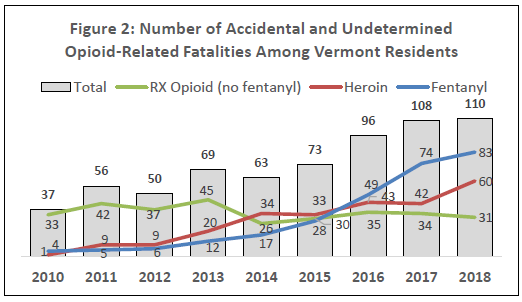
Of the 110 cases in Vermont, both fentanyl (74 to 83) and heroin (42 to 60) saw an increase from 2017 to 2018, while prescription opioids saw a small decline (34 to 31).
Of the total state fatalities, three deaths were determined to be suicides (3% of all opioid-related deaths). Seven non-Vermont residents died in Vermont in 2018 but are excluded from the data analyzed below. At the date of this analysis, the Vermont Office of the Chief Medical Examiner (OCME) has one pending in-state death investigation and two cases pending for out of state deaths.
RELATED STORY: Chittenden County sees 50 percent decline in opioid-related overdose fatalities in 2018
Public attention has been focused on opioid misuse and abuse. All data that follows are accidental and undetermined cause fatalities that involved an opioid. Deaths due to suicide were removed to show deaths more likely associated with abuse and dependence of opioids – the type of death some consider an “overdose.” Preliminary data shows 110 accidental and undetermined cause deaths among Vermont residents in 2018.
At this time, that represents a 2% increase from 108 deaths in 2017. The rate of death in 2018 is 17.6 fatalities per 100,000 Vermonters – a rate that is not statistically different from the 2017 rate. Opioid-related fatality has nearly tripled since 2010, when 37 of these deaths were recorded (5.9 per 100,000). However, in the last few years the rate of increase has gone from 31% (2015 to 2016), to 12% (2016 to 2017) to the current rate of 2% with the preliminary data.
Males comprise 60% of accidental and undetermined opioid-related fatalities among Vermont residents. Women comprise 40% of these deaths. The average age of death is 40 (median 38). Half of these deaths occur among persons between 30 and 50 (51%). Nearly all accidental and undetermined opioid-related fatalities are among white, non-Hispanics (97%).
NOTE: The data tables include place of death and place of residence. These data show county of residence. The data revealing the place of death show somewhat higher totals, but very similar ratios.
Substances Involved in Opioid-Related Fatalities Among Vermonters
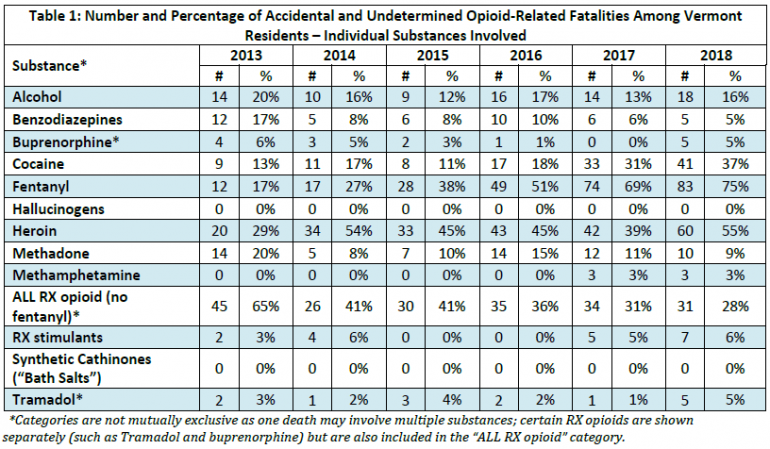
Fentanyl is currently the most prevalent substance involved in opioid-related deaths. In 2018 it was found in 75% of these fatalities and has been increasing each year since 2013. Heroin is the second most common drug, now found in more than half of these deaths (55%); cocaine was found in 37% and RX opioids was found in 28% of 2018 deaths.
 Opioid-related fatalities involving fentanyl have continued to increase since 2010. Fatalities involving heroin initially declined between 2016 and 2017, but Vermont saw an increase in these deaths from 2017 to 2018. Prescription opioid fatalities (excluding fentanyl) have been decreasing, most sharply since 2013. The number of deaths from fentanyl surpassed those involving heroin for the first time in 2016; and both heroin and fentanyl deaths are higher than prescription opioid-related deaths.
Although the figures in this brief refer to increases in fentanyl and heroin separately, many deaths involve both drugs and others. The numbers reported above are specifically presented to indicate how often toxicology testing finds a particular drug in a decedent’s blood.
As stated earlier, most opioid-related fatalities involve multiple substances. The most common combination of substances was involving fentanyl and heroin, which accounted for nearly half (47%) of all opioid-related fatalities. Over one-third of deaths involved fentanyl and cocaine (35%). The third most common combination was cocaine and heroin, found in 21% of deaths. These three substances together – fentanyl, heroin and cocaine – were found in 19% of opioid-related accidental and undetermined
fatalities.
Key Points from the Opioid-Related Fatalities Brief, 2018 Preliminary Data Publication
• The preliminary 2018 opioid-related accidental and undetermined fatality data appears to show Vermont continues to bend the curve on the upward spiral of opioid-related fatalities. There wasa 30% increase from 2015 to 2016 (from 74 to 96 deaths among Vermont residents)and a 12% increase from 2016 to 2017 (from 96 to108). As of February 2019, preliminary data shows a 2% increase in deaths (from 108 to 110).
• Deaths involving fentanyl continue to increase. Fentanyl was found in three out of four opioid-related accidental and undetermined fatalities in 2018(compared to 69% in 2017). The number of fatalities involving fentanyl has nearly tripled since 2015.
• At the same time, the number of opioid-related deaths involving a prescription opioid has remained relatively consistent since 2015 (31 deaths in 2015,35 in 2016, 33 in 2017and 31 in 2018). Given that the number of overall deaths increasedduring this time, the proportion of deaths involving a prescription opioid has decreased considerably (from 41% in 2015 to 28% in 2018).
• Fatalities involving heroin increased in 2018–heroin was found in 55% of all opioid-related accidental and undetermined fatalities (up from 39% in 2017).
• Opioid-related fatalities involving cocainecontinued to increase. Cocaine was present in more than one-third of accidental and undetermined opioid-related deaths (37%in 2018, up from 31% in 2017).
• This brief shows seven additional deaths in 2017 than were reported in the Annual Brief released in March 2018. All seven deaths were Vermont residents who died out of state. Out of state deaths can take up to two years to be finalized in Vermont’s Vital Statistics datasystem. Thus, data is considered preliminary until Vermont has received all out of state deaths. Due to these time lags, the Department of Health expects to revise the 2018 opioid-related death numbers in the future.
• Additionally, as the methodology for defining an opioid-related fatality continues to evolve, Health Department analysts occasionally review past years of data to ensure consistency. This year a review of years 2010 through 2016 resulted in slight changes in previous counts due to strengthened inclusion criteria necessary to define an “overdose."
Note: All of the fatalities assessed and discussed above are “accidental and undetermined opioid-related fatalities."
Source: Vermont Department of Health February 2019