

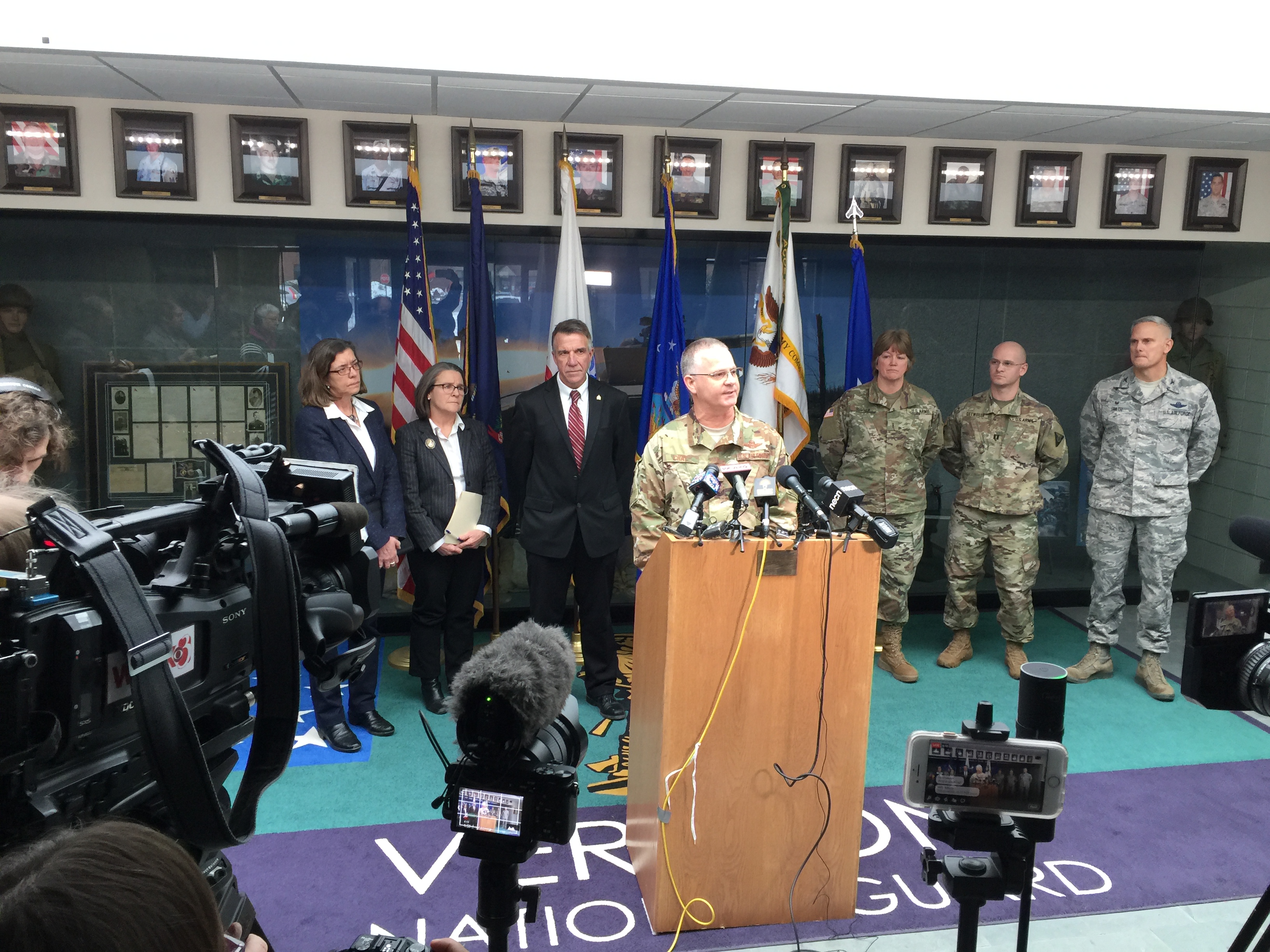
General Steven Cray addresses a press conference at Guard HQ on December 6, 2018. VBM photos
by Timothy McQuiston, Vermont Business Magazine The Vermont Legislature this session will weigh-in on a scathing series of articles last fall that described the Vermont National Guard as a frat house full of womanizing and over-flowing with beer. The Guard bristles at that portrayal and has called the reporting in some respects false and reckless.
Legislators convened the new session last Wednesday. Among their many duties this year will be electing a new adjutant general to lead the 3,500-member Guard. Before the articles by VTDigger.org began to run at the end of last November, General Steven Cray had notified Governor Phil Scott that he would not seek another term. Cray will return to his civilian job as an airline pilot.
Vermont is unique among states in that the Legislature elects the adjutant general in a political process.
 Governor Scott speaks at the press conference, as General Cray listens. VBM photos.
Governor Scott, among others, doesn’t like the process and called it “demeaning.” He said that it probably does not provide all the background needed to make an informed decision.
“It's a flawed process,” Scott said. He would prefer a judicial nominating approach. The Legislature plans to consider changing the process.
In recent memory, the process included a sort-of palace coup by senior Guard officers led by Martha Rainville, which resulted in the Legislature electing Rainville over long-serving Major General Donald Edwards two decades ago.
But in this case, the controversy is over a series of VTDigger stories that described the Vermont Guard under Cray as a place in which, “Leaders have condoned a culture of alcohol abuse and sexual misconduct.”
The stories that VTDigger describes at great length from more than two-dozen sources include impropriety that led the Guard in recent years to remove the head of its Air Force fighter wing and force the retirement of its chaplain.
Another story included in the series described the Guard’s difficulty in recruitment and retention and sources suggested that the Guard intentionally dragged its feet in discharging soldiers in order to artificially bolster its readiness numbers.
The stories cast the Vermont Guard in a salacious light less than a year before basing the controversial F-35 stealth fighter jets in Burlington, scheduled for this fall.
In the series of stories, the Vermont Guard put up little fight in combating the allegations. It also made missteps in how it handled the reporting.
General Cray declined to be interviewed for the stories and the Guard issued a warning to its members not to talk to the press. The Guard briefly banned VTDigger from future press conferences and then quickly reversed its position before any were held, but still incurred the ire of the Vermont press corps.
Governor Scott said he disagreed with the decision to exclude VTDigger.
“I think you all know my feeling,” Scott told the reporters at a tense press conference with Cray shortly after the stories appeared. “It’s about keeping the press open. I think it’s important. I think it’s important for the process and for our democracy. As difficult as it is to face you week-in and week-out, I don’t think I’ve ever excluded anyone.”
On December 6, Governor Scott and General Cray held that press conference in the lobby at Guard headquarters at Camp Johnson in Colchester.
The Vermont Guard covers two campuses, one at Camp Johnson and the Air Guard base at Burlington International Airport. The Vermont Air National Guard employs approximately 930 and the Vermont Army National Guard approximately 2,340. There are also about 130 state employees.
Along with the crush of media in the wide lobby where the press conference was held there were about 50 Guardsmen in fatigues. Scott brought his secretary of administration (Susanne Young) and chief counsel (Jaye Pershing Johnson). The portraits of 14 Guardsmen who had fallen in the line-of-duty are mounted on the back wall of the lobby.
Governor Scott and General Cray were the only ones to speak, first with statements and then in a Q&A with reporters. The press conference lasted nearly an hour.
Scott started off thanking the Vermont Guard for their service and said even in exceptional organizations there will be “the occasional bad apple,” which should not diminish the overall exemplary standard of service displayed by the Guard.
These individual mistakes are the exception not the rule, Scott said, “They do not represent the Vermont National Guard as a whole or reflect the vast majority of members in leadership who serve with honor.”
General Cray has served in the Guard for nearly 34 years and three terms as adjutant general. He also indicated that new measures would be instituted to ensure that woman would feel safe while serving in the Guard. At the time of the press conference, he did not dispute the facts reported in the stories (the Guard sent a response the next day, see below), but was clearly unhappy with the tone of the pieces.
“I vehemently disagree with and dispute the negative characterization of our members and our culture in recent media coverage,” Cray said in a statement. “I believe that through adversity we will continue to grow and improve our organization. While we as an organization have made significant progress in our response capabilities, we are still battling the societal issues of sexism and harassment. The Vermont National Guard is committed to ensuring those who have the personal courage to report harmful bias, acts of discrimination, or crimes of sexual assault are validated and those who are responsible will be held accountable.”
Cray said his office is “always open” to anyone who needed to report a problem and the Guard has its own process as well as being a member of community diversity and sexual assault prevention efforts.
The governor later encouraged any member who did not feel comfortable reporting incidents to the Guard to call his office directly.
Cray said all the incidents mentioned in the articles had been investigated and adjudicated. He said privacy provisions prevented him from discussing the individual cases.
Cray said every organization can improve and he would put in place new policies to increase transparency of cases and their disposition, to bolster sexual harassment prevention efforts, and to work with the Legislature to track the progress of these “action items.”
Cray said that one of the unfortunate outcomes of the VTDigger articles was the public release of confidential personal information. He said he received a complaint from one of the subjects of the articles, described as a victim, who didn’t realize that their information would be made public. The personal information did not come from the Guard, he said.
He said the Guard did and will continue to protect confidential information.
He said all the cases were handled at many levels inside and outside the Guard and “appropriate action was taken.” Governor Scott also said he felt the process had played out fairly.
However, in response to reporters’ questions, Guard spokesperson Lieutenant Mikel Arcovitch sent Vermont journalists an extensive list of issues the Guard had with the stories (SEE LIST AND FULL VIDEO OF PRESS CONFERENCE BELOW).
Among those issues was the Guard’s offer to VTDigger to have its sources sign consent forms to allow the Guard to open its files to reporters.
Arcovitch told VBM that without a signed consent form (“Authorization for Disclosure of Information” approved by the Judge Advocate General), the Guard was “prohibited” from releasing any personnel information regarding the individuals central to the stories. That information would include detail on why certain individuals, including the chaplain, the wing commander and a whistleblower, were either retired, demoted or dismissed.
Despite a lack of transparency on the Guard’s part being a central issue in the series, the VTDigger stories never mentioned the offer of the consent form.
VTDigger editor Anne Galloway, in an email exchange with VBM in December regarding the waiver and transparency, said they could not get any of the sources they approached to sign the consent.
She did not address why the Guard’s offer was not mentioned in any of the VTDigger stories.
“As we reported,” Galloway wrote in an email, “we made repeated efforts to get comments from the Guard and its leadership over a period of three weeks.
“As for the consent forms, we reached out to the subjects of the investigations directly, including in some cases going to their homes or place of employment.
“The Guard made clear early on they would not comment on investigations, turned down repeated requests for an interview in person or on the phone, and provided limited answers to a series of written questions. After several weeks of attempts, the Guard raised the issue of consent forms as we were about to publish and had already reached out to the subjects directly.
“At that point, VTDigger had been seeking interviews with key Guard members named in the series for weeks. Almost without exception, our calls for comment with these individuals were not returned.”
Arcovitch sent Galloway the consent form on November 20. The stories began to appear on VTDigger.org on November 25, the Sunday after Thanksgiving.
 VTDigger Stories
The flying fraternity: A ‘Top Gun’ culture pervades the Vermont National Guard
The flying fraternity: Guard commander’s wings clipped after secret rendezvous
The flying fraternity: Africa, alcohol and the Afterburner Club
The flying fraternity: Ghost soldiers of the Vermont National Guard
The flying fraternity: Female Guard members claim barrage of harassment
The flying fraternity: Chaplain’s female assistant claims coercion
The flying fraternity: Whistleblower says Guard retaliated against him
The Legislature
Every two years the Legislature in a joint session elects the adjutant. This is typically a simple task of renewing the term of the current general. Vermont is the only state to elect its Guard leader in this manner.
Governor Scott opposes this method and made his feelings known in uncertain terms during the press conference.
Scott also said that he anticipated the Legislature would want to pursue these issues further, beyond the election of a new adjutant general, and into the accusations by former soldiers and airmen found in the VTDigger articles.
Senate President Pro Tem Tim Ashe (Chittenden- D/P) was asked by VBM if the Senate would hold hearings on the matter.
In an email exchange, Ashe said: “Our Government Operations Committee will hold hearings on the current policies and reporting requirements regarding discipline, workplace harassment and equity issues to determine if any changes are merited. I will also be asking the committee to evaluate the current process for selecting the Adjutant General. While I support the Legislature making the selection, I believe we can improve the process by creating a process similar to what’s in place to screen judicial applicants.”
The process has been without controversy for more than 20 years. But in 1997, Martha Rainville, a major on the Air Force side, challenged General Edwards, who was regular Army, served two tours in Vietnam, graduated Norwich University and was a legislator himself before running successfully for the Guard post in 1980.
Edwards had the reputation of being a hard-nosed soldier. Rainville, 38, was Air Force and a generation younger.
Rainville became the first woman adjutant general in the history of the National Guard.
Rainville wasn’t the highest-ranking officer but many of her Guard peers rallied around her and held their breath, because, as now retired Lieutenant Colonel Scott Baldwin told VBM in a profile on Rainville in 2005, “We were worried about our jobs," Baldwin said. "If we didn't win, it wasn't going to be pretty."
Rainville told a furious Edwards she was running and then lobbied the Legislature and won by a wide margin. But it was a bitter contest that left a bad taste in the mouths of many lawmakers from Democratic Speaker Ralph Wright to Republican Senator Vince Illuzzi.
Edwards went on to serve on US Representative Bernie Sanders’ staff before retiring himself. He died at 81 at his home Maine in August 2018.
Rainville’s tenure, meanwhile, was marked by 9/11 and she was widely praised inside and outside the military.
When Sanders moved up to run for US Senate in 2006, Rainville sought his seat and ran as a Republican against Peter Welch in a spirited contest. Welch prevailed and hasn’t faced as stiff a test since.
Following Rainville as adjutant was Michael Dubie, brother of Lieutenant Governor Brian Dubie. The brothers were both Air Force pilots. It was a smooth transition as was the one to Steven Cray in February 2013.
Cray will step down in February. There had been rumors that Cray was being forced out because of the VTDigger articles.
Scott confirmed that General Cray had told him about three months prior to the December press conference that he would not seek another term.
Cray said he was retiring. He said in December that there didn’t seem to be another position in the Air Force that he thought was a good fit for him as he was resuming his position with American Airlines.
Whoever will be the next leader of the Vermont National Guard will face a phalanx of questions and demands on conduct within the two campuses of the sprawling military base.
Response from Vermont National Guard regarding VTDigger articles
December 7, 2018
Ladies and Gentlemen of the Media and Vermont National Guard Service Members:
After yesterday’s press conference we felt it was important to clarify several points. The paramount point is that law and military regulation prohibit the VTNG from disclosing specific details about its personnel actions. Do not misunderstand this to be a way of avoiding open discussion. There are both civil and criminal ramifications if the Privacy Act or HIPAA or certain military regulations are violated.
Yesterday there were questions that asked whether the TAG disagreed with the tone of the VT Digger series of articles, and its characterization of the VTNG culture, or whether he disagreed with the facts as reported by the VT Digger. There were some back and forth questions and answers about the subject that may have confused some or all. In the interest of ensuring that there is no misunderstanding, the TAG wishes to clarify that he does not agree with the accuracy of how VT Digger characterized the culture of the VTNG; and he does not agree with the tone or environment described in the VT Digger articles. Additionally, several matters reported as facts by VT Digger in its several articles were false, partially true, exaggerated, ignored whole aspects of the facts, or a combination of one or more of these. The following items are examples of the mischaracterized or misrepresented facts in the several VT Digger articles and is not exhaustive. There are more examples which may or may not be shared, depending on law, rule, or regulation.
1. The suggestion that the VTNG or the VTANG retaliated against Lt Col Rector is false. VT Digger knew or should have known that the VTNG is prohibited from discussing employment matters protected by the Privacy Act. The VTNG provided VT Digger with a consent form (via certified mail) which it made clear it would have honored. Had VT Digger presented it to Lt Col Rector for signature, the VTNG would have been able to freely and openly discuss the facts alleged by VT Digger in its several articles. The VT Digger either disregarded the form, or Lt Col Rector did not sign it. If Lt Col Rector grants the VTNG permission, the VTNG remains ready and willing to discuss all details concerning the underlying matter.
2. The assertion that witnesses were gagged and kept from talking is false and recklessly ignores that in litigated cases, parties are represented by counsel, ethics rules forbid counsel from talking to represented clients, and law and regulation requires a Judge Advocate to impose limitations on the release of official information as to its form, content, or use. Limitations may include, but are not limited to: releasing information in paper or non-native electronic formats; redacting information due to privilege or some other protection; approving only limited topics to be covered in testimony; ensuring all parties acknowledge witnesses do not bind the United States or the Air Force, if appropriate; and any other reasonable limitations or restrictions. Judge Advocates may accompany witnesses to an interview, deposition, or hearing and advise them concerning the release of official information and the assertion of any applicable privileges or protections held by the Air Force. Moreover, and in any event, the VTNG merely coordinated and did not prohibit anyone from talking to any witness.
3. The suggestion that Lt Col Rector was denied due process is false. The Technician Personnel Regulation (TPR) 752 hearing process, which is presided over by an Officer from outside Vermont and who is officially appointed by the National Guard Bureau in Washington D.C., governs employment adverse action appeals, including discovery and disclosure, the calling of witnesses, and the presentation of an employee's case. The VT Digger should have known about the existence of this process as it is a matter of public record and could have discovered it with a minimum of effort.
4. The allegation that the VTNG "allowed" certain employees to leave without discipline or in other cases, stripped the employee of his or her retirement and benefits, is another item recklessly presented by VT Digger as fact. Technician Personnel Regulation 715 governs, among other things, resignations and voluntary and non-disciplinary actions in the National Guard Technician Program. And 5 CFR Part 715 governs separation actions requested by employees in the executive departments (and others) of National Guard Technicians. Resignation in order to avoid an adverse action proceeding is not allowed by 5 CFR 715.202 (b). Collectively, these regulations (as well as others) dictate what the VTNG (or the National Guard of any other State) can and cannot do. This too could have been learned by VT Digger with a minimum of effort before inaccurately suggesting that the VTNG can somehow strip an employee of benefits and retirement that have vested. Had VT Digger diligently inquired about these processes, it could have accurately represented the VTNG in its several articles.
5. One of the articles also inaccurately states, "In 2010, Rector was appointed to serve as the Burlington Wing's Sexual Assault Response Coordinator (SARC), a position that involved investigating credible allegations of sexual impropriety." The role of the SARC, however, is to provide advocacy services to the survivor through their healing process following a report. This may include communicating to the survivor updates on the investigative process. In no way is the SARC authorized to investigate, or even to evaluate whether or not an allegation is credible. To do so would be dereliction of duty.
6. Similarly, the number of cases described in the articles did not accurately portray the facts regarding sexual misconduct. It is true that if added up, the number of cases depicted in each Legislative report add up to 35, not 31, as described. However, survivors have the option of converting a restricted, or confidential report, to an unrestricted report in order to involve the chain of command and initiate an investigation. Twice, survivors converted cases in a different Fiscal Year than the one they had originally reported in. Thus, the same case was represented in multiple reports. During the period described, the VTNG had 33 unique cases between 2012-2017. Fourteen (14) of those 33 identified a Vermont National Guard service member as the alleged offender. Nineteen (19) of those 33 referred to incidents prior to 2013. It is incomplete to simply state the number of cases received during any given time without looking closer at the context of those cases.
7. One of the articles published a chart titled: "Sexual misconduct at the VTANG" (Article 5). But this title inaccurately suggests that the total number of reported assaults occurred in a smaller pool of people (i.e., the approximately 1000 Airmen in the VTNG) when the reality is that the number of these reported assaults actually occurred in a much larger pool of personnel—nearly 3 times larger—which included both Air and Army personnel. An accurate title that does not recklessly disregard the true numbers would be: "Sexual misconduct reported to the VTNG."
8. One or more of the articles referenced that Guard leadership allowed a Service Member to “ride off into the sunset...." This is not factually accurate. In accordance with law and regulation, the Vermont National Guard does not have the authority to administratively discharge individuals with 18 or more active years of service. The decision authority for this level of action is the Secretary of the respective service (Air or Army), and outside the authority of the VTNG.
9. The suggestion that one of the VTANG pilots was allowed to fly a fighter jet to the Washington D.C. area in order to engage in improper behavior is absolutely false. In 2014, Air Force regulation allowed Wing Commanders to fly a jet to attend a commanders’ conference under certain circumstances. Those circumstances were present when the person identified in the article flew to D.C. Once at the conference, attendees are further prohibited by law and regulation from engaging in many things that are personal in nature.
10. Finally, over the several articles, the VTNG was falsely depicted as operating without oversight. This is also absolutely false. The VTNG is subject to fiscal oversight by the United States Property and Fiscal Officer, who is a member of the Active component under Title 10 of the United States Code (the VTNG is comprised almost exclusively of members of the Reserve Component under Title 32 of the United States Code and of State employees). Similarly, the Active component has a Title 10 Inspector General embedded within the VTNG to ensure regulatory compliance. VTNG Judge Advocates (lawyers) are subject to oversight by The Judge Advocate General of the Army and The Judge Advocate General of the Air Force, and by the Bar licensing authorities of their respective States. In addition, there is further and direct oversight from the Secretaries of the Army and of the Air Force over all Soldiers and Airmen.
VBM NOTE: The consent form was attached to an email.