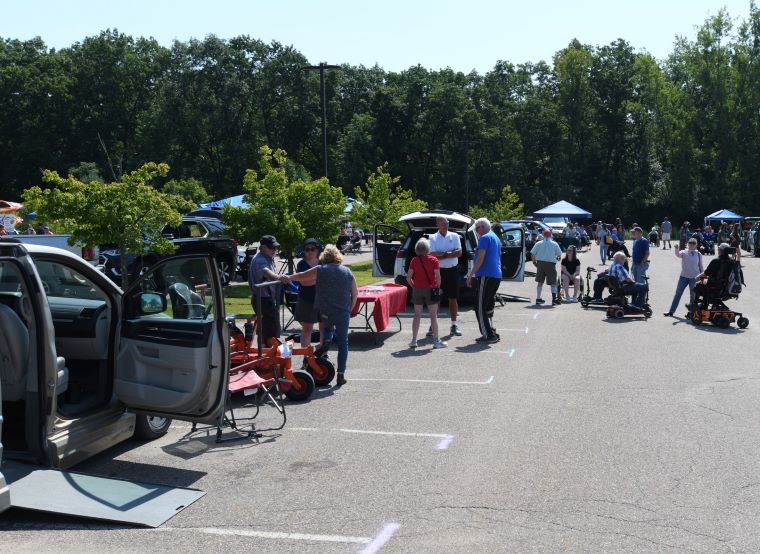
Vendors, patients and users of adaptive technology across a wide variety of motor vehicles gathered Saturday on the Fanny Allen campus, to participate in a car show highlighting adaptive technologies used to modify cars, vans, trucks and recreational vehicles. The event was hosted by University of Vermont Medical Center’s Driver Rehabilitation Program. UVMMC photos.
UVM Medical Center’s Driver Rehabilitation Program serves those who, due to injury, physical limitations or medical issues, use adaptive technology to safely and effectively operate motor vehicles
Vermont Business Magazine Leading-edge technological and mechanical systems were on display at the Fanny Allen campus in Colchester on Saturday, as UVM Medical Center’s Driver Rehabilitation Program and Trauma Survivors Network hosted an Adaptive Car Show, shining a light on the often-novel and little-known equipment, specialized training systems and rehabilitation programs that help individuals with physical limitations and other clinical needs enjoy – or recapture – the ability to safely and effective drive.
More than a dozen adaptive vehicles crowded the College Parkway parking lot on Fanny Allen’s campus amid a festival atmosphere that brought adaptive car owners together with clinical specialists, community programs supporting individuals with adaptive motor vehicle needs, and visitors eager to learn more about how adaptive vehicle technology works and the wide range of injuries and conditions served by the hospital’s Driver Rehabilitation Program.
“What most people don’t know is that the need for this technology and training is huge,” said Suzanne Vetter, one of two Occupational Therapists who staff UVM Medical Center’s program. “At driver rehab, we see people before they can drive and after a serious injury. Our job is opening the road to independence.”
Adaptive vehicle technology spans a wide range of training systems, programs and vehicle modifications designed to directly address issues that include reduced range-of-motion and general physical limitations, to clinical conditions that range from glaucoma and ocular issues to progressive and degenerative disorders such as multiple sclerosis and Parkinson’s disease.
“So many people benefit from these technologies and training – and so many more could,” said Abby Beerman, Coordinator of Injury Prevention and Trauma Services at UVM Medical Center, who oversees the Trauma Survivors Network and partnered with the Driver Rehabilitation Program to co-host the event. “When people have a need for adaptive technology there are often those that feel uneasy using it, because there’s a stigma around it. Others simply don’t know it exists or how it could benefit them or others in their life. Today is about celebrating and normalizing these incredible technologies and the positive impact they create.”
The 18 adaptive vehicles on display Saturday included cars, vans and other on-the-road vehicles, as well as off-the-road vehicles like an adaptive kayak and an adaptive race car. The vehicles utilize technology that ranges from modifications nearly every has seen –wheelchair lifts and other adaptations meant to serve those with limited mobility – to novel mechanical systems like hand controls that enable individuals to drive without the use of their legs.
Vetter, who in her capacity as an occupational therapist at the Driver Rehabilitation Program works with everyone from quadriplegics to individuals with an Autism diagnosis, said the program’s mission goes much deeper than simply outfitting people with novel mechanical systems or providing them with advanced training and evaluations to determine whether they are a candidate for adaptive vehicle technology.
“One of our primary goals is to connect people to each other,” she said. “We work with local ophthalmologists to serve patients with vision issues; we do clinical evaluations for patients with memory issues and serious injuries; we work across all stages – from kids who are learning to drive for the first time, to older individuals whose ability to drive has become compromised by one thing or another. We have so many people who use this technology that don’t know each other, and we really want to develop a community and raise awareness.”
UVM Medical Center’s program, which serves about 100 active patients and has a substantial waiting list for evaluation and training services, includes two occupational therapists, two adaptive cars outfitted with a variety of technology and used for special driving instruction courses, and an advanced driving simulator that is used for both driving practice and patient evaluations. The program also uses a lineup of more mundane equipment, like physical, visual and cognitive tests which are used to determine whether individuals could safely drive using adaptive technology.
“This program is such a great opportunity to serve people and address a huge need in our community,” said Vetter. “That’s probably my favorite part of the job; you get to help people open this door and step through into freedom. It’s meaningful and exciting, and there is a lot to do.”
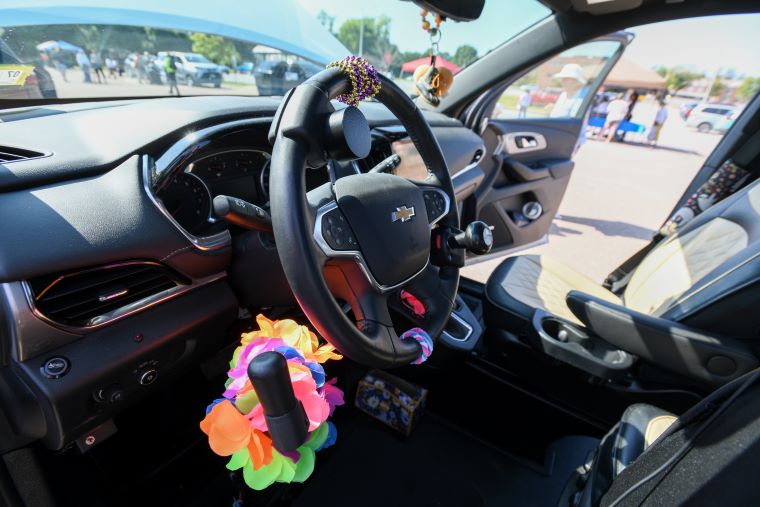
The interior of a Chevrolet truck modified with adaptive steering controls was among more than a dozen vehicles on display Saturday, when University of Vermont Medical Center’s Driver Rehabilitation Program hosted an Adaptive Car Show on the Fanny Allen campus.
About the University of Vermont Medical Center
The University of Vermont Medical Center is a 499-bed tertiary care regional referral center providing advanced care to approximately 1 million residents in Vermont and northern New York. Together with our partners at the Larner College of Medicine at the University of Vermont and the College of Nursing and Health Sciences, we are Vermont’s academic medical center. The University of Vermont Medical Center also serves as a community hospital for approximately 150,000 residents in Chittenden and Grand Isle counties.
The University of Vermont Medical Center is a member of The University of Vermont Health Network, an integrated system established to deliver high-quality academic medicine to every community we serve.
Source: The University of Vermont Health Network UVMHealth.org
To support vital journalism, access our archives and get unique features like our award-winning profiles, Book of Lists & Business-to-Business Directory, subscribe HERE!