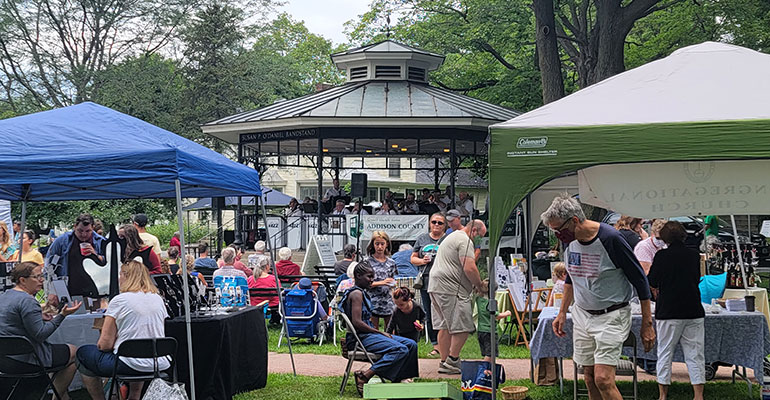
Photo: Celebrating the 41st annual Vergennes Day. Courtesy photo.
by Olga Peters, Vermont Business Magazine Gone are the days of simply returning to pre-pandemic normalcy for Addison County businesses. Their sights are set firmly on the future, actively seeking the next stage of growth.
“Our goal at the chamber, and I believe for all business organizations here in the county, is to move beyond pre-pandemic levels,“ said Phil Summers, executive director of the Addison County Chamber of Commerce.
Amey Ryan, owner of IPJ Real Estate based in Middlebury, enthusiastically describes Addison County as “like heaven on earth.“ She cites several reasons for this:
A strong farming community.
A network of locally owned businesses.
Healthy institutions such as Middlebury College and Porter Medical Center.
Three vibrant Shire towns — Bristol, Middlebury and Vergennes — where a business fills almost every downtown storefront.
Manufacturing and other large businesses that attract workers from across the country.
“It feels very quintessential Vermont,“ Ryan added. “And it’s a little bit of a melting pot of people from everywhere.“
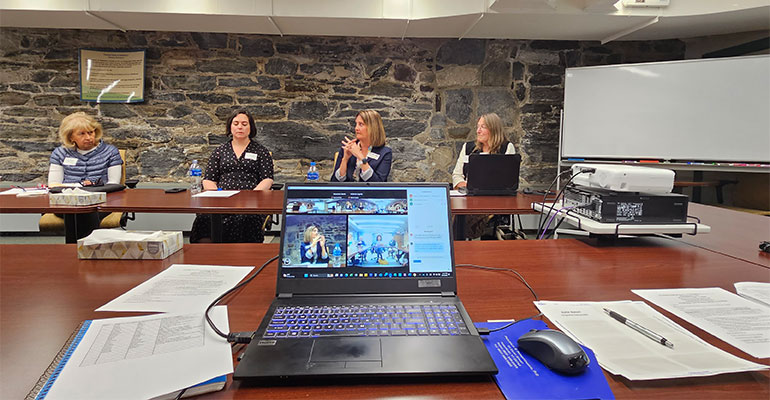
Photo: The Addison County Chamber is considering expanding its training webinar offerings. Courtesy photo.
Addison County, Vermont’s fourth-largest county with a population of 37,363, boasts a remarkably diverse economic landscape. Farms, value-added food producers, manufacturers, colleges, healthcare providers, restaurants and hospitality businesses all contribute to the county’s thriving economy.
According to the U.S. Census Bureau, Addison County has a median household income is $85,870, which is higher than the state average, and a poverty rate of 7.5%, which is lower than the state rate of 10.4%.
The sector employing the most people is educational services, health care and social assistance, which accounts for 28.9% of the workforce. Both manufacturing and retail employ just over 11% of workers in the county.
Addison projects, expansions, and the good news along with the challenges
It’s worth noting that the sector categorized by the Census Bureau as agriculture, forestry, fishing, hunting and mining employs 5% of workers, placing it in the middle of the county’s industry rankings. However, in conversations with Addison County residents, agriculture is often highlighted as one of the county’s key economic drivers and, perhaps more importantly, a significant social asset.
Like many Vermont communities, Addison County faces challenges related to a lack of housing, child care and workers. However, Fred Kenney, executive director of the Addison County Economic Development Corp., remains optimistic. He points to positive developments like new housing projects and the expansion of the Otter Creek Child Center as signs of progress.
“The good news is that the challenges are, in most cases, balanced by some good news and the projects that are happening,“ Kenney said.
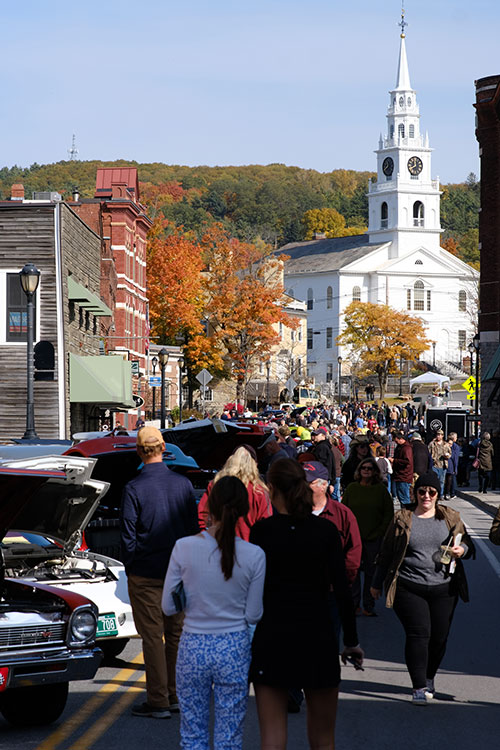
Photo: Middlebury Car Show. Courtesy photo.
A Steady Economy Reaching a New Normal — With a Caveat
Kenney emphasizes the county’s fortune in having a robust group of midsized entrepreneurs who own and operate their businesses locally. This local ownership, he notes, fosters a vested interest in both the economic and social well-being of the community.
Kenney acknowledges, however, that not every sector has experienced the same level of recovery from the pandemic. While some sectors have returned to pre-pandemic operations, others have had to adapt and implement new business practices.
The restaurant and hospitality sectors, for example, introduced new ways to interact with customers and adapted new technologies like touchless check-ins and curbside pickup to maintain service while ensuring safety.
Many other employers developed new approaches to hiring and retention. Remote work has revolutionized the modern workplace, and attracting millennials and younger generations now demands innovative approaches from employers.
“The way that generation thinks about work and thinks about businesses is so different than people from my generation, we just had to take that into account,“ Kenney said.
Realtors and restaurant owners are still grappling with the lingering effects of the pandemic economy, Summers observed. Despite these challenges, he expressed optimism for the future.
“As a community, we feel like we’re reaching a point of comfort and are eager to start growing businesses and taking them to new heights.““
Workforce Issues Persist
Addison County’s workforce dilemma poses a complex challenge. While many businesses are eager to hire, they face a twofold obstacle: a limited pool of qualified Vermonters available for employment and a lack of affordable housing options for potential newcomers.
“I’ve been in the restaurant business close to 30 years, and one of the most challenging, frustrating and expensive things is staff turnover,“ explained Ben Wells, who owns the Middlebury Marquis Theatre, an independent, two-screen movie theater with a Southwestern-themed restaurant and bar on Main Street in Middlebury. “If you’re constantly trying to hire and train new people, that’s time and energy not spent improving something else.“
Wells has adopted a policy of prioritizing the hiring of individuals who are kind, intelligent and have a positive attitude, fostering a fun and engaging work environment. He generally experiences positive outcomes with staffing, with several employees at The Marquis having remained with the business for years. After a brief period of lower staffing levels, employee numbers have rebounded, although Wells noted a decrease in job applications during the spring.
The Vermont Department of Labor reported in June that the Middlebury labor market boasted an unemployment rate of 1.9%, slightly below the state’s 2.1% rate.
According to Summers, businesses across all sectors have faced difficulties finding workers since 2020. However, the ways in which industries have adapted to this labor shortage vary significantly.
In Summers’ experience, some sectors, like manufacturing, have implemented changes to their production systems, enabling them to maintain output with fewer employees. Conversely, public-facing businesses, such as restaurants, have been forced to reduce their operating hours due to the lack of available staff.
“We are still faced with situations where a lot of our restaurants, a lot of our retailers, are still not open at pre-pandemic hours,“ Summers said.
Ned Horton, owner of Otter Creek Bakery stores in Middlebury and East Middlebury, along with Hare and the Dog liquor stores in Middlebury and Vergennes, noted that many of his employees relocated to Addison County during the pandemic and have expressed satisfaction with their decision to do so.
“I’ve got two managers from different businesses who moved here from New Jersey,“ Horton said. “I feel fortunate to have found them, and they’ve become an integral part of the community. They’ve invested in some land and are doing some level of farming.“
Horton, who also owns a property investment, management, and real estate marketing firm with offices in Vermont, Maine, and Tennessee, expressed his optimism about the Addison County economy, noting its “solid base of businesses and entities that have been here a long time.“ He noted, however, that the number of workers seeking less than full-time employment has recently increased.
“We’ve replaced some staff members that were full-time with two people that weren’t looking for full-time,“ Horton said.
Vermont has a reputation for being tough on businesses. Both Summers and Wells believe this reputation is well-deserved.
Summers recalled his experience managing a sports facility in Virginia, where the county manager actively supported his initiatives and helped bring ideas to fruition. Summers clarified that this support was not based on any illicit favors but rather stemmed from the county’s commitment to fostering economic prosperity.
“The difference between there and here is pretty dramatic,“ he said.
Wells believes that Vermont imposes more regulations, fees and stricter restrictions compared to other places, making it more difficult to generate profit and often causing frustration for business owners.
He illustrated this point by citing the example of purchasing alcohol. In Colorado, where Wells previously owned a restaurant, the state allowed direct negotiation between restaurants and distributors regarding alcohol prices. However, in Vermont, such negotiation is not permitted, and establishments are often unaware of the wholesale prices, which can significantly impact already narrow profit margins.
“I think people want to be out. They want to be socializing. They want to change it up,“ Wells said. “I believe strongly in gathering spaces. We’re social creatures.“
The rising costs of goods have presented a challenge for Wells, who is committed to maintaining affordable prices for young families. While he has strived to absorb these increased costs, some price adjustments have been unavoidable. However, Wells has managed to avoid raising the price of movie tickets, prioritizing accessibility for families.
“I do my best to keep pace with living wages (for employees), but I can only charge so much money for popcorn, candy and tacos,“ he said. “If I want these items to be affordable for our guests, I can also only pay employees so much. Everything’s connected.“
Flooding and Resiliency
Vermont’s geography has posed unique challenges for Addison County business owners, who have experienced several floods and a surprise freeze in recent years. Adam Lougee, executive director of the Addison County Regional Planning Commission, noted that the county’s predominantly flat terrain makes it more susceptible to widespread flooding compared to the mountainous areas of the state, which mainly experience damage to road infrastructure.
Otter Creek’s numerous wetlands have effectively absorbed excess stormwater, protecting downtowns from the severe damage experienced by cities like Waterbury, Montpelier or Barre.
“Most of those floodplains are protected, and they’re not going away,“ Lougee said. “It’s just a question of how the weather changes.“
Resilience is a key focus in the commission’s discussions with its member towns
Lougee stated these communities have done extensive work in the last five years, including installing stone-lined ditches and increasing the sizes of culverts on their roads. Ripton, one of the towns hardest-hit during Tropical Storm Irene, has seen the benefits of these upgrades to its road and culvert infrastructure.
The regional planning commission has encouraged its member towns to apply for the $90 million in Federal Emergency Management Agency funding available statewide for the construction of flood mitigation projects.
Kenney emphasized that any economic sector reliant on natural resources or water, such as agriculture or recreation, or situated in a downtown area, must prioritize resilience and sustainability. He noted that relocating heating and electrical infrastructure, along with excess inventory, from basements to attics is a crucial measure in this effort.
“We have to think about how we’re going to develop housing and grow businesses when the locations in which we can develop are getting more and more limited by those (natural disaster) impacts, and by the regulations that are getting developed because of those impacts,“ Kenney said.
The EDC and chamber of commerce plan to expand their regular seminar offerings to include sustainability and mitigation training, likely in collaboration with the federal Small Business Development Center.
Home Sweet Home
Addison County’s housing market is currently facing significant challenges with an extremely low inventory, according to realtor Ryan. As of July, she reported only 49 residential listings for the entire county, a stark contrast to the pre-COVID numbers which would have been closer to 250.
Ryan noted a shift in the market, with price reductions, longer listing times and buyers opting for bank financing and requesting protections like home inspections. Overall, she views trends like increased home inspections as positive, believing that the more informed a buyer is about a property, the better equipped they are to make a sound decision.
Ryan described the county’s housing market as “softening“ due to a shrinking pool of buyers, many of whom are experiencing “buyer fatigue“ after prolonged unsuccessful searches.
She emphasized the wide range of prices in Addison County’s current market, stating, “The price of the 49 residential properties currently available range from a $59,900 deer camp in Goshen to a nearly $6.8 million lakefront property on Kimball Dock Road in Ferrisburgh.“
While Ryan believes the housing market has moved beyond the frenzy of the COVID-19 pandemic, some houses are still selling above asking price, contributing to inflated prices.
Of the 49 properties currently listed in the county, nine are priced above $1 million. Ryan and her colleagues have observed a notable increase in million-dollar sales since the pandemic began.
Coldwell Banker Hickok & Boardman’s 2023 year-end market report for northwest Vermont reveals a significant shift in Addison County’s housing landscape since the pandemic. Overall, prices have surged by 42%, while the number of available units has declined.
Specifically, in 2020, the county saw 377 single-family homes sell with a median price of $285,000. By 2023, the median sales price had risen to $404,000, despite a decrease in sales to 278 units.
For some homeowners, a shift in work arrangements is prompting a move. They initially purchased properties four years ago with the understanding of remote work, but their employer has since mandated a return to the office. Ryan is currently assisting around a dozen clients in relocating to be closer to their workplaces.
Like many communities, Addison County is grappling with a shortage of affordable housing for workers, often referred to as “missing-middle housing.“ This lack of suitable options poses a significant challenge for both residents and employers.
“We really have zero entry-level housing,“ Ryan said. “Even a condo that might have been entry-level housing a few years ago is now selling for the mid-twos ($250,000) to almost three ($300,000).“
She added that someone fresh out of school, earning $65,000 a year with no down payment, couldn’t afford a house with a $6,000 tax bill.
“Doesn’t it seem crazy to have a two-bedroom condo that you paid $300,000 for, and your tax bill is $6,000?“ she asked.
Paying 30% of one’s household income towards housing is generally considered affordable by housing experts. However, in Addison County, 14% of households are severely cost-burdened, with housing costs exceeding 50% of their income, according to HousingData.org. Additionally, 17% of households pay between 30% and 49% of their income towards housing.
Summers, of the Addison County Chamber, recalls a poignant encounter at Vergennes Day last year with a young man struggling to find housing and had resorted to sleeping in the town’s gazebo on the green.
“A real nice kid He had a bike, and he said he had just gotten a job about two weeks ago at one of the car dealers or a gas station, basically doing mechanic-type work,“ Summers recalls. “He hadn’t been able to find an apartment or any place to live.“
After Summers offered a few suggestions, the young man replied, .“Well, if I can’t find something pretty soon, I’m just going to have to go back home.““
When Summers returned to the gazebo a week later, the young man was gone.
“Those are the folks that are hurt the most by this housing crisis,“ Summers said. “It’s the people working in the trades and trying to come here and get a job.“
In Ryan’s view, the county’s economic challenges are primarily rooted in housing and child care issues. She attributes the obstacles to improving housing and child care to stagnant or ineffective legislation that either mandates unattainable goals or operates on overly restrictive timelines.
“As I’ve said for years, if we could fix the housing and child care issues in this state, we’d probably be in a better place,“ said Ryan, who is commemorating her 25th year in the real estate business.
Wells, owner of the Marquis Theatre, noted that many of his employees who wish to buy a home have been priced out of the market. He highlighted the difficulties faced by employees commuting to Middlebury, as movie theaters and restaurants typically operate late into the night, and people are hesitant to drive home in adverse weather conditions, such as snowstorms.
According to the Vermont Housing Finance Agency (HousingData.org), the majority of Addison County residents commute between 15 and 29 minutes each way to work.
Ryan added that the county also faces a shortage of elderly or age-appropriate housing, leaving many residents who wish to downsize feeling trapped in their current homes.
Summers identified the high cost of construction as a major obstacle to affordable housing. He explained that builders can only create affordable units if developers have access to state funding. However, he noted that some residents prioritize preserving Vermont’s existing landscape and actively oppose new housing development.
“Without some change, the state isn’t going to have anybody here to work,“ he said. “They’re going to be really upset when their favorite restaurant is only open on Saturdays.“
Ryan questions whether recent increases in education taxes and municipal costs may prompt a reevaluation of previously halted economic development projects and housing developments.
Kenney estimates that Addison County requires at least 800 or more housing units annually to meet the projected demand. However, he remains optimistic, noting that development is indeed occurring..
Keeping an Eye on Act 250
Member towns of the regional planning commission are closely monitoring the recently passed Act 181 (H.687) with keen interest. Act 181 introduces a three-tier system for determining Act 250 jurisdiction and temporarily exempts some housing developments from the permit process while the new Land Use Review Board establishes the tiers.
Lougee noted that the commission’s member towns are curious about how the Legislature’s recent changes to land use regulations will impact the county’s more rural communities.
“The towns without water and the wastewater infrastructure — and in our mountain towns that are probably between 75% and 95% covered with forest — are concerned about some of the new criteria around habitat connections and the forest blocks, and how that might impact their ability to do anything in the more rural economy,“ Lougee said.
Lougee clarified that the changes in land use regulations are not meant to hinder the ability of rural communities to develop housing or businesses. However, Act 181 may inadvertently create stronger incentives for development in compact downtowns, potentially leading to less development in rural areas.
He acknowledged the concerns of rural communities, stating, “While there’s no intention to harm rural communities, the incentives are structured in a way that could encourage development to concentrate elsewhere. This is a valid concern.“
Kenney is keeping an eye on the potential impact of updates to the state’s land use code on new housing development. He expressed skepticism, stating, “We need to develop all types of housing, and I’m uncertain if the recent changes will facilitate that.“
He cited a housing development in Vergennes as an example, noting that the developer has successfully built 10 units and plans to construct another 10 soon, with ambitions for an additional 100 units in the future. However, due to the legislative changes, Kenney believes the developer may be forced to cap the project at 75 units.
“Seventy-five units will help, but the developer wants to build 100,“ Kenney said. “It’s in a location near downtown where people agree housing is needed, and even the recently passed legislation acknowledges that we want housing in such areas.“
Kenney explained that at 76 units, the project would trigger the Act 250 permitting process, leading to delays and increased costs. Therefore, the actual limit on the project’s size is determined by the developer’s willingness to navigate the Act 250 process. In Kenney’s opinion, most developers will avoid this process if possible.
Lougee added that with the significant focus on housing in recent years, both by the Legislature and the community, the only way to achieve denser housing is to provide necessary community infrastructure, such as water and wastewater systems. Only Middlebury, Vergennes and a small section of Bristol, Orwell and Shoreham have wastewater systems, he said.
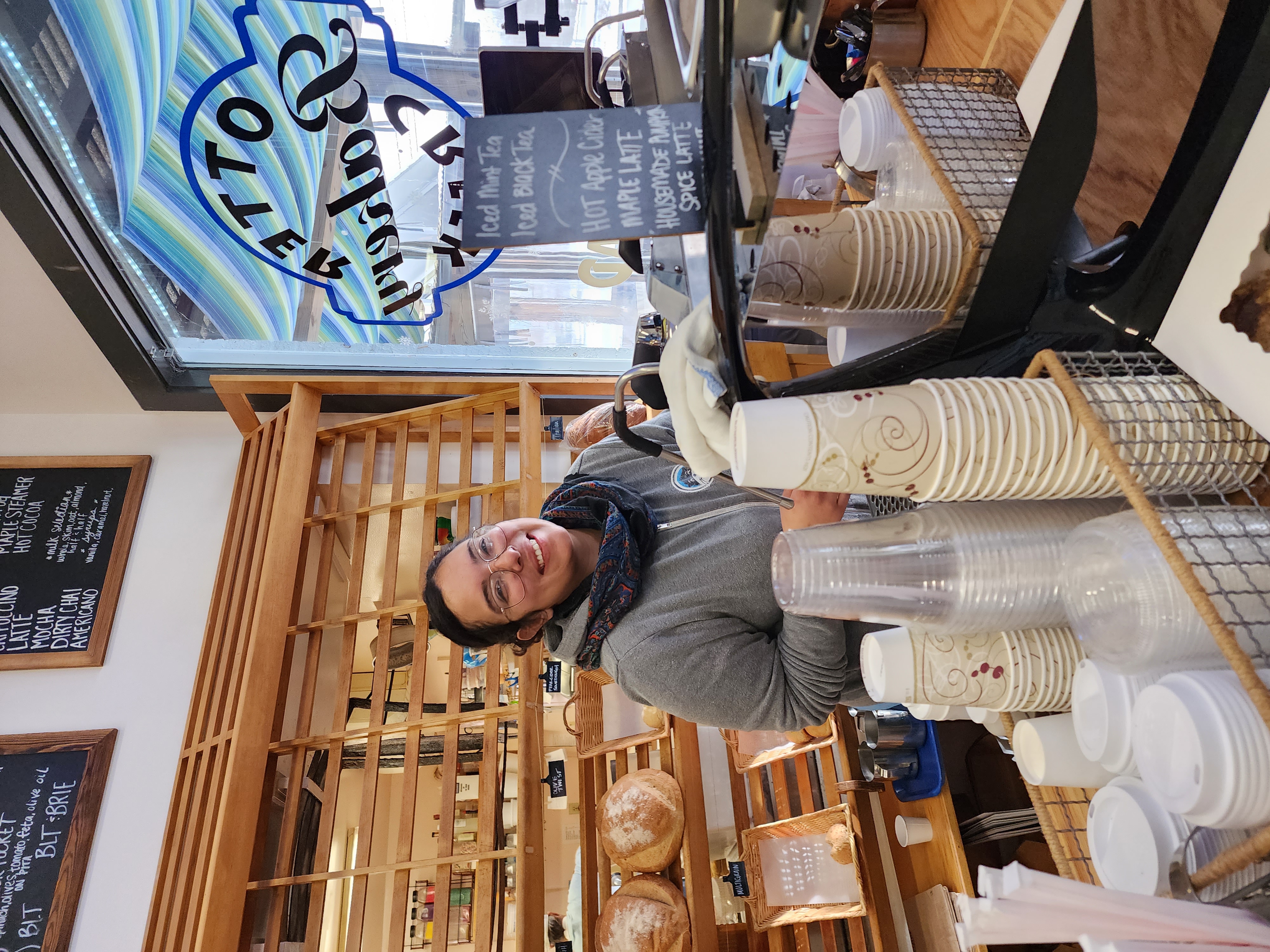
Otter Creek Bakery in Middlebury. Courtesy photo.
Looking for the Next Mom and Pop
The Addison County Economic Development Corp. encourages business owners to prioritize succession planning. Kenney believes the county’s numerous midsized local businesses are vital to the economy and community, contributing to a vibrant and enriching environment. However, he is concerned that many owners have not yet considered the future of their businesses once they retire.
“I think that a lot of small businesses don’t really think about it until it’s almost too late,“ he said. “They’re really not prepared to hand it off.“
At a recent seminar on succession planning hosted by the Addison County EDC in collaboration with the Vermont Employee Ownership Center, a nonprofit organization dedicated to promoting and supporting employee-owned businesses in Vermont, many participants were surprised to learn about the complexities involved in selling a business.
Businessman Horton is an advocate for succession planning, suggesting that entrepreneurs consider buying into an established business with existing employees and a loyal customer base, rather than starting from scratch. He reflects on this approach, saying, “What can I bring to the table to add to that business? Keep it going, avoid mistakes and make it even better if possible.“
Horton acquired Otter Creek Bakery from the husband-and-wife duo who had established and run the business for 35 years.
“This was something a little bit new for me, but it was a foundational business in the community,“ he said.
Horton’s decision to return to Vermont stemmed from a deep appreciation for the unique qualities of Vermonters. He described it as a distinct “spirit, attitude, creativity and industriousness“ that resonated with him.
Similarly, Wells, who acquired the Marquis Theatre from its previous owner, was drawn to the opportunity despite his background in Southwestern cuisine and lack of experience in the movie industry.
He explained, “I had been a stay-at-home dad and was coaching rugby at Middlebury College, but I wanted something more fulfilling.“
Maple Landmark Woodcraft Turns 45
Maple Landmark Woodcraft, a cornerstone of the Middlebury business community, was established in Lincoln in 1979 by Mike Rainville. His passion for woodworking was nurtured during his childhood, where he often assisted his grandparents in building houses and sheds. Their Yankee ingenuity and resourcefulness instilled in Rainville a deep appreciation for utilizing local resources.
Over the past 45 years, despite numerous changes, the value of local resources has only grown stronger.
“Utilizing local raw materials, employing local craftspeople and being as self-reliant as possible helps to insulate us from supply chain disruptions, world and national events like COVID, and strengthens our connection with customers both locally and nationally,“ Rainville explained.
Welcoming — and Keeping — New Neighbors
Addison County offers a welcoming and close-knit community, with numerous opportunities for residents to connect and engage with one another, Ryan asserted.
We’ve got a good cultural scene — lots of markets, festivals and events — and people who want to be a part of a community find it easy to do that,“ she said. “You’re actually somebody whose face somebody else recognizes in the grocery store.“

Photo: A group gathers at the Addison County Visitor Center. Courtesy photo.
The Chamber of Commerce has received a state grant to support individuals considering relocating to Addison County through the state’s Think Vermont GROW (Grants for Relocation Outreach Work) program, which offers personalized assistance to workers interested in moving to Vermont.
In Addison County, this relocation initiative is called Imagine Addison County. The grant has two primary objectives: attracting new workers to the county and providing comprehensive support to newcomers in finding a community and establishing long-term residency in Vermont.
“The state has told us that a lot of people who moved into the state during the pandemic have already left because they didn’t feel comfortable here, or they couldn’t do this or that,“ Summers said. “So we’re trying to find those people (who have remained) and create opportunities for them to get together with other like-minded folks and become acclimated with everything Addison County has to offer.“
Launched in January, the grant has enabled the chamber to hire a full-time outreach coordinator focused on connecting with individuals interested in relocating to the area. Through Imagine Addison County, the staff can assist newcomers by connecting them with employment opportunities, landlords, and real estate agents, providing information about local school districts, and sharing details about community events.
“It’s a challenge when people say they want to work here — or even they have a job — but they can’t find an apartment,“ Summers said. “I don’t want to sound like a Debbie Downer, but it’s a bit of an ’unwelcoming, difficult obstacle’ that we’re having to overcome.“
Kenney stressed the importance of connecting with affinity groups in a new community, especially for underserved populations. These groups can provide invaluable support and a sense of belonging.
A Little Caution and a Lot of Love
Summers noted that while there is a sense of growth in Addison County, the business community is approaching it with balanced optimism.
“When I got here three years ago, there were a lot of empty storefronts in Middlebury, Bristol and Vergennes,“ he said. “A lot has changed since then. I think people are feeling pretty good.“
He cited Adagio Chocolates, a boutique chocolaterie in Middlebury, as an example, noting their cautious approach of starting with a soft opening and limited hours to test the market before expanding.
For Horton, the sense of community is the most rewarding aspect of owning a business in Addison County.
“I think Addison County is very unique. There are strong community leaders who are passionate about the area,“ he said. “We have some really strong organizations and businesses here, and everyone is willing to help each other. I’m not claiming our county or our Vermonters are superior to others, but we certainly have some exceptional people.
Olga Peters is a freelance writer from Southern Vermont.
To support great journalism, access our archives and get unique features like our award-winning profiles, Book of Lists & Business-to-Business Directory, subscribe HERE!