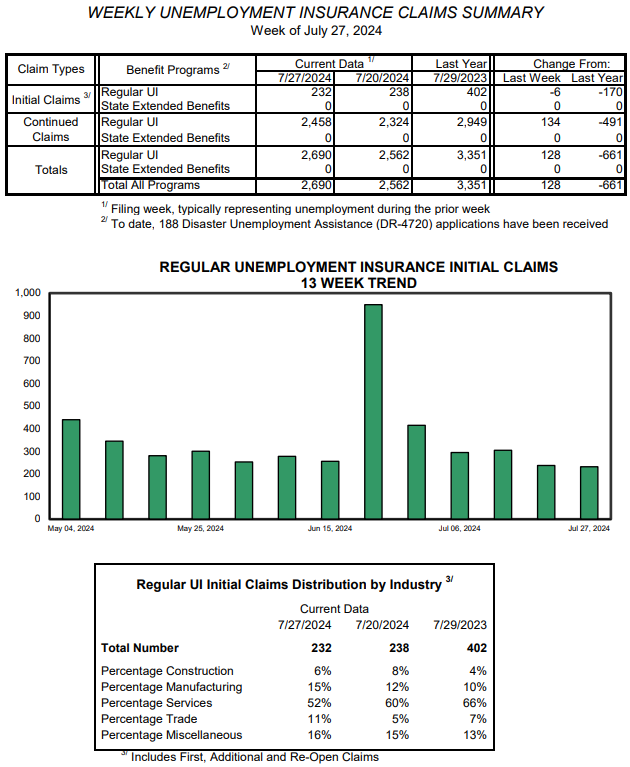
by Timothy McQuiston, Vermont Business Magazine Weekly unemployment claims fell slightly last week to their lowest levels since last year. For the week ending July 27, 2024, new claims were 232, which is typical of summer lows.
Meanwhile, unemployment claims and hiring have stalled nationally, and the stock market has reeled as the Federal Reserve Bank decided not to lower interest rates this week.
The Service industry accounts for the most claims this week with 52%, down from 60%. Manufacturing accounted for 15% of claims, up from 12%.
See tables below.
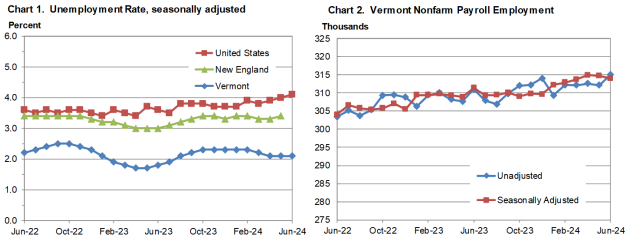
For the week, initial claims were down 6 for the week and down 170 from this time last year. Meanwhile, the state unemployment rate remains near historic low levels as employment and the labor force have increased (2.1 percent in June 2024).
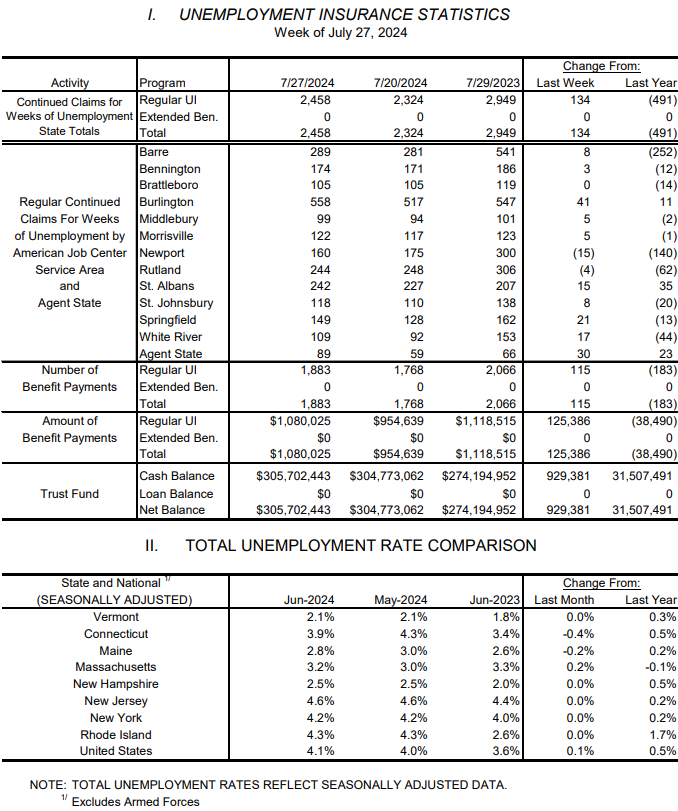
Vermont has the second lowest rate in the nation, behind South Dakota (2.0%). Nevada and California (5.2%) have the highest rates.
The comparable United States rate in June was 4.1 percent, an increase of one-tenth of one percentage point from the revised May estimate.
The Vermont civilian labor force participation rate was 65.7 percent in May, an increase of one-tenth of one percentage point from the prior month’s revised estimate.
For new and continuing UI claims, there were a total of 2,690 claims, up 128 from the week before and 661 fewer than last year.
Workers affected by July 2024 flood should apply for unemployment benefits
Nationally for the week ending July 27, In the week ending July 27, the advance figure for seasonally adjusted initial claims was 249,000, an increase of 14,000 from the previous week's unrevised level of 235,000. The 4-week moving average was 238,000, an increase of 2,500 from the previous week's unrevised average of 235,500.
Job growth was less than expected to only 114,000 well below the 179,000 expected, CNBC reported, and the US unemployment rose to 4.3% for July. Mortgage rates fell on the employment news.
For all that, and with inflation "ebbing," the Federal Reserve is expected to cut interest rates in September after declining to do so July 31, which disappointed investors.
The Vermont Unemployment Trust Fund is well capitalized. As of last week, there was $305.7 million in the Trust Fund, up nearly $100,000 for the week (as claims are paid out on one side, employers are contributing to the fund on the other). The pre-pandemic Trust Fund balance on March 1, 2020, was $506.2 million.