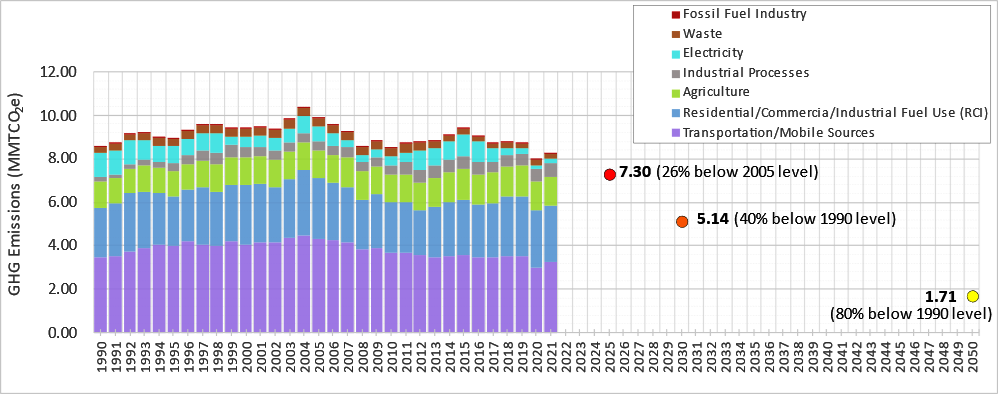
ANR graph: Projections continue to suggest that Vermont is generally on-track to meet the 2025 GHG statutory requirement while a significant gap remains between the current emissions trends and the January 1, 2030 requirement.
Vermont Business Magazine Today, the Agency of Natural Resources’ (ANR) Climate Action Office (CAO) released the latest Greenhouse Gas (GHG) Emissions Inventory and Forecast report (1990-2021). As in prior years, the two largest sectors of GHG emissions in Vermont in 2021 were transportation and heating fuel use in buildings. As shown above, transportation emissions rebounded in 2021 following sharp decline during the height of the COVID pandemic in 2020. Yet 2021 emissions were lower than 2019 emissions and all years prior through 1990, when the inventory was first established.
Vermont is one of 23 states that creates its own state emissions inventory. Vermont has been producing its Inventory since 2007.
In 2020, the Global Warming Solutions Act took Vermont’s goals for reducing greenhouse gases and made them statutory requirements – emissions must be reduced by 26% below 2005 levels by January 1, 2025, 40% below 1990 levels by January 1, 2030, and 80% below 1990 levels by January 1, 2050. The GHG Inventory measures Vermont’s progress towards these requirements. In 2021, Vermont emissions were 16% below 2005 levels, and 3% below 1990 levels.
In addition to documenting Vermont’s past GHG emissions, the Inventory report provides 5-year and 10-year forward-looking emissions projections based on supplemental modeling by a separate, independent study. These projections continue to suggest that Vermont is generally on-track to meet the 2025 GHG statutory requirement while a significant gap remains between the current emissions trends and the January 1, 2030, requirement.
ANR continues to refine the data used to create the Inventory. In addition to using emissions data from the Environmental Protection Agency, Vermont works to use as much Vermont-specific data as possible. For example, this year the GHG Inventory made an improvement in accounting for heating oil and diesel emissions by using actual fuel sales data to calculate emissions. As a result, some diesel emissions that were previously categorized in the Residential, Commercial and Industrial sector now are more accurately reported in the Transportation sector. As Vermont works to reduce its emissions, we are committed to finding and utilizing new data sources to better inform policy and programs.
To further the goal of bettering Vermont’s understanding of greenhouse gas emissions sources, ANR conducted two studies that finished this year. The first—a Life Cycle Analysis Study—shows the cumulative emissions that each energy source produces, from its time of extraction and production, to transporting that fuel to Vermont.
“This ‘cradle-to-grave’ analysis gives us a fuller picture of how much each fuel source—from oil to natural gas to wood—contributes to climate change,” said Jane Lazorchak, Program Manager of the Climate Action Office. “The GHG Inventory only reflects emissions that are actually produced in Vermont, but of course there are impacts with extracting, processing, and transporting fuels before they are burned. The Life Cycle Analysis is a separate tool that complements the GHG Inventory to help us make informed policy decisions.”
The second study looked at the most appropriate tools and datasets for the GHG Inventory to calculate agricultural emissions. The study suggested a potential method that could better factor in the many climate benefits of local agriculture by using local datasets in the future.
ANR is finalizing a consistent release date for the Inventory report and standardizing how to make significant changes to the methodology, ensuring that changes are discussed in a public setting to allow for input. This year, updates to the methodology and datasets were presented and discussed during public meetings of the Science & Data Subcommittee of the Vermont Climate Council, demonstrating what this could look like.
Learn more about Climate Change in Vermont and Vermont’s Greenhouse Gas Emissions Inventory.
Source: 7.25.2024. Vermont Agency of Natural Resources, Montpelier, VT Website
To support great journalism, access our archives and get unique features like our award-winning profiles, Book of Lists & Business-to-Business Directory, subscribe HERE!