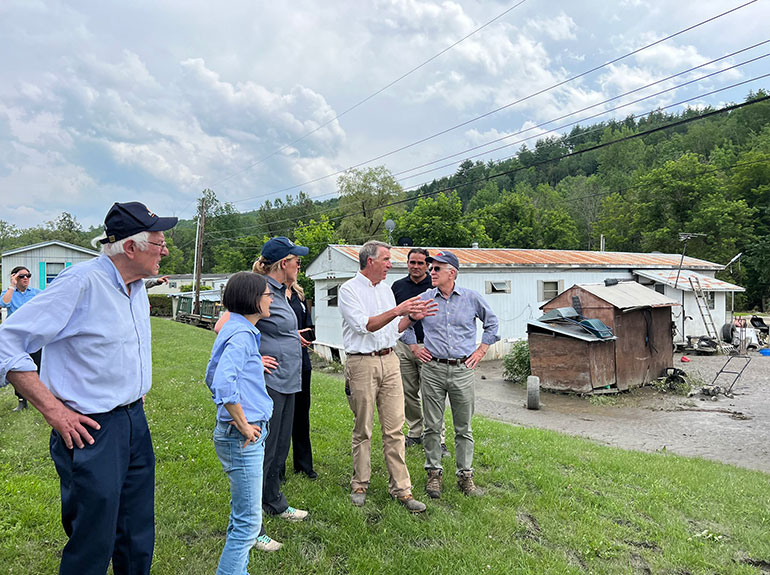
From left, Senator Sanders, Congresswoman Balint, FEMA Administrator Deanne Criswell, Governor Scott and Senator Welch survey the damage in Barre on July 12. Courtesy photo.
by Olga Peters, Vermont Business Magazine Barre City has a conundrum: How can it become more resilient to future flooding while also preserving land for housing?
During last summer’s flood, the city’s mostly residential, low-income North End neighborhood absorbed a devastating blow. The city has received 57 buyout applications from property owners whose buildings were substantially damaged.
If approved by the Federal Emergency Management Agency, the buyouts will help compensate property owners. In exchange, the city would return the land to green space. Forever.
The exchange, however, could mean less land available for housing and, for a city with a Grand List based mostly on residential properties, a loss of property tax revenue. A chance also exists that when the housing goes, so will residents.
City Manager Nicolas Storellicastro doubts that the city can afford so many losses.
“There’s momentum to make the neighborhood both resilient and keep people here in housing,“ Storellicastro said.
So, the city is developing plans to balance flood mitigation, increase housing and move forward with buyouts, although not all would go through the FEMA process.
Last fall, the Scott administration unveiled a set of renderings to reimagine the North End. The drawings, developed by the Montpelier architecture firm Black River Design, included a new park and razing over 90 existing housing units to build 225 new apartments and homes in their place.
“The governor presented some really broad parameters, which I think are pretty consistent with ours,“ Storellicastro said. “Which is, we need some sort of mix of dense urban housing and mitigation, and that’s sort of what’s coming together. It might not be happening in one big fell swoop, but we’ve certainly got a pathway to start moving in that direction.“
After the state’s presentation, the city held a series of public meetings and released a survey asking residents what they wanted for the North End. Storellicastro said there was public sentiment for:
A greater mix of housing, including multifamily and apartment buildings.
More recreational areas.
Removing obstacles — for example, an obsolete railroad trestle — from waterways that collect debris during high-water events.
In response, the city has developed three pathways to implement these ideas over the next several years.
Build a floodplain along North Main Street, relocate the Wobby Park playground, which sits on land outside the flood zone and construct 28 to 30 housing units on that space. The city has published a request for letters of interest to find developers.
Build those 28 to 30 housing units on the Seminary Street parking lot.
Build the units on land currently occupied by a cluster of damaged homes along Main Street, between Second and Third streets. In this case, the city would purchase the homes directly instead of going through the federal process. These clusters of damaged homes sit in a flood-prone area of the city. Storellicastro said any new construction would meet FEMA’s flood mitigation standards. A few buildings in town were previously built to such standards and came through the flooding with little to minimal damage, he added.
Storellicastro said the city feels a sense of urgency around building the new housing.
“The Wobby playground redevelopment, assuming somebody gives us a compelling proposal, could break ground next year,“ he said. “We own that property, it’s out of the floodplain and we don’t have to do any buyouts. All we have to do is remove a playground, and that can become a developable lot later this year.“
The Seminary Street plan, which has received interest from developers, already has utilities and other municipal infrastructure in place. Storellicastro estimates the work could be performed next year.
He suspects that purchasing the property clusters will take longer.
As of March, the city was still gathering information on how much the potential projects would cost.
Completing all three pathways would mean a potential 72 new housing units.
Storellicastro said he understands FEMA’s rationale for wanting to return flood-prone property to green space through its buyout program. But he said the plan could have adverse consequences for the city.
“It’s a very difficult decision because we know we would be putting housing back into an area that was hit hard,“ he said. “Flood guidelines will protect these buildings in the future, but can we guarantee that these houses will never flood again? Absolutely not. At this point, it’s a risk that we have to take. Otherwise, we’re basically giving up on a whole part of the city.“
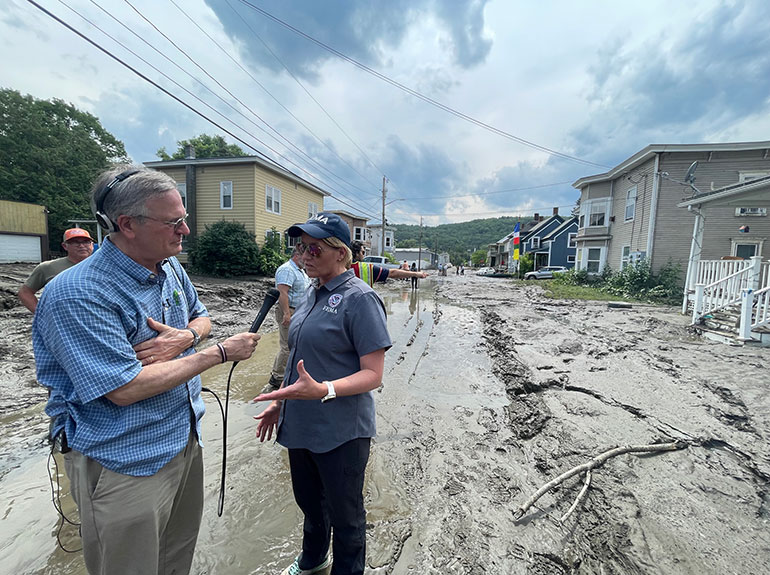
FEMA Administrator Deanne Criswell is interviewed by Vermont Public's Bob Kinzel in Barre on July 12, on a tour of flooding destruction with Governor Scott and the Vermont congressional delegation. Courtesy FEMA.
Midway Into Recovery
“The lack of available housing made the human impact of the floods dramatically worse,“ said Douglas R. Farnham, Chief Recovery Officer.
Tight housing markets meant people displaced by the floods struggled to find alternative housing. It also meant Vermont lacked rentals for out-of-state construction workers who traveled to make emergency repairs.
The state Recovery Office oversees and coordinates recovery efforts across state government and operates eight task forces that aim to connect resources to where they are needed.
Reducing the future risk to Vermont’s housing stock is one reason Farnham has focused his work on Hazard Mitigation. He also advocates standardizing the state’s flood hazard rules. It would make the system easier to navigate, but it might also take pressure off municipalities. After the July floods, Farnham heard examples of residents reaching out to their municipal flood administrator but never hearing back.
“I think that’s also a municipal capacity issue,“ he said.
Farnham collaborates with peers from Vermont Emergency Management, the Agency of Natural Resources, and the Agency of Commerce and Community Development.
In his opinion, some of the regulations that are in progress and wending through the Legislature have the potential to slow development.
“The Senate Natural Resources [committee] was trying to really bulk up our regulation and our structure along the river corridors in a way that we think would bring things to a screeching halt,“ he said. “But we did propose a compromise to them of standardizing the flood hazard rules in Vermont so that it was no longer different in each municipality.“
As of March, Farnham was unsure whether the committee would incorporate the suggestions.
In Farnham’s opinion, Vermont is still in the medium-term part of its recovery process. Many homeowners and businesses made repairs. Communities still have substantial long-term work ahead.
The state has received applications totaling approximately $10 million for hazard mitigation projects and direct buyouts, he said. For the long-term, he’s identified $100 million in hazard mitigation projects.
Farnham noted that after Tropical Storm Irene, it took the state approximately three years to iron out its mitigation projects. He hopes to have the projects related to the July flooding ready for the 2025 construction season.
Unfortunately, Farnham doubts the state can make businesses affected by the July floods economically whole.
He said the estimated economic damage to businesses was over $300 million. The state put up $20 million in grants through the Business Emergency Gap Assistance Program (BEGAP). Still, he said the support met less than 10% of the estimated damage.
“Unfortunately, it’s not the role of state government to make businesses whole when something like this happens,“ Farnham said. “But it is our responsibility to try to mitigate and reduce the risk of going forward.“
Later this year, Farnham plans to host regional discussions around the proposed mitigation projects.
Looking To The Future
Farnham agreed, “Barre has a lot of tough decisions ahead of them.“
The state has assigned Patricia Moulton, Central Vermont Recovery Officer, to assist communities like Barre City through their recovery process. Moulton recently served as president of Vermont Technical College and previously was the secretary of the Agency of Commerce and Community Development.
In Farnham’s view, large-scale hazard mitigation is the best way to reduce the risk to housing.
Storellicastro said that it might seem that Barre City must choose between safety or new housing.
He believes the community has other options, such as trusting FEMA’s flood guidelines and incorporating mitigation standards into new housing.
The good news, according to Storellicastro, is that the summer floods changed the housing conversation for Barre City residents.
He explained that before the floods, residents lacked the appetite for multifamily housing. The idea of building on a park would have flopped.
“Barre can’t afford to give up all this land in perpetuity; we have no space to grow,“ he said. “So, it’s either riding the death knell of the city’s future by giving up all this land for redevelopment or taking the risk and building to [flood] standards.“
To support great journalism, access our archives and get unique features like our award-winning profiles, subscribe HERE!