DEW Construction is overseeing construction of Cambrian Rise, a 1,050-unit multifamily housing development in downtown Burlington slated for completion in the fall. Photo courtesy DEW Construction.
by Olga Peters, Vermont Business Magazine
Richard Wobby Jr., executive vice president of the Associated General Contractors of Vermont, predicts another great year ahead for Vermont’s construction industry.
Extra federal and state funding flowed through contractors’ projects. Repairing the damage from the summer and winter floods kept companies busy.
“Between FEMA (flood repairs) and our normal workload, we’re probably going to see somewhere around a 12% increase in total work out there,“ Wobby said. “The work is there, and we are flying.“
The worry, he added, is that Vermont’s approximately 15,000 construction workers are insufficient to meet demand.
Early in the 2024 construction season, many state contractors report being busy, but not as busy as they’d like to be — or could be.
“People come to me and ask, ’Where did the workers go?’ said Travis Kingsbury, president of Kingsbury Cos., a full-service general contractor in Middlesex. “And I say, ’I don’t know where they went.’“
Mel Baiser, co-founder and director of strategy and vision at Brattleboro-based HELM Construction Solutions, said that most companies their firm works with are actively hiring, especially for skilled carpenters capable of bringing leadership to the job site, office managers/construction bookkeepers and project managers.
“Meeting labor needs is still an issue,“ they said. “Workers have been moving between companies in search of better wages, benefits, working conditions and culture.“
Jason Webster, president and co-owner of Huntington Homes in East Montpelier, said he and other home builders in the region face a sort of Hobson’s choice to remain competitive in today’s market.
“The free market would say that when demand is strong, you try to increase supply or raise prices to slow it down,“ Webster said. But raising prices has little appeal to Vermonter homebuyers and can serve to exacerbate the housing crisis.
Kristen Connors, co-owner and general manager of VerMod High Performance Modular Homes in White River Junction, agreed. “Our vision is building affordable housing for anybody who wants to have housing,“ she said.“ And the words ’affordable’ and ’housing’ don’t go hand-in-hand anymore.“
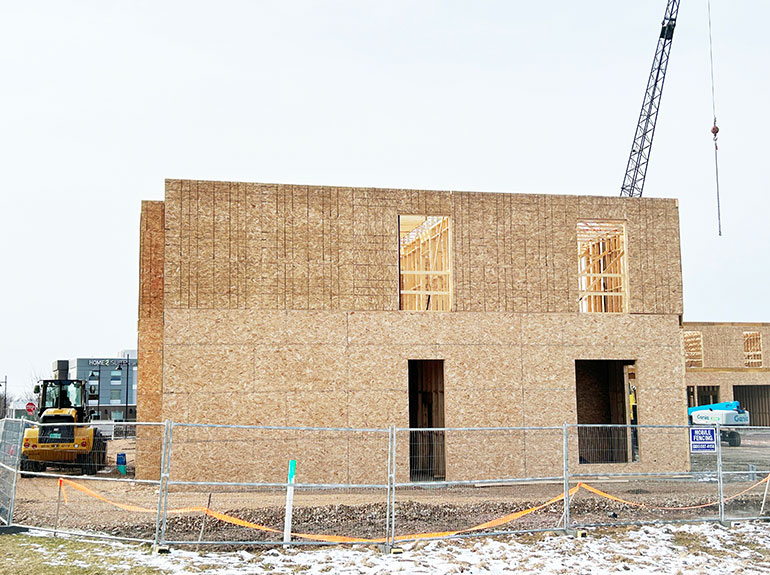
More construction at Finney Crossing in Williston. New development will include a new hotel, just across the way from the new Home2 Suites hotel. A LaQuinta Inn opened just down Route 2 in Williston last year. VermontBiz photo
’Hitting a Brick Wall’
Matt Wheaton, executive vice president at DEW Construction in Williston, said this year’s housing market seems similar to last year’s.
“Challenges are similar in that deals are taking a little longer to get started through either financing challenges or a lack of labor,“ Wheaton said.
Higher interest rates have caused some clients to hit the pause button as well, he added. He noted that fewer municipal and school bond requests are being approved by voters these days.
Approximately one-third of school budget votes failed in communities that held town meetings in early March. And several school districts recently turned down bond requests for construction projects, the most notable of which may be a $99 million proposal for a new Woodstock Union High School.
As Kingsbury succinctly stated, “Last year, we hit a brick wall.“
His firm lost out on several municipal projects because their bids were too high for the project’s budget. The kicker? In every case, Kingsbury had submitted the lowest bid.
“These are public works projects,“ Kingsbury explained. “They are not second homes or ponds or amenities that people just want. They are necessary works.“
Inflation is certainly a major cause of today’s volatile market. Kingsbury said his company has seen a 20% increase in wages over a two-year time frame.
Kingsbury had expected to see more municipal projects with healthier budgets based on the amount of federal American Rescue Plan Act and infrastructure funding coming to the states. Unfortunately, it doesn’t seem the money will go as far as hoped.
Baiser and their co-founder at HELM Construction, Kate Stephenson, said they, too, have felt the brunt of increased labor costs as well as the rising cost of materials. Their company currently provides remote services to nearly 80 contractors, design-builders and architecture firms across the U.S. and Canada.
“We have witnessed overall costs increase by anywhere from 20% to 30% compared to pre-COVID times,“ they wrote in an email. “The reality of labor and material costs relative to the ability of homeowners to afford repairs, maintenance and improvements is a challenge.
“While lead times may still be longer than pre-COVID times,“ they added, “builders with good project management systems in place are able to plan ahead and better manage expectations around these aspects that are out of their control.“
In Baiser and Stephenson’s experience, costs “are not necessarily inflated but are certainly not affordable to the majority of our population.“
“This discrepancy cannot necessarily be solved by architects and builders. It requires solutions on community, state, and federal levels,“ they wrote. “Housing is too expensive for most of the population to afford, so ’market rate’ for well-built construction doesn’t match ’market rate’ for most buyers.“
Bob Stevens, founder of Stevens & Associates, a design and development firm specializing in historic and architecturally significant projects, and co-founder and president of M&S Development, which specializes in acquiring funding for complex housing and economic development projects, said rising costs have put multiple projects in his portfolio on hold.
“We’ve had several clients who said, ’I don’t know how to build this anymore because the cost of my debt just went up, and the cost of building just went up,’ Stevens said. “I know a lot of the affordable housing projects continue to be built, but they had to bring more subsidy to close the gap.“
Housing is generally considered affordable if a household pays less than 30% of its monthly income to secure the housing, according to experts in the field.
“The cost of construction has increased at more than double the rate of people’s wages or the cost of housing,“ Stevens said. “We have a gap between what people earn for wages here and what it costs for us to deliver a house for them.“
Workforce Issues Persist
VerMod’s Connors, like others we spoke with for this article, said it is difficult to build in Vermont right now due to the acute labor shortage. Small business like hers, she added, can find it particularly challenging to maintain capacity in this environment.
VerMod produces zero-energy, or net-zero, modular homes from their factory in Wilder. To date, the firm has placed more than 100 homes across New England, including Vermont, New Hampshire and Massachusetts. Company co-founder Steve Davis operates a mobile home park and focuses on providing affordable modular homes to residents there.
The company recently changed its business plan from building to order to constructing one unit at a time, which is then rented or sold. Connors said the change was necessitated by the labor shortage and because customers have had trouble obtaining mortgages. Both factors made VerMod’s production timelines too unwieldy.
Wobby, of the Associated General Contractors, said, approximately two-thirds of the industry wants to add staff and expand. This includes specialists like cabinetmakers, finish carpenters, siders, excavator operators and paving operators.
Many of these skilled workers, Wobby, added, are 55 and older and have started to think about retiring. In response, organizations like AGC and career centers are diligently recruiting new workers.
Wobby said more workers in the 20- to 35-year-old age range are now entering the trades. The number of women has also increased, which Wobby sees as a positive development for the industry.
The 33 to 55 age group is the most underrepresented, Wobby said. As a result, teams may have uneven levels of experience and need more midcareer workers.
“We’re all competing for the same talented individuals,“ DEW Construction’s Wheaton said
To find new talent, DEW staff have expanded school visits beyond career centers and into elementary schools.
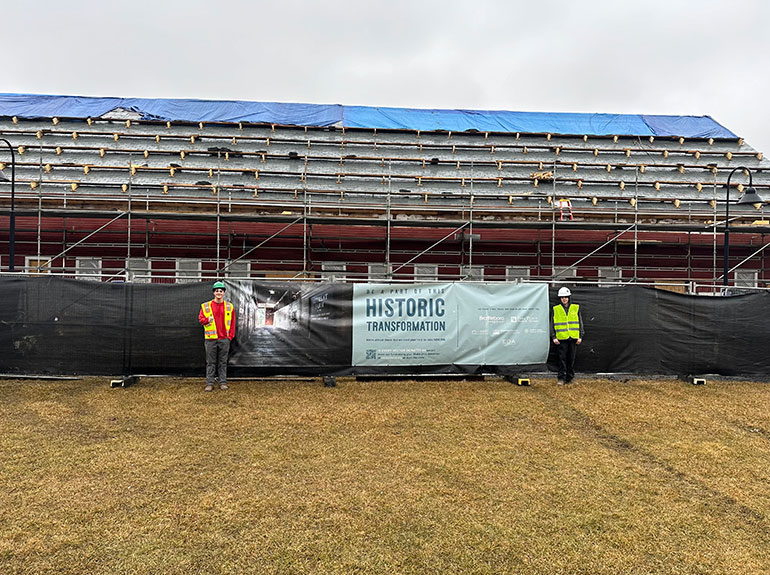
Randolph Technical Career Center students Kellan Ballou, a senior in the Electrical Trades Program, and Peyton Johnson, a senior in the Construction Trades Management Program visit the Retreat Farm project in Brattleboro. Photo courtesy DEW Construction.
“There are different types of career paths, not swinging a hammer, right? It’s more than that,“ Wheaton said.
AGC took over the Vermont apprenticeship program and received state grant funding to train staff, added Wheaton, who serves on the group’s board of directors.
“The program teaches them how to work with different personalities, how to read blueprints, what it means to be reliable and how to do simple finances,“ he said.
DEW participates in the apprenticeship program because the company views it as an investment in its people
“We hope they’ll stay with us, but they may not after the apprenticeship,“ he said. “But investing in the person will make the whole industry that much better.“
Wheaton started his career sweeping floors for his father, who was a contractor. He eventually earned a master’s degree in architecture.
“The tools, pieces and parts of wood construction haven’t changed all that much, but the complexity of building science is very different,“ he said.
Baiser and Stephenson said they’d like to see more funding and resources available for workforce development efforts in Vermont.
“Assisting small companies in hiring and training apprentices and entry-level positions is key,“ the HELM co-founders wrote in an email. “HELM provides direct support with hiring, onboarding and training to our clients. We also aim to provide specific education and training related to themes of diversity, equity and inclusion to better prepare companies for the changing workforce.“
Kingsbury Co. has focused on recruitment and training staff for several year, Travis Kingsbury said. And the work is paying off.
In addition to its internal internship program and training through AGC’s apprenticeship program, the company hired a full-time recruitment and retention staff member last year.
“We are getting some really quality people in the door,“ Kingsbury said.
According to the Public Assets Institute’s “State of Working Vermont 2023“ report, private employers created jobs at the fastest rate in more than 20 years last year. Despite a low unemployment rate and a growing job market, the state’s labor force has not fully returned to its pre-pandemic levels.
The report also noted that more men than women left the labor force during COVID-19 and that men have stayed out at a higher rate.
Douglas Farnham, Vermont’s chief recovery officer appointed by Gov. Scott last August to coordinate flood recovery efforts, said Vermonters need to be open to the idea of receiving help, even from people coming from out of state.
“We have been getting pushback from people that don’t want crews from out of state coming in to help them (with recovery work), Farnham said. “I don’t think we can afford to be picky right now.“
The state’s top housing official, Alex Farrell, said housing developers need help with infrastructure costs, an important first investment in most building projects
“If you’re going to build a large development where you have to bring in a road, sidewalks, water and wastewater, you are making a potentially multimillion-dollar investment that does not create any cash flow,“ Farrell said.
Vermont’s Department of Housing & Community Development, of which Farrell is commissioner, always urges housing developers to build in areas with existing water and wastewater capacity.
“We’re always going to try to figure out mechanisms to help clear that infrastructure hurdle,“ he said. “But in the meantime, we’re really focused on at least fundamentally creating an environment in which development can happen, particularly for projects that we know can pencil out.“
Diversifying Portfolios Pays Dividends
At DEW Construction, multifamily housing projects remain a strong segment of their business. Still, these projects can take time to get going.
“Typically, the projects receive their estimates and then go through their funding cycles, and allocations are made,“ Wheaton said. “Then they ramp their design team back up, and all of a sudden, it’s a year and a half later. Then you do another estimate, and the market has totally changed.“
From offices in Vermont, New Hampshire and Maine, DEW manages a portfolio of approximately 1,000 housing units per year in various stages of completion. Wheaton stressed that DEW intentionally takes on a variety of project types, a practice he believes provides a layer of protection against a volatile economy.
HELM Construction’s Baiser noted that some of the smaller residential sector firms their company works with have healthy project loads and are scheduled out one to two years with work.
“This has been positive for the financial health of these small businesses throughout the state and has resulted in some increases in wages and benefits for the workforce,“ Baiser wrote. “Throughout the pandemic, we have also witnessed companies investing more in the well-being and professional development of their team members in an effort to retain their most loyal and skilled employees.“
Huntington Homes and its 75 employees are currently seeing unprecedented backlogs,“ Webster said. “We’re still trying to build for everybody, not just the wealthiest. We’re just pushing our backlog out.“
The company ran a production backlog of approximately three months five years ago. Today, the backlog averages nine to 12 months.
Webster said the company has lost clients because of the lag time between order and delivery. Some are simply unwilling to wait. Others are boxed out by expiring construction loans.
“So a build with us could take a year to a year and a half on a construction loan that’s only good for nine to 12 months,“ Webster said.
As a result, many of Huntington Homes’ clients bypass the banks and pay in cash.
A Question of Affordability
While rising labor costs have put a strain on many businesses, Wobby believes better worker compensation is a net positive.
Baiser agreed, writing, “Design, carpentry and trade partner labor rates have gone up to what we believe to be more sustainable rates.“
According to Wobby, the multiplier effect of every dollar paid to someone in the construction industry represents $2.30 spent in the local community.
As jobs in the construction industry become more complex and technical, the need for a better-educated and more highly skilled workforce becomes critical. It logically follows that today’s workers deserve higher wages.
This naturally leads to a discussion about the cost of living in a state where it is difficult to find affordable housing, health care, child care and the like.
“One definite thing that we can all agree on — and I don’t care what industry you work in — is it’s hard to afford living here,“ Kingsbury said.
On multiple occasions, he said, potential employees have turned down jobs because the pay wasn’t enough to cover living costs.
“I honestly believe that there’s no better place in the country to live than Vermont,“ Kingsbury said. “But if you can’t find a job that supports that lifestyle, then it’s hard to be here.“
Olga Peters is a freelance writer from Windham County.
To support great journalism, access our archives and get unique features like our award-winning profiles, subscribe HERE!