by Olga Peters, Vermont Business Magazine
VermontBiz Windham County’s economy has a little bit of everything from large manufacturers such as Sonnax or wholesalers such as G&S Wholesale, so smaller startups, artisan food products, arts organizations, and higher education. Here, a few business owners and nonprofit leaders share their experiences working in the Southeastern Vermont economy.
Reducing Housing Costs One Manufactured Kitchen At A Time
Imagine showing up to a new home carrying three-pronged electrical cords and discovering that the contractor wired the house with only two-pronged outlets.
Jason Van Nest, co-founder and CEO of LOGIC Building Systems, explained that mismatched and non-standardized internal housing standards are one reason modular buildings remain a small part of the market.
LOGIC Building Systems on Main Street, Brattleboro, is a startup that asks, what if people could purchase kitchens, bathrooms, and utility rooms like any other appliance with the costs, sizes, and necessary connections known upfront?
“We're planning to do manufacturing later this year; we're still searching out the final investment capital and lining up the first couple of customers,” said Van Nest, who co-founded the company with CFO Jim Verzino.
On its surface, the company plans to manufacture modular - a practice known as offsite construction - kitchens, bathrooms, and utility rooms to reduce the costs of new housing.
“In a manufacturing setting, we can reduce waste; we can reduce the CO2 emissions by somewhere between 40 and 50 percent. We can bulk order. We're not just buying one washing machine; we're buying 50, and we can remove all of the bulk packaging out of the waste stream,” he said.
LOGIC’s goals, however, go deeper than their finished product.
Van Nest is an associate architecture professor at the New York Institute of Technology and the director of the college’s Center for Offsite Construction. He is drafting open-source internal building standards and trying to persuade HUD and enormous real estate development firms to adopt them. Once standards are in place, modular buildings could become more accessible, if not the norm.
It might not sound like a radical concept, but it is. Fundamentally, contractors build homes in the same way as builders 100 years ago, he said. This means each house is a collection of subcontractors and different services. Unlike cars, where people can look up the vehicle’s MSRP (manufacturer’s suggested retail price), building costs can fluctuate during the project.
Van Nest likens the situation to the good old days of connecting computers. Before the standardized USB drive (Universal Serial Bus), every computer tower arrived with various connections to accommodate no two computer brands using the same type of cables.
“The beautiful thing about modular kitchens and utility rooms is that if you want a 600 square foot one bedroom, we will give you a kitchen, a bathroom, and a utility room,” he said. “If you want a 900 square foot two-bedroom apartment, we will just sell you another bathroom. We'll give you the Legos you can mix and match.”
Other countries, such as Sweden, Norway, Finland, and Japan, have standardized their building systems to save money through modular construction and create more affordable housing.
“Brattleboro is a great place for modular because we're less than a four-hour drive to both Boston and New York City’s huge real estate markets,” he said. “So, if we can stand up even a modest manufacturing facility in Southern Vermont, then we can access real estate markets much larger than ours, and we can bring those larger markets dollars back into the local economy.”
The challenge LOGIC faces right now is finding its first customers. Van Nest jokes and says he’s spoken to plenty of second customers, and large organizations are excited to incorporate modular products into their housing projects but feel wary of the risks of going first.
Several individual homeowners have approached LOGIC about producing a modular for a new ADU. Van Nest said the company hasn’t reached the scale yet that would make it cost-effective for an individual.
“That's why we're really struggling to find the right first customer to really launch correctly and prove the system and then just get going,” he said.
Eventually, Logic hopes to raise enough capital to open a manufacturing center in Brattleboro.
“People are here, they're talking, and they're open-minded, and it's such a wonderful place to raise a kid. It's just a challenge to do business,” Van Nest said.
In Van Nest’s opinion, most of Vermont’s economic and governmental power is along the Interstate 89 corridor. The situation has left Southern Vermont competing to develop the economic opportunities seen in larger population centers.
That said, Van Nest also sees new opportunities in Windham County thanks to the influx of white-collar professionals who have relocated to the county since the pandemic.
“Colleagues in my child's schoolwork for Amazon and Warner Brothers and are really bringing in a new economic base to the area because those paychecks don't come from Vermont,” he said.
Last year, the startup participated in LaunchVT, an intensive mentorship and business accelerator run by the Lake Champlain Regional Chamber of Commerce. As of April, Van Nest had submitted a discretionary spending request to Congressman Peter Welch and Senator Bernie Sanders’ offices. The request was to supply kitchen and bathroom modules to Vermont’s nonprofit housing developers, such as housing trusts. The company seeks to fill the positions for head of product and head of software. Learn more at their website: https://www.buildwithlogic.com
Maple Valley Owner Acquires Brewery
Beers from the Whestone Brewery will soon go by the name North Chair.
Earlier this spring, Sugar Mountain Holdings, the company behind renovating the former Maple Valley Ski area on Route 30 in Dummerston, purchased the Whetstone brand and brewing facility in Brattleboro.
Keane Aures, owner of Sugar Mountain Holdings purchased the brewery, equipment, the Whetstone brand and beer recipes. The Whetstone’s head brewer, Connor Busch will remain on staff. In the coming months, Aures said the team plans to release a new line of beer under the name North Chair Brewing (named after one of Maple Valley’s ski lifts).
“The head brewer is still there continuing to make those great beers that he was making,” Aures said. “We are collaborating with him to tweak the recipes a little bit and see if we can make them better. I don't think there's anything that can't be made a little bit better. So we are endeavoring to make the best beer we can possibly make.”
The hope is that profits from the new line of beers will finance the renovations of Maple Valley. Aures wants to turn the former ski area into a brewery and music venue.
And, he loves the mountain.
“I drove by it so many times and always thought, what a unique and wonderful spot it was this beautiful ski mountain that came right down to the West River,” he said.
He wondered why no one had turned the small ski area, which closed in the 1990s, into a brewery. Then he thought, “Why shouldn't I turn it into new brewery?”
When asked what his timeline is for the whole project, Aures joked saying, “I hope to have everything up running and fully operational by 2019.”
Wait. What?
After many years navigating the state’s Act 250 permitting process, Aures said he stopped putting dates on things.
Businesses owners and developers often hiss under their breath about Act 250, the state’s land use law. They complain that the permitting process is too long, too unpredictable, and too expensive.
The complaints at times can sound like broken records playing over and over.
Unfortunately for Aures, the Act 250 frustration was real.
Aures purchased the more than 370-acre Maple Valley Ski area in 2018. According to news reports, he submitted his Act 250 application to the state in 2020. He received his permit late last year.
“The process took much longer than I ever thought it would. But here we are, and we've come through to the other side,” he said.
Aures said he needs to review the Maple Valley project before moving forward with renovations. The long Act 250 process cost several thousand dollars itself and delayed the project enough so that costs have increased.
“As some businesses in Vermont may have noticed, there's been some price increases in the last couple of years,” Aures joked. “That applies to equipment, that applies to materials, that applies to construction costs, that applies to site work, across the board, those costs have gone up substantially.”
Despite the long permitting process, Aures said he never considered giving up.
“Maple Valley is such a great spot and I believed in the project so much and I thought all along, we were right on the facts in the law so we would eventually come out in the right, so yeah, it is essentially faith in the project that kept it going,” he said.
The Dummerston community also kept Aures going.
“The community support was fantastic,” he said. “A lot of people reached out and really encouraged me to stick with the project.”
Aures said he never understood some of the pushback he received from the state during Act 250. He was trying to revive an old business and support the economy, he said. He feels the Windham County economy needs more support from the state and its institutions.
Aures purchased only a piece of the Whetstone empire. The original owners, David Hiler and Tim and Amy Brady, still own the Whetstone Station restaurant and attached brewery and River Garden Marketplace in Brattleboro and the Kampfires Campground in Dummerston.
For now, Aures said he is 100 percent focused on making great beer.
“When that starts to generate some revenue for us, we'll slowly turn our attention back to how we can get Maple Valley up and running,” he said. “Right now, the focus isn't on the details of Maple Valley. The focus is making great beer and making sure that we carry on the tradition of the Whetstone and introduce our new North Chair brand.”
“Once we're on solid footing there, we can turn our attention elsewhere,” he said.
Growth At Grace Cottage Hospital
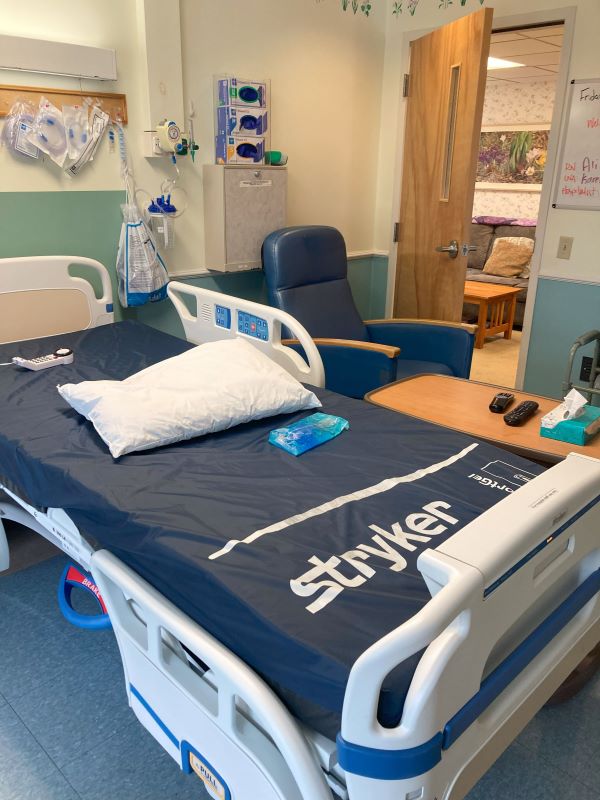
During an April visit to Grace Cottage Hospital, recalls Andrea Seaton, Vermont Congresswoman Becca Balint asked doctors, if they had a magic wand, what would they fix?
Top answer: Housing.
Transportation came in at number two.
Balint visited the 19-bed critical access hospital in Townshend to announce the award of a $1.5 million federal appropriation Grace Cottage received toward its Family Health Clinic capital project.
Doug DiVello, President and CEO, said the Windham County economy is “a microcosm of what’s happening across the country.”
In his opinion, a tough economy ripples through everything, especially people’s social networks and ability to care for each other.
“If you're a young couple, and you've got elderly parents, if you begin to struggle financially with regard to paying your bills and feeding your kids and paying your mortgage, it doesn't leave a lot to help your elderly parents. It's all linked together,” DiVello said.
He added, “Healthcare is more expensive than it's ever been in this county, and access is not getting much better,” he said.
Housing is an ongoing issue for the county and hospital.
“People can't work if they can’t put their head down at the end of the day,” DiVello said.
He said the state’s housing shortage has affected potential and current Grace Cottage employees.
The lack of stable housing also impacts patients, he said. According to DiVello, hospitals are supposed to discharge patients to safe environments.
“If we feel like there's risk in terms of a patient going home that they're not going to eat healthy, that they're not going to be able to afford groceries, that they're not going to be able to fill their prescriptions, and take their medications… often, that will impact negatively a discharge decision for a patient that would otherwise just go home,” he said.
Andrea Seaton, the senior director of development, marketing, and community relations, said Grace Cottage's primary care practice has attracted more patients from Brattleboro. However, the West River Valley, also known as the Route 30 corridor, lacks public transportation. Brattleboro patients sometimes miss appointments, she said.
Hospitals are still recovering from the pandemic, DiVello added. They struggle to hire enough staff, and dependence on traveling medical staff keeps labor costs high.”
Seaton added that the number of patients accessing the hospital with Medicaid insurance has increased since the pandemic. She said that Medicaid’s lower reimbursement rates cover less than half of the hospital’s costs.
DiVello reassured the audience that the hospital is actively addressing its financial challenges. As a designated critical access hospital, the federal government provides additional reimbursements. Fundraising, however, is a significant part of Grace Cottage’s efforts. The hospital raises approximately $2 million annually to cover the shortfall in Medicaid and other reimbursements, demonstrating its commitment to sustainability.
“The community has been so supportive,” Seaton said. “They understand that independent rural hospitals are a vanishing breed, and we are here because our community is voting with their dollars and with their feet.”
DiVello believes that when people are healthier, they avoid the need for costly procedures and deal with fewer chronic diseases.
“If people live a healthier lifestyle and have somebody to coach them, and remind them, and take care of them, and give them prescriptions for medications, and give them good habits and advice, they'll be healthier, and they'll consume less of the health care dollars available to our community,” he said.
To this end, Grace Cottage has increased its number of primary care providers and woven a network of on-site services around its primary care. Under one roof, the hospital operates a lab, X-ray and CT scan imaging, a pharmacy, and mental health services. DiVello said having these services in one place provides efficiency and also makes the process of providing care easier for primary care doctors.
He said the strategy is win-win. Patients will have better access to health care, and the hospital will be able to pay its bills and hire strong clinicians.
A total of 229 employees, with 169 full-time staff, work at Grace Cottage.
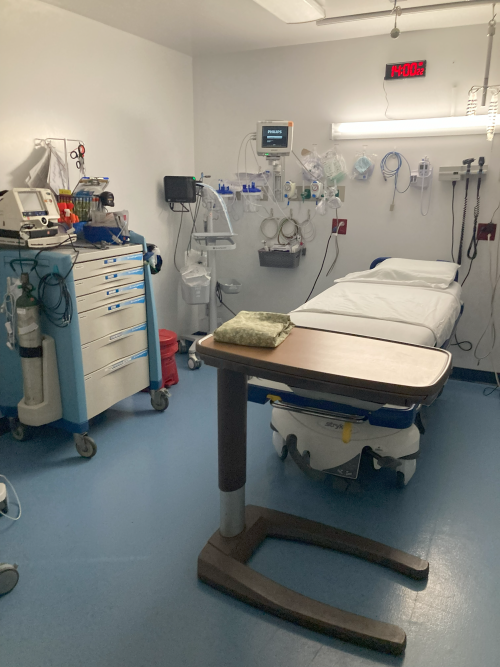
This is part of the ER. It's a room rigged to connect with physicians in Dartmouth for extra consultations.
DiVello said Grace Cottage has seen some improvement in its ability to hire new staff in recent months, including new people to fill leadership positions, such as a new chief nursing officer.
“The word on the street is that she's a wonderful leader, and so, as a result, we're seeing some employees who we lost during the pandemic come back to Grace Cottage,” he said.
Seaton said, “Working at a hospital is stressful. You're dealing with patients who are in pain. You're open 24/7 365. So there's absolutely no break.”
This constant stress was one reason DiVello emphasized employee appreciation when he arrived six years ago. In Seaton’s opinion, this appreciation of employees shows up in the hospital’s high level of patient satisfaction.
On a note of celebration, Seaton shared that the hospital’s new clinical building would significantly enhance the clinic’s ability to serve staff and nearly double the hospital’s primary care capacity.
Along with the $1.5 million Balint announced, the project started with a challenge pledge of $5 million from Joseph and Elizabeth Pollio. The hospital is working with healthcare architects Lavallee Brensinger. The firm has created plans for a 23,000-square-foot building at its campus's north end.
So far, Grace Cottage has raised $7.8 million in pledges and gifts, with $12.2 million to go toward its goal.
The organization’s current clinic buildings are part of the hospital’s original houses, built in the 1840s. As a result, the private homes converted into clinics have uneven floors, small rooms, and narrow hallways that no longer meet the needs of Grace Cottage’s primary care practice. The current practice hosts 13 providers, 50 nurses, and support staff. According to Grace Cottage’s website, in 2018, the clinic saw 21,000 individual patient visits. By 2022, that number had grown to 31,000.
Potash Hill Expands Its Offerings While Seeking Sustainable Funding
The Marlboro Music is adjusting to a new phase in its more than 70 years as an organization: life as a landlord.
“We didn't really set out to have the title of property owner - that was not necessarily in the mission statement,” said Director of Communications Brian Potter. “But, we really took on ownership to preserve the campus and protect our future here.”
Marlboro Music, the internationally recognized chamber music residency and festival, has called the former Marlboro College campus its summer home since 1951. The festival also has a sister music series in Philadelphia.
After Marlboro College merged with Boston’s Emerson College in 2020, it seemed the campus might lack an organization to shepherd it into the future. Democracy Builders Fund, a nonprofit higher education organization led by Seth Andrew, purchased the campus. After Andrew was arrested on charges of wire fraud, money laundering, and making false statements to a financial institution, the festival acquired the campus in 2021.
“Ownership definitely brought some unique challenges,” Potter said. “We extended the budget, we increased our staffing for fundraising, and have the responsibility to bring life to the campus now from September through May every year.”
Marlboro Music created the nonprofit Potash Hill, Inc. to oversee and maintain the campus, which costs approximately $1.5 million a year to operate.
Potter said most of the campus maintenance is funded by generous yet temporary philanthropy. Rental income only provides a fraction of the budget's needs. In the long term, however, Potash Hill aims to be self-sustaining through rental income.
“Our goal was really to activate the campus to benefit the creative economy of the region, to honor the legacy of the campus, and just being mindful of the fiscal realities of what it takes to own this beautiful place,” Potter said.
The organization has since constructed the Jerome & Celia Bertin Reich Building and Residence Hall, which opened in 2021. The building houses chamber music rehearsal studios, a music library, offices, gathering areas, and an 18-room residence hall. Potter said that other areas on campus are good for rehearsals, but Reich Hall, purpose-built for chamber music, “has been a game changer.”
Four new practice rooms that can also be used as meeting spaces were recently installed in the Woodard Building, which is part of the campus’ arts complex area.
“It's a real benefit to be able to make improvements like that impact the summer program and then can also help attract tenants during the non-summer months.”
The Brattleboro Food Co-op has taken over management of the campus kitchen and provides meals during the festival.
Another tenant is the Marlboro Studio School, which is based in the campus’ Visual Arts Center. Directed by former Marlboro College professor David Eichelberger, the school offers classes in fine arts and media. Launched in the spring of 2023, it will host its first week-long residency in May. The school also offers classes for youths and adults.
This fall, the campus will welcome a program called Contemplative Semester. The program provides a four-month concentration on mindfulness, medication, and community for young adults ages 18 - 25. According to the organization’s website, the research-backed curriculum helps participants improve their mental health, build social connections, and develop skills around ethics.
The Marlboro Music Festival will welcome approximately 85 artists from 16 countries this summer. Several of this year’s teachers are previous festival students.
“The community aspect is so crucial underneath everything that goes on here and forms the music making,” Potter said. “Having not only the musicians here, but their family members, we have grandparents here, we have kids here, our staff members, the local community, it's a really unique synthesis of all those things that really go beyond the music.”
Landmark College: Meet Students Where They Are
Landmark College President Peter Eden, PhD., spoke with VBM the day after fellow liberal arts college Goddard College announced it would close.
He had a lot on his mind.
Eden often hears that Putney’s Landmark College has it easy. As a small specialty school supporting students with learning differences (LD), people believe it has extra insulation protecting it from the financial pressures faced by other small liberal arts colleges.
“Nothing could be further from the truth,” he said. “We’re not insulated at all. Other specialty colleges have gone bankrupt.”
In Eden’s opinion, Landmark’s strength rests in its business model and brand.
But, he adds, the college’s brand is tricky.
Schools across the county operate support programs for college students with dyslexia, ADHD, or autism, for example, he said.
Still, Eden said, programs for students with LDs are expensive to run. That’s one reason few colleges specialize in LD programming and structures.
Landmark defines neurodiversity as any condition where learning is challenging, such as dyslexia, ADHD, or autism. In Eden’s opinion, supporting students with an LD is about providing a supportive environment.
But. There’s a but.
A business’s greatest strength can become its greatest weakness, he added. For Landmark, it’s learning differences. Most young people, he said, want to avoid a special ed college.
“They don't grow up thinking they're going to go to a special ed college like Landmark,” he said. “They don't have our mascot on their bedroom wall.”
For Eden, Landmark has avoided problems by avoiding depleting business practices that have led similar colleges to close.
At the top of the list is the practice of offering discounted rates, sometimes to the level of net revenue that is less than operating costs. He said some New England colleges discount their rates by 60 - 80 percent. If schools also have low enrollment and a small endowment, they could struggle or close, he said.
Landmark, by comparison, discounts its tuition only by 32 percent. Almost every student receives some sort of aid. The school’s $32 million endowment is considered small, but it's enough to help the school during any lean times, he said.
Half of Landmark’s students transfer from other schools. The rural campus hosts 200 faculty and staff and 500 students. He said that the school reaches hundreds more high school and college-aged students through its online programs. Landmark also operates an auxiliary campus, the Bay Area Success Center in San Mateo, California, with plans to establish a hub in Los Angeles. For much of its 39-year history, the college offered 2-year degrees. When Eden became president in 2011, he added four-year baccalaureate degrees.
According to the school’s website, the 2032-24 academic year tuition is $64,290. Add other expenses such as on-campus housing, books, transportation, food, and personal expenses and Landmark estimates the full cost at more than $84,000.
Eden said, Landmark’s comparatively less expensive LC Online programs are more accessible to students. Tuition for online programs is $46,950. Additional expenses will depend on a person’s home community. Landmark estimates tuition and extra expenses for a person living independently (not with parents) will total just over $67,000.
Still, Eden said that while Landmark is protecting its operating budget, he knows the school has lost students because of its price point.
“We don't give so much aid that we don't have enough money to run on as a not-for-profit organization,” he said.
LC Online is an essential part of Landmark because it allows the college to meet students where they are. He envisions establishing micro campuses across the county. The online programs and California satellite site help bring Landmark to its students.
So far, these business practices have insulated Landmark from some of the financial panic experienced by other small colleges.
“Even during the tough times of five or six years ago, when the demographic realities really hit us, we saw some deficits in our operating budget, and we didn't panic. We didn't lay off people. There's your economic contribution element,” he said.
Staffing and workforce housing “is a nightmare” for Landmark, like most businesses in Vermont. A few years ago, the college purchased a couple of houses for faculty and staff who couldn’t find housing locally.
Eden said society has changed since Landmark opened its doors. People are more aware of neurodiversity. As a result, students tell him they were looking for a supportive program and that Landmark became their first choice. Increased awareness is another double-edged sword because now, every school offers supportive programming.
“So everything I just told you, none of that fits on a bumper sticker,” he said.
And here, Eden needs to vent just a little on behalf of Landmark students.
“What I can't stand is when society romanticizes [neurodiversity] and say, Oh, you're autistic, you're gonna be an eccentric surgeon. I saw that Netflix show. I hate that,” he said. “People like the superpowers thing, but to me, it's like, [students] just need the right environment, where everyone understands them, and where they don't feel like they're in a special program, and they don’t feel shame.”
Innovation at Brattleboro Memorial Hospital
Brattleboro Memorial Hospital President and CEO Christopher J. Dougherty said hiring new staff members and clinicians is easier than in recent years. He takes this as a sign that the economy is improving.
From a health perspective, he feels the community is on the cusp of good things, which, hopefully, a healthier economy will speed up.
BMH is one of Windham County’s three largest employers, with an annual payroll of $45.6 million. The hospital employs 683 people with approximately 550 FTE and the rest per diem, according to its 2022 Community Impact Report.
He points to improved access to primary care as a bright spot for the community. While BMH has yet to recruit the full number of primary care providers he feels the community needs, BMH’s recruiting efforts are paying off, and slowly, more clinicians have joined the hospital.
As a byproduct of the county’s aging population, Dougherty also sees the need for highly specialized services such as orthopedics and cardiology.
Dougherty said wages can be a challenge. BMH recently completed a market survey to determine how competitive its wages are compared to those of the surrounding area.
“We're working on what needs to be done to address market equity issues,” he said.
He expects the hospital will raise several employees' wages to bring them equity in the market.
“Our efforts to bring more clinicians into this community is economic development,” Dougherty said. “It's people with higher education who will be earning higher income in this community, buying houses in this community, paying taxes in this community, and spending their disposable income in this community. I think we're on the cusp of something good as we recruit more (clinicians).”
But here, Dougherty pauses to add a concern. Although the county’s economy seems to be picking up, he said it could drop again based on Legislative decisions.
“You know, the state wants to add taxes to higher incomes,” he said. “But eight miles from us is New Hampshire, and there's no state income tax.”
Dougherty said hospitals have unique medical-specific inflationary issues. A big current driver is pharmaceutical expenses, specifically dietary medications like Ozempic, which are very popular and costly.
“The other thing that is unbelievably costly, yet unbelievably effective, are some of the cutting edge cancer medications, the immunotherapy, and biologics that are unbelievably expensive, yet unbelievably effective,” he said. “Needing to utilize these higher cost items is a different type of inflation than what you wouldn’t find in normal business.”
He also thinks hospitals bear regulatory and administrative burdens—prior authorizations, claim processing denials, management—that are separate inflationary costs related to health care. Alleviating that administrative burden would help a great deal, he said.
By administrative burden, Dougherty means all the effort, paperwork, and time hospitals spend meeting regulations and interfacing with insurance companies, both private and federal, such as the Centers for Medicare & Medicaid Services (CMS).
“So to get paid, you actually have to uphold all these regulatory items. I'm not saying they're bad. I'm just saying there's a cost,” he said.
BMH serves many patients with either Medicaid or Medicare for their insurance. The downside is that the federal government reimburses healthcare providers approximately $0.70 on the dollar, said Dougherty. CMS recognizes this discrepancy and provides additional reimbursement for hospitals designated as Medicare-dependent. These are facilities where 60 percent or more of their inpatient or discharges are for Medicare patients, often have fewer than 100 beds, and tend to be in rural areas.
Dougherty’s more significant concern is with Medicare Advantage,, a Medicare program provided through private companies compared to the federally run Medicare program.
In Dougherty’s opinion, Medicare Advantage provides less coverage and can saddle hospitals with additional costs. For example, the plan won’t pay for care in a long-term facility if a patient needs additional care, like physical therapy, after surgery and isn’t strong enough to return home. If a patient can’t return home or go into long-term care, they’ll need to stay in the hospital, which, according to Dougherty, advantage won’t cover in such a case.
“So this becomes a big economic challenge because the patient can’t go into long-term care, but they also can't go home,” he said. “So, guess where they stay? And guess who doesn't pay for a hospitalization that doesn't need to be a hospitalization?”
With challenges comes innovation, said Dougherty.
Mobile Integrated Health is a collaboration in progress between BMH and Rescue, Inc., one of the county’s EMS services. The program aims to reduce the number of people needing the emergency room and the number of avoidable hospitalizations.
As of April, the hospital displayed a red banner across the top of its homepage advising people that emergency room waiting times might be longer because of the high volume of visitors. BMH’s 2022 community impact report shows that the hospital experienced 14,130 ER visits.
For the Mobile Health initiative, paramedics are trained to provide in-person consultations or evaluations via telemedicine. They are available six hours a day, six days a week. These teams can check for correct medications, look for infections, and respond to patients’ concerns. The initiative was designed around patients undergoing total joint replacement (TJR) surgeries.
Last year, BMH Orthopedics & Sports Medicine received a $225,000 grant for the Mobile Integrated Healthcare initiative through the Pennsylvania nonprofit Rural Health Redesign Center Organization (RHRCO) by way of the Northern Border Regional Commission. The organization advocates for access to quality health care in rural communities.
Dougherty gave an example of how the initiative works from his experience as a cancer patient.
One Sunday night, Dougherty had a terrible reaction to his chemotherapy. He started vomiting every 20 minutes, he said. In the early hours of Monday morning, his wife drove him to his local emergency room.
“The worst place for an immunocompromised person to go to is a hospital emergency room,” he said. “I get admitted to the hospital for four days because I was basically dehydrated.”
If the hospital had operated a mobile unit, Dougherty said he could have called the team. They’d have followed a screening protocol, likely provided him with an IV of saline, and told him to call his cancer center on Monday morning. He said he could have avoided a trip to the ER and a four-day hospital stay.
“We can make change by investing in things that are not bricks and mortar, but by investing in great care delivery that can go out to the homes to do things in a lesser cost environment,” he said.
Dougherty is also proud of the role BMH’s primary care sites play as patient-centered medical homes.
“Patient-centered medical homes is an evidence-based, best practice for caring for people in primary care,” he said. “That means they focus on health screenings, health promotion, and preventative care to the fullest extent to keep people as healthy as possible.”
He continued, “When you combine that, ultimately, with the Mobile integrated Health, that means the community paramedics are really taking the patient-centered medical home to the patient's home,” he added.
Mount Snow’s 2023-24 Ski Season Strong
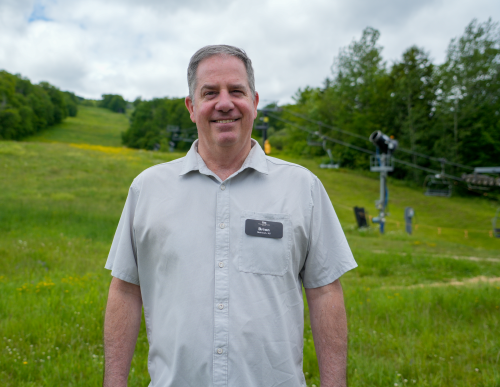
Vice President and General Manager Brian Suhadolc
Mount Snow in Dover wrapped its 2023-24 ski season on Sunday, April 21.
In an email, Vice President and General Manager Brian Suhadolc described the season as strong. The resort received positive feedback from guests.
“From our holiday celebrations in December and the New Year’s Torchlight Parade and Fireworks to the live music supporting our lively après scene, to rail jams and the Carinthia Classic Powered by Rockstar Energy Drink, we kept the vibe going strong throughout the resort all season long,” he wrote.
Mount Snow is one of three Vermont ski resorts under the ownership of Vail Resorts. The company named Suhadolc as Mount Snow’s vice president and general manager in 2022.
Suhadolc wrote that Mount Snow doesn’t share employment statistics. He wrote that the resort is proud of its employees and their work meeting visitors’ needs.
Recruitment is a top priority for Mount Snow. The Vail Resort network took measures to recruit and maintain employees in 2022. The efforts have paid off, Suhadolc wrote.
“In March 2022, we invested more into our team than ever before, spending an incremental annual $175 million across the Vail Resorts portfolio on staffing, with a $20/hour minimum wage, expanded benefits, seasonal frontline leadership development opportunities, an investment in new affordable housing and more – which have been instrumental in driving our success the last two seasons,” he wrote.
Employing staff, however, is only one side of the equation. Employees also need housing they can afford, which is a struggle for Windham County residents. Suhadolc said Mount Snow recognizes this challenge.
“Affordable housing needs to be a priority for the entire community, us included,” he wrote. “We know the nature of real estate in mountain communities exacerbates finding seasonal housing for workers.”
“We need people to come and support our tourist economy, but we also need affordable housing for our employees, and we’re committed to finding solutions to ease the burden,” Suhadolc added.
Suhadolc said that the mountain consistently invests in projects that maximize visitors’ time on the slopes, for example, improving the quality of snowmaking, grooming, lifts, and guest services.
In the 2022-23 season, Mount Snow underwent what its parent company calls Epic Lift Upgrades, a series of capital projects at resorts throughout the company’s portfolio.
“We have great data on how guests move around the mountain, which has informed investments in new lifts that have greatly improved the guest experience at the resort,” Suhadolc wrote.
At Mount Snow, these upgrades included the new high-speed, 6-person Sundance/Tumbleweed lift and the new high-speed, 4-person Sunbrook lift.
Mount Snow launched technology this ski season that allowed visitors to store their season passes or lift tickets on their smartphones.
“An excellent example of providing guest convenience is our Mobile Pass and Mobile Lift TicketTechnology, which eliminates the need to wait in line for a pass or lift ticket and is key for skiers and snowboarders,” he wrote. “This is different than a plane ticket, for example, because you don’t have to take your phone out of your pocket; the Epic Pass is read by Bluetooth® Low Energy technology.”
Suhadolc added that the digital-based pass reduces plastic and RFID chip waste. Plastic cards were still available to visitors who could not or did not want to use their phones as their pass.
For the upcoming 2024-25 season, Vail is expanding My Epic Gear, a ski equipment subscription program, to its Vermont resorts that it has operated at some of its other properties.
The subscription program claims to offer skiers and riders the benefits of gear ownership, but with more choice, lower cost, and no hassle. For a $50 membership, subscribers can choose from more than 50 gear models from 15 brands. The program provides free delivery or slope-side pick-up and drop-off so members can avoid carrying around their gear.
“You can select a model of skis or snowboard at the beginning of the season and get that model any day, fully tuned,” Suhadolc explained. “Let’s say it’s a powder day. You can try out different skis or snowboarding at any time. You can also get customized insoles and boot fitting as an option.”
Read more about My Epic Gear here: https://news.vailresorts.com/2024-03-19-Vail-Resorts-Launches-My-Epic-Gear-Membership-for-2024-25-Season-as-Company-is-Named-Among-Worlds-Most-Innovative-by-Fast-Company
An adult weekday lift ticket at Mount Snow can cost $119. Prices go up during peak ski times like weekends or holidays. Suhadolc said the mountain offers the Epic Pass, a membership program that can lower the average cost to ski at Mount Snow to $71 a day. According to Suhadolc, this program has made skiing and riding accessible to more people.
“It has transformed the industry by providing incredible value, flexibility, and access before the season starts,” he wrote.
Read more about the Epic Pass and Epic Day Pass here: https://news.vailresorts.com/2024-03-05-Epic-Passes-Now-On-Sale-for-the-2024-25-Winter-Season-Lock-in-the-Lowest-Price-to-Legendary-Resorts-Like-Vail-Mountain,-Whistler-Blackcomb,-Park-City-Mountain,-Breckenridge-and-More
Vail Resorts also continued its sustainability program, Commitment to Zero, which launched in 2017. The program seeks to achieve a zero net operating footprint by 2030. This includes “zero net emissions, zero waste to landfill, and a zero net operating impact to forests and resort habitat,” wrote Suhadolc.
“We’re all super excited by this commitment to make our mountains more sustainable and inclusive,” he wrote. “We have four pillars of our Responsibility program: Sustainability, Inclusive Access, Community Support, and we support our team through the Epic Promise Employee Foundation.”
Vail’s 2022-23 Environmental & Social Responsibility Report outlines the company’s progress toward its goals. For example, according to the report, Vail achieved 100 percent renewable electricity two years in a row across the company’s 37 resorts in North America. The company also met its energy efficiency goal ahead of its 2030 target and reduced landfill waste by 36 percent of its baseline.
Specific to Vermont, Mount Snow hosted members of the Nubian Empire Ski Club from Albany, NY, as part of Vail’s Inclusive Access program. The program seeks to increase access for members of the BIPOC community and provide adaptive measures for people with physical or mental needs.
When the summer floods hit Ludlow last year, Okemo shut down operations. Through Vail’s EpicPromise Employee Foundation, the organization provided disaster relief funding, including a donation to the Vermont Community Foundation and gift cards to grocery and hardware stores for Okemo employees.
Read the 2022-23 Environmental & Social Responsibility Report here: https://www.vailresorts.com/wp-content/uploads/2024/01/VR_ESR_Report_FY23-1.pdf
Suhadolc noted that even though the 2023-24 ski season has ended, Mount Snow will continue to operate in the summer and autumn.
The mountain operates lift-service mountain biking and scenic chairlift rides on its Bluebird Express. The Bullwheel restaurant serves food on the mountain’s summit. The golf course is open, and the resort hosts live musical performances.
“We welcome everyone to come join us!” he wrote.
To support great journalism, access our archives and get unique features like our award-winning profiles, subscribe HERE!