An example of a Wetlands Inventory Map of the parcel in Halfmoon Cove Wildlife Management Area in Colchester. The blue and pink areas represent mapped wetlands. The area in red is the parcel that was screened above. It shows that wetlands cover the entire parcel.
Vermont Business Magazine In celebration of American Wetlands Month, the Vermont Department of Environmental Conservation (DEC) wants to help land buyers make informed decisions when buying property with wetlands.
“When buying land, it is important to know if some or all of the property is part of or near a wetland,” said DEC Commissioner Jason Batchelder. “If you plan to develop your property, it may be necessary to obtain a wetland permit.”
Before purchasing property, find wetland locations and learn more about wetland permitting:
- Identifying Wetlands: Use the online Wetland Screening Tool.
- Wetlands Permitting: Check out the online and print permitting resources.
Wetland regulations can affect whether a property can be developed. Under the Vermont Wetland Rules (VWR), most development projects within 50 feet of a wetland require a permit. The rule applies to projects in or near wetlands on both developed and undeveloped parcels. Some examples of projects that often require a permit include those that clear vegetation, place fill, or build permanent structures.
Additionally, parcels of land that are mostly wetland – informally known as “swamp lots” – may not have enough upland area to be developed under the VWR. Aside from the potential financial and legal burdens of violating the VWR, building on swamp lots could result in other problems. For example, the wet soil could lead to mold, a backed-up wastewater system, a flooded basement, or a shifting foundation.
“Just as it is important to look for rust under a car before buying it, it is important to look for wetlands on a property before building on it,” said Laura Lapierre, DEC Wetlands Program Manager. “If you are thinking about buying a lot with wetlands, it is a good idea to reach out to your county’s District Wetland Ecologist.”
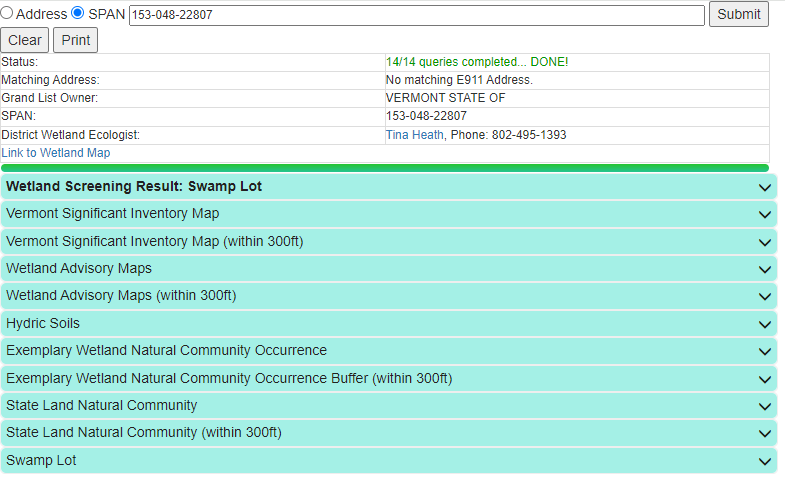
An example of the results from the Wetland Screening Tool. The parcel is located in Halfmoon Cove Wildlife Management Area in Colchester. It is marked as a “Swamp Lot” since it is entirely wetland. Clicking the “Link to Wetland Map” option on the left loads a map of wetlands on the parcel.
Learn more about wetland identification, permitting, and mapping. Contact a District Wetlands Ecologist. If Laura Lapierre is not available at 802-490-6177 or [email protected], contact Zapata Courage at 802-490-6179 or [email protected].
The Department of Environmental Conservation is responsible for protecting Vermont's natural resources and safeguarding human health for the benefit of this and future generations. Visit dec.vermont.gov and follow the Department of Environmental Conservation on Facebook and Instagram.
Source: 5.15.2024. Vermont Agency of Natural Resources, Montpelier, Website
To support great journalism, access our archives and get unique features like our award-winning profiles, subscribe HERE!