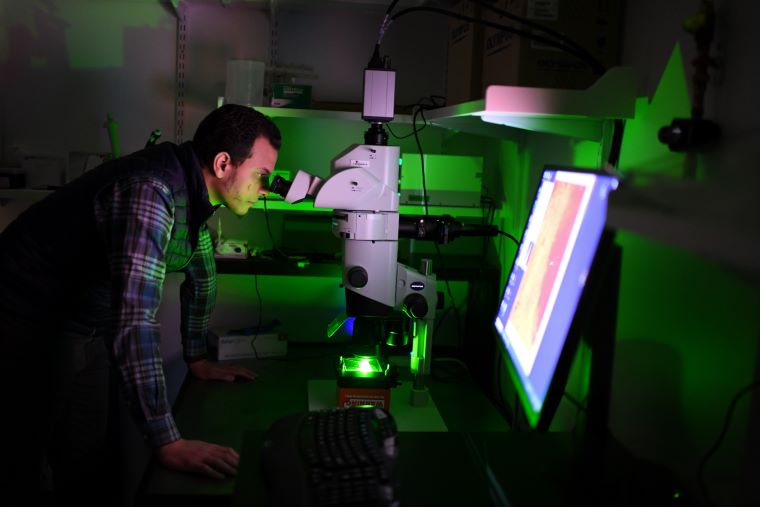
Photo of Osama Harraz, Ph.D. (Photo Credit: David Seaver)
Larner Scientist Seeks to Advance Neurodegeneration Research
Vermont Business Magazine Larner College of Medicine scientist Osama Harraz, PhD and his colleague from the University of Maryland, Thomas Longden, Ph.D. are recipients of a prestigious Collaborative Pairs Pilot Project Award from the Chan Zuckerberg Initiative’s (CZI) Neurodegeneration Challenge Network (NCDN). This award supports pairs of investigators and their teams in exploring innovative, interdisciplinary approaches to tackle critical challenges in neurodegenerative diseases and fundamental neuroscience.
Harraz and Longden's project will focus on the reprogramming of blood flow to satisfy the changing needs in different brain regions, a process that the team refers to as vascular signaling plasticity. Certain brain regions are engaged in energy-intensive processes—such as complex cognitive functions like learning or memory formation—and therefore require more blood flow to sustain their functions.
This is analogous to a flexible irrigation system delivering water to a field of crops depending on where growth is needed most.
“This is an exciting opportunity for Drs. Harraz and Longden to advance our scientific understanding of neuroplasticity aross the lifespan. Results of this innovative research will have implications for the treatment of neurodegenerative diseases and recovery from cerebrovascular and traumatic brain injuries,” said Kate Tracy, Ph.D., Senior Associate Dean for Research at the University of Vermont’s (UVM) Larner College of Medicine
The CZI’s Phase 1 Pilot Project Award empowers collaborating teams to explore new, transformative ideas related to neurodegeneration. Harraz, Longdon, and their supporting researchers at UMD and the Larner College of Medicine’s Harraz Lab will receive a total of $200,000 over 18 months to support their project. Successful progress in this phase may lead to eligibility for a Phase 2 Pilot Project Award, where the chosen Collaborative Pairs teams would receive an acceleration grant of $1.6 million over four years.
The impact of blood flow in the brain extends beyond the provision of energy; Harraz, the Bloomfield Early Career Professor in Cardiovascular Research and an assistant professor of pharmacology at the Larner College of Medicine, recently showed that the associated forces with flow are sensed through mechanical interoception. While a link between vascular signaling plasticity and brain blood flow sensing has not been established, Harraz, Longden, and their respective teams will delve deeper into this possible connection and its impact on neurodegeneration. Their goal is to demonstrate whether manipulating blood flow sensing and vascular signaling plasticity could potentially slow, stop, or even reverse the progression of neurodegenerative diseases.
Collaborative Pair Awardees must hold a Ph.D. or M.D., hail from separate institutions, be classified as early or mid-career investigators and provide a statement on diversity and equity, among other criteria. Awardees are selected based on the quality of the scientific team, the extent to which the collaboration leverages complementary strengths and the potential of the work to advance neurodegeneration research or fundamental neuroscience.
“By unifying two distinct and challenging research areas—vascular plasticity and blood flow sensing—this project will unveil a novel dimension of brain plasticity which without the combined expertise of our groups would remain hidden,” said Harraz, who is also a member of the Vermont Center for Cardiovascular and Brain Health (VCCBH). “We are excited to bring together two teams of emerging scientists to test out-of-the-box ideas, that could lead to breakthroughs and novel therapies that are much needed to combat neurodegeneration.”
Awards such as this exemplify the impact of private funding in advancing science and medicine. Unlike public funding avenues, private institutions like CZI enable researchers to explore cutting-edge concepts beyond their usual investigations. They are more inclined to take risks and invest in unconventional or high-risk, high-reward projects that public agencies might find too speculative. This support for innovative ideas fosters scientific breakthroughs and drives progress across various fields.
For more information about the Chan Zuckerberg Initiative’s (CZI) Neurodegeneration Challenge Network (NCDN), click here.

Photo of the Harraz Lab team members, from left to right: Mohammad Elmahdy Ph.D., Grace Ebner, Emily Xin Rui Lim, Ph.D., Osama Harraz, Ph.D., Michael Ippolito (Photo Credit: David Seaver)
About the Larner College of Medicine at the University of Vermont
Founded in 1822, the Robert Larner, M.D., College of Medicine at the University of Vermont is dedicated to developing exceptional physicians and scientists by offering innovative curriculum designs, state-of-the-art research facilities, and clinical partnerships with leading health care institutions. The College’s commitment to excellence has earned national recognition, attracting talented students, trainees, physicians, and researchers from across the country. With a focus on diversity, equity, and inclusion, the Larner College of Medicine prides itself on cultivating an environment that uplifts and supports its local community, faculty, and student populations while advancing medical education, research, and patient care throughout Vermont and beyond.
Source: 2.21.2024. BURLINGTON, VT—Larner College of Medicine med.uvm.edu