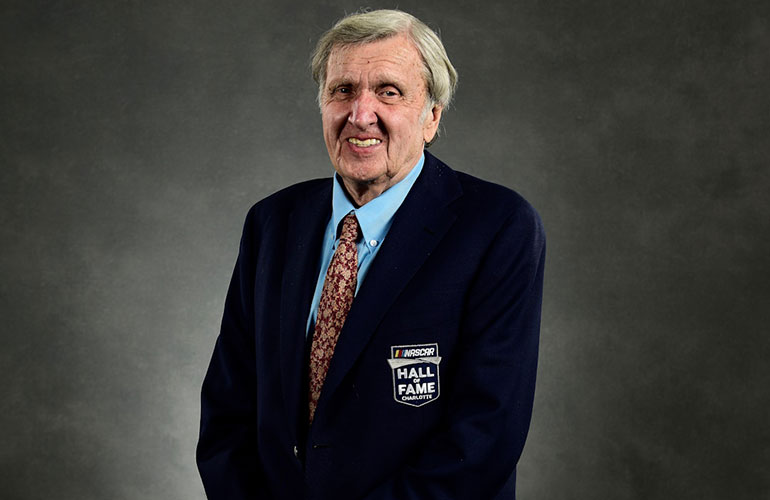
Ken Squier. NASCAR Hall of Fame. Courtesy photo.
by Timothy McQuiston, Vermont Business Magazine
There are some famous Vermonters who are more well known outside of Vermont than in. Ken Squier is one such individual.
Squier, who died Nov. 15 at 88 years old, is famous across the nation as the voice of motor sports. From 1979 to 1997, he served as the lap-by-lap commentator for NASCAR on CBS, followed, after a short break, by another 16 years of race commentary on TBS. He was the first announcer to give lap-by-lap commentary for the Daytona 500, a competition he coined “The Great American Race.” For these and other efforts, Squier was inducted into the NASCAR Hall of Fame in 2018, the first full-time media person to be so honored.
Richard Petty and Dale Earnhardt Jr., the Michael Jordan and Kobe Bryant of stock car racing, are among the many to sing Squier’s praises and send their condolences.
On the day after Squier’s passing, Earnhardt tweeted: “Ken Squier was there when NASCAR was introduced to the rest of the world in 1979 for the Daytona 500. I’m convinced that race would have not had its lasting impact had Ken not been our lead narrator. We still ride the wave of that momentum created on that day. Ken’s words and energy were perfection on a day when Nascar needed it. I am forever grateful for his major role in growing stock car racing. RIP.”
Closer to home, Gov. Phil Scott, who made his name not as a construction business owner or politician but as a successful stock car racer at Thunder Road in Barre, the track that Squier built, eulogized his old friend this way: “I will always cherish the memories of all the time we spent together and be thankful for his mentorship, humor, creativity and passion. From the booth, he often described those racing as ‘common men doing uncommon things.’ But in reality, he was describing himself — because Ken was indeed a very common man who did extraordinary things.”
Kenley Dean Squier was born April 10, 1935, into the radio family that owned WDEV in Waterbury. He owned the station till the day he died (see full obituary at www.wdevradio.com).
The studio is on Stowe Street in Waterbury in a red brick building typical of old New England downtowns. You go in a wooden door fitted with a glass window that does not exactly boast of a going concern. You trudge up to the second floor on suitably rickety steps into a Spielberg movie set of a postwar radio station, with stuff piled high and snug recording booths, from which something magical would, of course, happen. And it happened every day.
The place smelled of radio. They played the music that serenaded you on the way to the dump (now called a "transfer station") on Saturday mornings. Local talk shows featured commentary from the distant shores of the right and the left. The musical programs were from the middle.
In a state rich with local, commercial radio news operations, WDEV may be the last one standing. The station also still broadcasts the Motor Racing Network, which Squier co-founded and which continues to broadcast NASCAR races on radio stations around the United States.
Not long ago, a few years after his retirement, Squier jumped in to call a couple of laps of the Daytona 500. He still had it, his voice and observations zipping around the track. It surprised me, because I never knew him as a young man.
The first time I met Squier was in the 1990s, and he told the story he often did about the auto racing epiphany the nation had after World War II. There was simply too much energy in the country to sit around and watch baseball. People wanted to get out and race automobiles, like the ones parked in their driveways. Stock car racing was truly born.
Squier founded two tracks in Vermont, the aforementioned Thunder Road and Catamount Stadium in Milton (rest in peace.)
Along with motor sports, as part of his TV deal, Squier called golf, of all things, and he loved that too. He was also a great fan of the Vermont Symphony Orchestra, jazz music and the communities of Waterbury and Stowe.
Squier was at the microphone during the famous on-track altercation between Cale Yarborough and Donnie Allison after a wreck gave Richard Petty the 1979 victory at Daytona. That fight made Petty famous — and put stock car racing on the map.
Squier never sought the spotlight himself, content to be at once famous and unassuming as he lived out his days in central Vermont. The last time I saw him was in 2021 at the Essex Junction train station, where he excitedly caught the first Amtrak Vermonter post-COVID.
Squier was, as always, in great spirits, with great enthusiasm for the trip that lay ahead.