Vermont Auditor of Accounts Doug Hoffer Ensuring Vermont has a sufficient number of nurses in our workforce is critical to meeting Vermonters’ health care needs, so I asked my staff to research the State’s nursing recruitment and retention incentive programs. The report is available on our website here.
The State has created numerous incentive programs in recent years, and while it can be tempting to conclude that any positive benefits justify the programs’ continuance, it is vital that precious funds be spent in ways that most effectively recruit and retain nurses and that maximize those nurses’ contributions to our health care workforce.
Our research found:
- The absence of performance measures and gaps in data collection make it challenging to determine if the incentive programs are working.
- A lack of internal controls between the Agency for Human Services and the Vermont Department of Health could result in recipients receiving two awards for the same year of required nursing work in Vermont.
- State-funded incentive programs do not appear to be coordinated with hospitals’ own recruitment and retention strategies, risking inequitable award amounts and inequitable geographic distribution of program benefits.
This memo is intended to provide a high-level summary of our findings and to offer suggestions to improve the efficacy and accountability of the incentive programs. This is an opportune time to modify State nursing workforce programs for two primary reasons.
First, not all funds have been awarded so it’s possible to improve program design and establish performance measures in time to apply them to many awardees. The information provided to us by AHS and VDH in Exhibit 1 shows program funds distributed as of November 28, 2023.
Second, maximizing the impact of the incentive programs can only help reduce hospitals’ reliance on traveler nurses. The reliance on travelers continues to be a budget drain, despite many hospitals making concerted efforts to move away from the use of travelers or to negotiate for better rates.
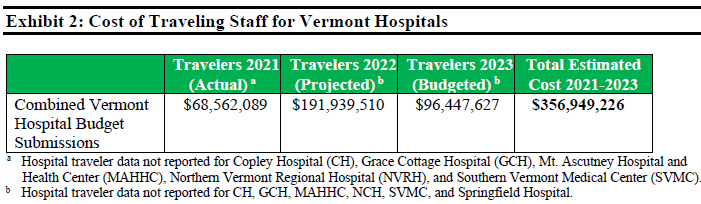
While we know the sum is very large, the true cost of traveling staff for Vermont hospitals remains unclear because of inconsistencies in how hospitals have been tracking and reporting these expenses.
According to the Green Mountain Care Board’s (GMCB) Director of Health Systems Finance, this leads to a potential underestimation of the system-wide reliance on traveling nursing.
The Director further explained that some hospitals report traveling nurses and physicians together, while others budget contracted nursing support as part of the overall nursing budget [which would understate the amount of traveling nurse expense reported to GMCB]. The Director stated that GMCB is currently evaluating the reporting process.
Over the past three years, the estimated cost of traveling health care staff in Vermont hospitals was $356.9 million. Exhibit 2 shows the combined cost of traveler staff at all 14 Vermont hospitals.
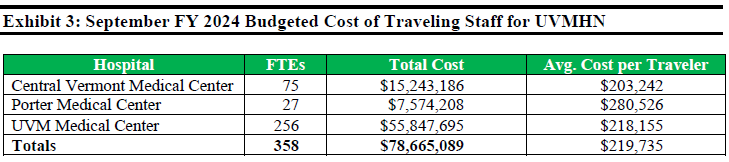
UVM Health Network (UVMHN) facilities accounted for a significant portion of the traveling staff costs shown in Exhibit 2. The FY 2023 budgets for their three network facilities included an increase of $52 million for nursing travelers alone.
The projected cost of traveling staff (including MDs) for FY 2024 is almost $79 million based upon the UVMHN’s budget submissions. See Exhibit 3 below for the breakout by UVMHN facility.
Travelers are paid at a premium; typically costing twice that of permanent staff. The pay differential can be a contributing factor in retention challenges for permanent staff positions. Any reduction of spending on traveling staff could be redirected into recruitment, training, and retention of permanent nursing staff, ultimately reducing the need to rely upon costly traveler nurse contracts – a virtuous cycle.
Background
The State of Vermont has numerous nursing recruitment and retention incentive programs. Each has different program requirements. Collectively, the intent of these programs is to enhance and expand the state’s health care workforce.
The programs include scholarships, education loan repayment (ELR) and forgiveness, and grants administered by AHS CO and VDH. Some of the award programs include a service obligation requiring awardees to work in Vermont for various lengths of time following receipt of the award.
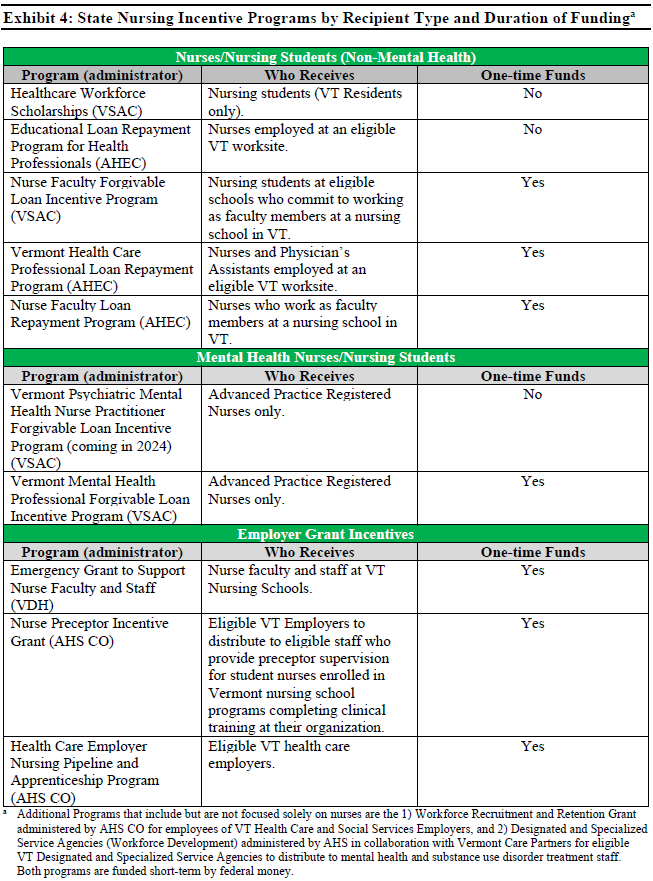
As shown in Exhibit 4, many of these programs are short-term, federally funded programs. Without additional resources, these programs will cease to exist. At the time of this memo, AHS has no plans to make these programs permanent.
Lack of Performance Measures for Health Care Workforce Initiatives
According to the AHS CO Health Care Workforce Director, recent projections of the demand for nurses1 are too low and not indicative of the current demand for nursing professionals in Vermont. The newly established AHS Health Care Workforce Data Center is expected to provide better data to understand the healthcare workforce. This data should enable more precise projections of nursing workforce needs over time and geographically throughout Vermont, allowing State officials to establish specific targets for the various nursing incentive programs. Officials do not expect such functionality for 1-2 years.
In the meantime, policymakers should desire to invest in the programs recruiting and retaining the greatest number of nurses for the longest duration at the least expense. However, there are no current plans for performance analysis of the recruitment and retention efforts of the health care workforce. Without performance measurement data and analysis, policymakers will be in the dark in terms of deciding which incentive programs, if any, should be funded and/or modified and which should be eliminated or curtailed.
A meaningful analysis is needed to understand how program efforts are directly correlating to growing and building the capacity of the Vermont nursing workforce over time. Without a defined process for planning, tracking, and reporting progress on the recruitment and retention of nursing staff, it is unclear how the State will measure its success at achieving intended results. A coordinated effort by AHS CO and VDH is needed to measure the performance of these incentive programs in successfully meeting the goal of increasing and retaining the long-term nursing workforce past any required service obligations. Progress in this area can and should start now.
Program Overlap
Service obligations for the State’s nursing incentive programs vary from none to one year of service (or two years for Retention Awards) per year of award as shown in Exhibit 5. While a person can receive awards under multiple programs, that individual is not allowed to fulfill multiple service obligations concurrently. We found that the lack of controls and inconsistently coordinated data across AHS CO and VDH incentive programs could allow for the possibility of concurrent service obligations or duplicative awards under multiple programs.
Individuals applying for the ELR program administered by Vermont’s Area Health Education Centers (AHEC) are asked to self-certify on the application whether they have a current or outstanding service commitment related to any other program. In effect, the State does not want a nurse to receive incentive funds from two sources for the same service year. Currently, Vermont Student Assistance Corporation’s (VSAC) applications do not include such a restriction on program/service obligation overlap, although language is being developed for next year’s application according to the VDH Public Health Nursing Director.
We confirmed with AHS and VDH that the current lack of coordination could result in a single service obligation period concurrently satisfying requirements for two different programs.
Further, according to the VDH Public Health Nursing Director, there is no process for verifying the list of awardees for state-funded programs to prevent this from occurring, although language is being added by VDH into their 2024 grant agreement with VSAC directing VSAC to share awardee lists with AHEC. VSAC currently provides identifiable awardee data to VDH. VDH had believed that VSAC was sharing their list of awardees directly with AHEC, who were verifying there were no duplicate applicants and then notifying VDH if it occurred. That belief was not well-founded. The AHEC Director stated that VSAC’s awardee data does not include identifiable information, and getting information directly from VDH has been challenging. Additionally, military or employer-based incentive awards create the potential for duplicative awards despite the intended restrictions. A coordinated effort by AHS CO and VDH is needed to ensure that the State’s intent to secure service for incentives is being carried out effectively.
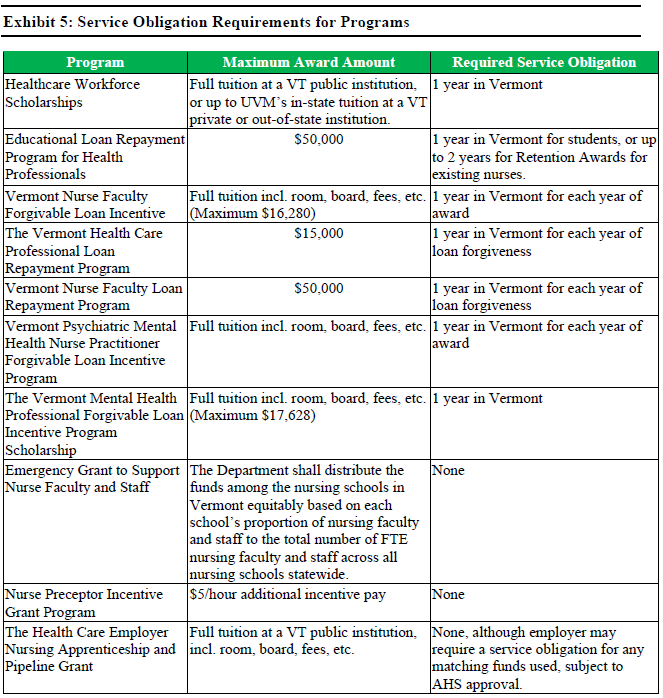
In addition to the lack of controls to prevent concurrent service obligations, two of Vermont’s three neighboring states, Massachusetts and New York, require longer service commitments for similar investments. This suggests Vermont could modify its programs to require longer service obligation commitments in exchange for each award. Furthermore, the annual median wage for an RN in Vermont in 2022 was $77,2302 which makes obtaining a nursing license a lifelong career investment. The service obligation should reflect not just the amount of the award, but the impact such an investment has on the lifelong career of a nurse.
Additional Incentive Programs
Nursing incentive programs at the hospital level (outside State budgeting) are an important resource to promote recruitment and retention and should be considered when developing state-funded programs. Different hospitals offer varying incentives based upon management decisions and/or financial capacity. Some hospitals, like Copley Hospital and Central Vermont Medical Center (CVMC), have implemented training programs that support career path development for current employees to increase their nursing workforce. Copley’s Nursing Assistant Education Program (NAEP) prepares participants to pursue careers as Licensed Nursing Assistants (LNAs). CVMC’s LPN Pathway program is employee-taught and is credited by management with savings in traveler expenses. In June 2021, 13 CVMC employees graduated and passed their Board exams to become LPNs. In another example, Gifford has partnered with Vermont Technical College (VTC) through the Joint Affiliation Nurse Educator Partnership program to help expand VTC’s nursing program. See Appendix I for a sample of existing Vermont hospital incentive programs.
State officials should consider these hospital-based programs when designing new or modifying existing nurse incentive programs. Vermont hospitals are not only competing against other states for nurses but are also competing against each other for a limited pool of candidates. If hospital-based programs are not taken into consideration, the State’s incentives may have the unintended effect of making it harder for more financially constrained hospitals to recruit and retain desperately needed nurses. It could also result in comparable nurses receiving disparate financial support in return for the same service obligation.
Suggestions to Promote Success and Accountability in Nursing Workforce Incentive Programs
- Develop quantifiable performance measures to determine the efficacy of the incentive programs you administer directly.
- Recommend language to the Legislature to align performance measures across all State-appropriated nursing incentive programs, regardless of who administers them.
- Align all State-funded incentive programs by establishing standardized service obligation and reporting requirements.
- Strengthen coordination of and harmonize AHS data across programs and departments relating to nursing incentives.
- Conduct outreach to nurses who have left Vermont to practice in other states to assess if retention efforts could have impacted their decisions and gather information about why they relocated.
- Conduct outreach to nurses who live in Vermont but are licensed in neighboring states (there are 641 licensed in Massachusetts alone) to determine what strategies might be effective to recruit them to work in Vermont.
- Establish longitudinal tracking of award recipients and control groups to analyze the effect the awards and duration of awardees’ participation in Vermont nursing workforce.
- Require awardees to provide basic data for a period of time after service obligation to facilitate program evaluation. The data should include, at least, employer and physical place of employment.
- Consider increasing the number of work years required of awardees to maximize funding.
While these suggestions are focused on the nursing workforce incentive programs, they could be applied equally to State workforce incentives for any industry (e.g., dental). Our suggestions, therefore, can improve the nursing programs while informing health care workforce strategies across the health care spectrum.
My staff and I have chosen not to audit any of these programs at this time, largely because many of them are too new to have a track record to assess. Before reaching this decision, my audit team conducted substantial research into the relevant programs in Vermont and in our neighboring states. We are happy to meet with you to discuss any of what they found. We will continue to monitor these issues, and I look forward to seeing the results of the State’s nursing workforce efforts.

Click here to read the memorandum.
1 Current and Projected Future Health Care Workforce Demand in Vermont
Source: 12.22.2023. Office of the State Auditor www.auditor.vermont.gov