Vermont Business Magazine As Vermonters prepare for the approaching cold weather, the Department of Environmental Conservation (DEC) is urging drivers to switch off their ignition to limit unnecessary idling of their vehicle engines.
“Idling gets you nowhere,” said DEC Commissioner Batchelder. “It wastes fuel and money, causes excess engine wear, and pollutes our air which impacts our health and environment.”
Motor vehicles are the largest source of air pollutants and greenhouse gases in Vermont. The exhaust from vehicle idling degrades air quality for all Vermonters and is most detrimental to children, older adults, and people with heart or lung disease.
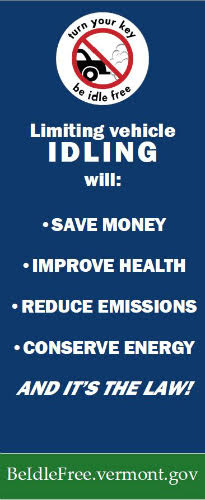
Limiting vehicle idling will save money, improve health, reduce emissions, conserve energy, and it’s the law.
If every car and truck in Vermont reduced unnecessary idling by one minute per day over one year, Vermonters would save over one million gallons of fuel and over $4 million in fuel costs as well as contribute to cutting carbon dioxide emissions by more than 10,000 metric tons.
You can help protect Vermont’s clean air and avoid unnecessary idling by:
- Turning off your vehicle when you are stopped for 10 seconds or more, except in traffic (30 seconds for heavy-duty vehicles).
- Warming up your engine and vehicle by driving gently. If needed, limit idling to 30 seconds (three to five minutes for heavy-duty vehicles), even in cold weather. Make sure windshield defrosting is adequate before driving.
- Use indoor spaces or waiting rooms instead of sitting in your idling vehicle.
In Vermont, the state law limits all motor vehicle idling to five minutes in any 60-minute period with some exceptions. Local jurisdictions may have additional idling limitations in place. The School Bus Idling Rule also states that school buses shall not idle while picking up and dropping off children on school property. Learn more at BeIdleFree.Vermont.gov.
The Department of Environmental Conservation is responsible for protecting Vermont's natural resources and safeguarding human health for the benefit of this and future generations. Visit dec.vermont.gov and follow the Department of Environmental Conservation on Facebook and Instagram.
Source: 12.6.2023. Montpelier, Vt. – DEC.