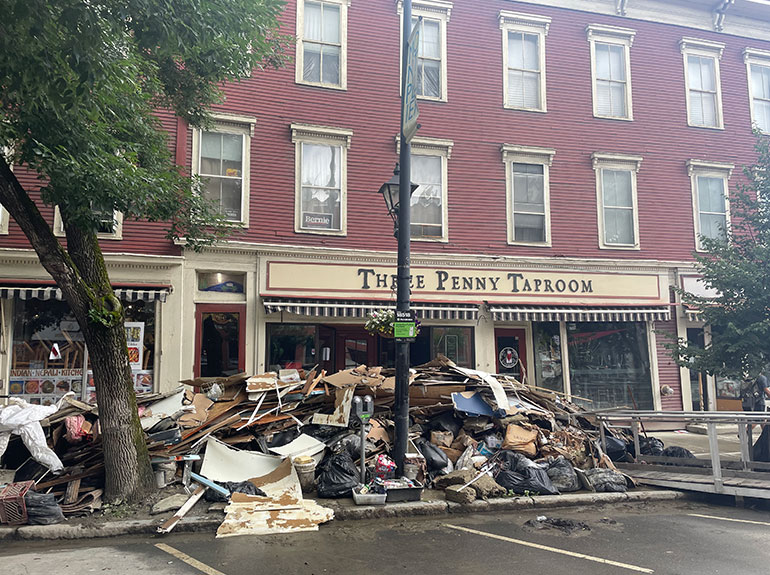
Montpelier cleanup after the flood. VermontBiz photo.
Region had adapted to a post-pandemic economy. Then the rains came
by Olga Peters, Vermont Business Magazine A conversation about Washington County’s economy starts with a question: Were you flooded?
The county’s economy had achieved — or at least adapted to — a new normal after several years of upheaval from the global COVID-19 pandemic. Yes, central Vermont felt the same squeeze from shortages that confronted neighbors across the state: housing, workers and affordable child care. Still, many businesses’ ledgers contained more black ink than red.
They’d reached a new normal, said Melissa Bounty, executive director of the Central Vermont Economic Development Corp. (CVEDC).
“2023 felt by all accounts like it was going to be a very successful summer and fall,“ she said.
Then, the July floods came.
According to the National Oceanic and Atmospheric Administration, the combination of a slow-moving storm, high winds and already wet conditions in the air and soil contributed to several rounds of flooding in July. The heaviest rain fell over a 48-hour period on July 10 and 11.
In central Vermont, rain totals ranged from 3 to 9 inches. Many of Vermont’s rivers crested at levels that broke their previous records. According to NOAA numbers, the Winooski River crested at 21.35 feet on July 11, 2 feet higher than during Tropical Storm Irene.
Areas of the state also experienced flash and localized flooding on July 7, 13, 14 and 16, according to the NOAA. Monitors at Montpelier Airport recorded 12.06 inches of rain throughout July, which broke a previous record set in 1989.
More than three months after the flooding hit, communities like Barre City and Montpelier continue in recovery mode. For many, the future is hopeful but uncertain.
Meanwhile, the communities spared by the rains look forward with a sense of growth and survivor’s guilt.
Perhaps no community will be spared completely from the floods’ economic ripple effects.
Currently, most communities are focusing on cleaning up, making repairs and returning to business as usual. But as the calendar nears the first quarter of 2024, a traditionally slow time for many businesses, what long-term economic impacts will they experience?
Reviewing the early flood-related data worries Bounty.
“I am concerned that it will have a broader impact than anyone was guessing,“ she said. “What if a steak costs $50 in February at a good restaurant in Washington County? That’s going to change things.“
Barre City and Montpelier anticipate municipal budget deficits in the millions. The rainy summer took its toll on agriculture, raising uncertainty around finding adequate animal feed this winter.
In some areas, the weather also reduced the number of summer visitors.
“I think the implications of that rainfall are often broader and more subtle and less flashy than 6 feet of water in downtown Barre or Montpelier,“ said Christian Meyer, executive director of the Central Vermont Regional Planning Commission.
The commission gathers trail count data from hiking areas in Waitsfield. This summer, Meyer noticed the number of people on the trails was half that of previous years. Then, he checked the rainfall data for June, July and August. It was twice that of previous years.
“It really impacts the tourist economy, and it impacts folks even going out to restaurants and walking the streets,“ he said.
And what about the revenues and wages lost when businesses closed? Could this mean less money circulating in the local economy in general?
According to Bounty, people probably won’t see the impacts until December, January or February.
Immediately after the flooding, Bounty provided testimony on the Washington County economy.
“I said that I felt like a doctor where all my patients weren’t going to make it,“ she said.
Wet File Cabinets and Muddy Streets
Flood waters inundated areas of Barre City and Montpelier.
Barre City’s residential areas experienced more damage than its downtown. Yet, several of its high-paying employees suffered damage. The floods left behind layers and layers of mud and silt.
In Montpelier, three municipal buildings sustained damage. More downtown businesses received flood damage than residential areas.
Compared to 2011, when Tropical Storm Irene swamped Waterbury, the city sustained minor flood damage.
Bounty became the CVEDC’s executive director in March. As part of her work with the organization, she spent the first 10 days after the flooding developing a dollar assessment of the physical damage. She estimated $90 million for Montpelier and $80 million for Barre.
Those early estimates have held — so far
“It did mean that it was almost a 50-50 split in terms of physical damage between the two downtowns,“ she noted.
Still, the type of damage done is different, she said.
The dominant impact on downtown Montpelier happened to small retail businesses and restaurants employing few people. Several of the city’s 10 key, high-paying employers were hit in Barre.
“These are employers who might be paying $60 or $70 an hour for engineers and other professions,“ she said. “That individual may be the breadwinner of a family of five. So the economic impact of the devastation of those 10 businesses is exponentially much greater than the economic impact of probably any Montpelier business.“
Preserving Housing in Barre City
Barre City’s economy is diverse, said City Manager Nicolas Storellicastro.
“It’s a little bit blue collar, a little bit white collar — a little bit of everything going on in Barre,“ he said. “It’s one reason I love this place.“
Economic sectors include manufacturing, such as granite work; state offices; and professional services, like law firms.
According to Storellicastro, most Main Street businesses lost inventory due to flooded basements. To his knowledge, none took much, if any, water on their first floors.
He said a few businesses located in the floodway and floodplain will likely close permanently or move.
Replacing lost housing stock occupies the city’s immediate focus.
Storellicastro anticipates a $2 million budget deficit for the municipality between requests for tax reductions and unplanned flood expenses.
“That’s a $2 million gap opening up in a $13.7 million budget. That is a big gap,“ he said. “We’re not going to nickel and dime the supplies budget to close a
$2 million gap.“
Storellicastro said 70% of the budget is fixed costs such as negotiated contract wages and insurance. In the long run, the city will recoup some flood money from the state or federal government. The city will also use its budget surplus.
In the short term, however, Storellicastro anticipates cash flow issues. In response, the city opened a $3 million line of credit.
“There’s no way to get out of this without some state or federal assistance,“ he said.
Without added assistance, the city risks dramatic tax spikes and service cuts. He’s asked state House and Senate members to consider a multiyear recovery assistance.
With the number of housing units taken by the flooding, Storellicastro worries that the city’s population may dip. It could leave fewer residents and businesses carrying a larger portion of the financial load.
If the Federal Emergency Management Agency buyouts of significantly damaged homes happen next year, then that means 30 to 40 former housing lots must remain perpetual green space.
Property buyouts are a method used by FEMA to reduce future flood damage. The agency will purchase some flood-prone properties from owners. The buildings are then demolished, and no future structures are allowed on these sites.
“You take 30 to 40 parcels off the tax rolls,“ he said. “That’s just adding to the burden of the people left behind.“
No Elevator in Montpelier City Hall
“The summer floods knocked Montpelier’s economy down several rounds,“ said Mayor Jack McCullough.
“This summer, we were really starting to feel like we were coming back pretty well. Businesses were open. People were out and doing all that stuff,“ he said. “And then June and July came, and we flooded. That’s really been a major setback.“
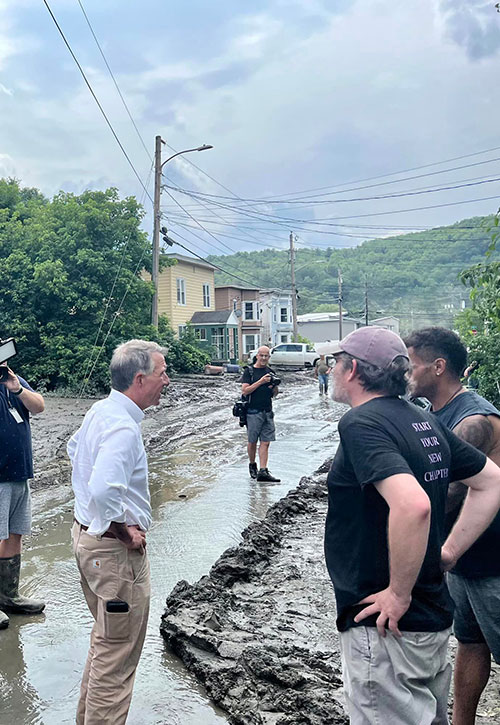
Photo: Gov. Scott surveys flood damage in Barre. Courtesy photo
McCullough explained that state government is a significant part of Montpelier’s economy. The city also hosts nonprofits and professional organizations attracted to the area because of state government. Many of the downtown businesses are locally owned. Recently, the city launched an initiative focused on using Montpelier’s proximity to outdoor recreation opportunities to attract visitors.
Even metered parking plays a role in the city’s budget. Parking typically generates $50,000 to $60,000 a month, McCullough said.
The shift to remote work since the pandemic also concerns the mayor.
“We count on the state employees every day to eat in our restaurants and shop in our stores, many of which are very unique,“ he said. “If they’re not spending their money, that’s a problem for us.“
William Fraser, Montpelier’s city manager, agrees.
“I’d say the biggest hole we had post-pandemic was state workers not coming back to work, or working remotely,“ he said. “Where we once had 2,000 state jobs situated here, now there’s maybe 1,000. I think that’s had an impact on our retail community, particularly the lunchtime crowd.“
In Montpelier’s case, the municipality itself is rebuilding. Flood waters damaged three city-owned buildings — the Fire Department, Police Department and City Hall, which sustained the heaviest damage.
“We’re really evaluating what we’re going to have to do with City Hall to make it more resilient to future floods,“ said McCullough. “That could involve doing some significant reconfiguring to the building’s uses and where things are located.“
As of mid-October, the city was gathering cost estimates to understand the extent of the damage before deciding the next steps. McCullough anticipated it would be a while before City Hall fully reopens.
According to Fraser, Montpelier is looking at about $10.8 million in damages to city-owned property. For now, City Hall is a little catawampus.
Its basement flooded and is now gutted. Supplies and files relocated from other areas of the building fill the City Council chambers on the first floor. Water damaged the elevator’s mechanics. These must be replaced and possibly moved to a higher floor. Meanwhile, the building is sans elevator.
“We still have city employees working in our Senior Activity Center, which is displacing some of their activities,“ he said. “The Zoning Department was down in the basement, and so a lot of files and things like pending zoning and building permit applications got flooded.“
The city has asked people to supply fresh copies of their zoning applications and building permits.
Montpelier officials are anticipating a $1.5 million budget deficit this fiscal year. Contributing factors include a reduction in rooms, meals and alcohol tax collections due to the temporary closing of several restaurants and hotels, and a drop in property tax revenues owing to an anticipated increase in abatement requests.
McCullough has repeatedly told Vermont’s congressional delegation that federal loans aren’t enough to solve the city’s fiscal woes. Grants must also be a part of the equation.
Waterbury Considers 1% Option Tax
Thankfully, when summer floodwaters poured into Waterbury, its water levels didn’t rise to the degree seen under Irene. Approximately 150 buildings sustained damage in July.
As an example of doing better but not unaffected, Karen Nevin, executive director of Revitalizing Waterbury, sat shivering in her 56-degree office on South Main Street in mid-October while waiting for contractors to finish replacing the furnace.
“Loss of business continuity may have happened for certain businesses even if the floodwaters didn’t flood their store,“ Nevin said. “My building is a perfect example where some businesses couldn’t function because there was no electricity.“
In Nevin’s opinion, Waterbury weathered this round of flooding in part due to lessons learned from Irene. The community implemented multiple resiliency measures over several years. These included infrastructure upgrades such as the 2019 Vermont Agency of Transportation’s Main Street Reconstruction project. The work included digging down 12 feet, finding the old water and sewer lines, replacing the entire system and increasing its capacity.
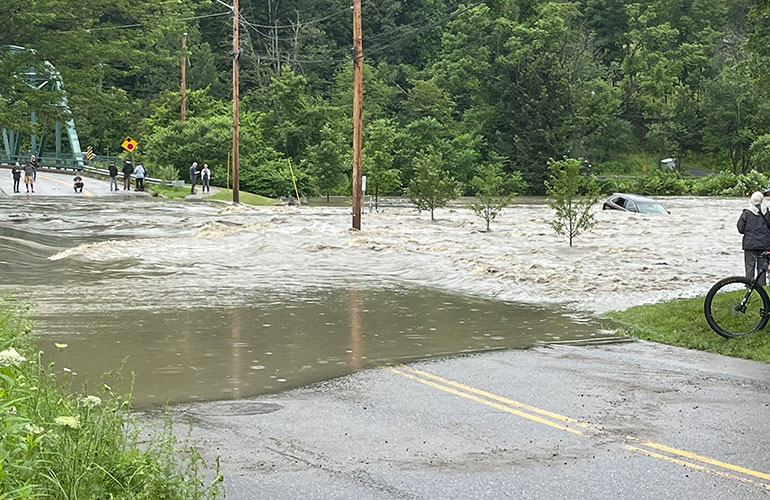
Photo: Flooding in Waterbury. VermontBiz photo.
“I have no heat because they are literally taking the entire furnace and putting it on the roof,“ she said. “The next time it floods, the basement will get wet —because it always get wet — but the power won’t go out. Things will keep functioning.“
There’s a street drain visible from Nevin’s office window that no longer backs up.
“Five years ago, when we’d have just a good old-fashioned rainy day, that drain would fill up, and the whole part of this road would just be a great big, flooded puddle. Now the drain manages the water,“ she said.
One economic challenge facing Waterbury is the need for more affordable child care. Municipal Manager Thomas Leitz said enrollment for the city’s eight-week summer camp is usually booked to capacity within hours by residents eager to shell out the $100 weekly fee to keep their children occupied, safe and happy.
Leitz added he’d like to expand the program from its current capacity of 160 children to at least 200, while also increasing the number of weeks it operates.
“I feel like that’s a huge add to the economy if we can give people affordable child care,“ he said.
One gap in the community’s economy is the drop in daily office workers frequenting downtown businesses since the onset of the pandemic. Leitz believes increasing the number of housing units downtown is one way to offset this dearth of business patrons.
If passed, the measure would levy a one percent sales tax on meals, alcoholic beverages and rooms, and some retail sales.
Based on data from the state Tax Department, Leitz estimates that by the time the option tax starts being collected in 2025, it will generate within the range of $700,000 in revenue annually.
He said residents should consider that money as something other than new revenue to feed the municipal budget. Instead, it can leverage the city’s ability to borrow money and manage its debt.
“At today’s interest rates, for every million dollars we borrow, if we’re going to pay that back over 20 years, we pay about $70,000 a year,“ he explained. “So at $700,000 a year, that gives us the ability to borrow $10 million without impacting your tax rate.“
The ability to borrow money at low interest rates is one of the biggest levers municipal governments have to access cheap cash, Leitz said.
“We can, in theory, have town meeting days in the future where we ask voters to approve improvements to the town paid for with the local option tax,“ he said. “So you can have some things that don’t impact your tax rate.“
Nevin sees strength in the Waterbury economy. The city has new restaurants and a new art gallery, businesses have plenty of customers and entrepreneurs are always looking for new business opportunities in town. The community hosts a robust health and wellness sector.
Keurig Dr Pepper moved out of Pilgrim Park. In the big picture, Nevin said the loss is a good thing.
“The benefit to that is we’re no longer a one-company town, which is what we were for years,“ she said.
This meant that layoffs had an outsized effect on the whole community.
A local developer has since purchased the property.
Nevin said the variety of smaller businesses now located at Pilgrim is healthier for the economy. If one of the smaller businesses should leave in the future, there are another 10 businesses still at the park. She was excited by a new company called Mavic moving into the property this year. The Canadian company manufactures bicycle tires.
Many of the downtown’s office spaces have emptied since the pandemic. Nevin doubts state employees will ever fully return to the state office complex.
“We miss having all those people in town,“ she said. “Every single one of those bodies doesn’t come out and go get lunch anymore. They don’t go and do their shopping after work, and they don’t get their car repaired. They don’t go to the dentist. So that’s a significant loss.“
Rebuilding a Sense of Empowerment
CVEDC set up a pop-up flood recovery center for three months after the flood. Staff counseled business owners and their employees on the next steps and helped them access resources. They met with over 1,000 individual business owners.
Organizations such as The Vermont Professionals of Color Network, the Center for Women and Enterprise, and fellow RDCs sent staff to support CVEDC’s work. Professionals from the Small Business Development Center also donated an equal number of hours.
Bounty said she felt grateful for the extra staffing. It meant more people received help than Bounty and her staff could have provided alone.
“I think that we created an environment that felt safe for people and was in contrast to other job centers that were led by FEMA or SBA, where there was one purpose, and it was to do the paperwork for a specific loan,“ she said. “We tried to have a much more holistic approach.“
Bounty said the councilors listened to people’s stories. She said business owners needed to find mental health, housing and food resources as much as business recovery funds.
Bounty created an assistance guide for staff. One whole section was devoted to “comparing yourself to others.“
“People would come in really fired up. They’d say, ’My neighbor’s landlord has been so much more responsive than my landlord,’ or ’My neighbor had just come into an inheritance of $50,000, and this is so much easier for her. I’m so mad at my neighbor and so jealous of my neighbor,’“ she recalled.
It’s hard to feel these complex emotions and rebuild from a flood simultaneously, Bounty added. She also believed people needed to share these feelings as part of their rebuilding.
“If you don’t feel empowered, how the heck can you make any decisions about your livelihood, your income, your day-to-day and your business?“ Bounty said.
FEMA assistance does not cover private business flood recovery. While the state’s Business Emergency Gap Assistance Program targeted businesses, nonprofits and agriculture losses, it closed down in late October.
However, the Vermont Main Street Flood Recovery Fund is taking grant applications through Nov. 15. This opportunity for a $2,500 award is exclusively available for small businesses that have not yet received a Main Street Recovery Fund grant.
Thanks to the support of individuals, businesses and communities, the fund has successfully raised over $800,000, enabling the distribution of nearly 300 grants to small businesses.
These checks are meant to provide needed bridge funding as these Vermonters regain their footing. Funds cover flood-related expenses, bolstering recovery efforts.
Possible Impacts on the Horizon
Bounty said people should note that the state has made strides in its disaster response systems since Tropical Storm Irene.
“If we look at COVID, if we look at other things that are similar, if we look at Irene, I think that lessons were taken from (these experiences) in terms of support and practical, human-facing things, how decisions were made, and I think equity and inclusion were considered,“ she said.
How this flood will strike communities in the future remains unknown.
Bounty expects the effects will be considerable. The CVEDC is collecting data to build long-term economic forecasts.
“I have one business that has $6.5 million of uncovered net economic injury. And that’s huge. I have one business that has $5 million of physical damage, and that’s huge,“ she said.
She added that it’s essential to tally both types of costs. They will fluctuate depending on how much a business was damaged by the flood, its size, business model and how its supply chain — goods, supplies and staff — connects to other damaged businesses.
CVEDC is compiling reports about various flood outcomes. Staff are even speaking with business owners who felt no direct physical impact from the flood. According to Bounty, the process includes questions about local sourcing of raw materials, local sourcing of foods for restaurants, and pricing of goods and services.
“It’s really indicating that this flood has a devastating and broad economic impact,“ she said.
According to Bounty, early estimates for the long-term outcomes clock in at $300 million. She expects the current number to be on the low side.
“When 87% of restaurant owners say, ’I used to source 75% or more of my food locally, and it’s either not available, or it’s doubled in price,’ I know that’s going to have an economic impact that we’re not measuring or defining yet. But that will show up,“ she said.
It’s Not Over Yet
The municipality opened the Barre City pool the weekend after the flood to help residents forget about their problems for a few hours.
“It wasn’t going to fix everything,“ Storellicastro said. “But maybe for someone just having a bad day, to forget the flood was something they needed.“
He stressed that even after the physical damage caused by the flooding has been addressed, the emotional trauma it wrought will still linger in many Vermont communities.
He recalls that many people, especially in Barre City’s North End, were rescued on bucket loaders.
Children who experienced the upheaval of COVID may now be living in temporary housing due to the flooding, he added.
“I think it’s important that as governments, we don’t forget to make sure that the trauma is addressed, making sure people have the resources they need to cope with this,“ Storellicastro said.
Olga Peters is a freelance writer from Windham County.