


Photo: A West Addison farm. VermontBiz photo.
Middlebury, the county seat, is home to the county’s two largest employers: Middlebury College, with 1,200 employees, and Porter Medical Center, with just over 700 staff. Rounding out the top five are Collins Aerospace, in Vergennes, and Counseling Service of Addison County and The Residence at Otter Creek, both in Middlebury.
Home to everything from hard-cider manufacturers and construction services to car dealerships and a toy company, the area is rife with a diversity of industries.
New developments in the business arena offer an exciting outlook for Addison County. Still, many businesses are struggling to regain their footing following the pandemic. Are business owners optimistic about the state of the economy and new opportunities? Or are they weighed down by challenges in the current business landscape?
What’s New in Addison County?
“Addison County’s greatest strength is the diversity of our economy, which ranges from mom-and-pop operations to value-add agriculture to large manufacturers such as Collins Aerospace,” said Fred Kenney, executive director of the Addison County Economic Development Corp. “There is growth in most sectors, including small manufacturers and machine shops; specialty food and beverage producers; and some retailers.”
The Neighborhood Development Area Designation, created to help developers and municipalities plan for new development in the downtown area, was granted to the town of Middlebury earlier this year. The designation was one of two awarded in Vermont by the Department of Housing and Community Development’s Downtown Development Board.
The building of necessary housing, including Stonecrop Meadows, is one such project. This multi-unit, mixed-income development will create additional housing in the area. Benefits of the program include a 50% reduction on an Act 250 application fee, exemption from the land gains tax and reduced wastewater permit fees.
Other housing projects are in the works.
David Provost, executive vice president for finance and administration at Middlebury College, said the school recently purchased 35 acres in town and is working with a local developer to turn the parcel into 100 to 200 units of affordable, market-rate housing over the next five or six years.
“The new housing will be open to all renters and buyers, including Middlebury employees and employees from the hospital in town,” he said.
Similar efforts are taking place elsewhere in the county, said Phil Summers, executive director and CEO of the Addison County Chamber of Commerce.
“We are seeing some slow but steady progress in addressing the housing shortage in the county, with new projects underway in Middlebury and Bristol,” Summers said. “This will eventually help with the ongoing labor shortage issue that is further complicated by our lack of affordable housing.”

Photo: ACEDC Executive Director Fred Kenney and state officials tour the Firehouse Apartments in Bristol. Photo: Mike Quinlan, Clover Ridge Media.
Other Growth in the County
Adam Lougee, executive director of the Addison County Regional Planning Commission, said the Middlebury Industrial Park has received several multimillion-dollar inquiries about new facilities, though many are still in the planning stages.
“These range from dairy processing to plastics recycling,” Lougee said.
Maple Broadband, a not-for-profit municipal entity working toward making affordable, reliable internet service available to all households and businesses within the Addison County Communications Union District, has begun building high-speed fiber optic networks throughout ADCUD's member towns, Lougee said.
Additionally, WCVT, Fidium and Comcast are in the process of deploying new cable within the region, bringing high-speed internet to more addresses than ever before, he added.
Lougee further noted that the county’s community theaters, Town Hall Theater and the Vergennes Opera House, are currently developing “significant” expansion plans.
A Common Refrain
It’s become an all-too-familiar refrain in Addison County and across the state: If the region’s profound shortages in labor, housing and affordable child care are not addressed quickly and adequately, the prospects for continued economic growth in the area will suffer.
The ACEDC’s Kenney said he and other business interests in the community are working tirelessly to make headway against the formidable problem.
“We are working with businesses on short-term and long-term approaches to address labor openings,” Kenney said. “Available and affordable housing and child care continue to impact business growth, but the region is making strides to address these issues as well.”
State officials at the highest levels have also responded. The Department of Labor, for example, recently provided $1 million for internships, apprenticeship programs and “returnships,” or short-term engagements for professionals wishing to reenter the workforce after an extended period of time.
But a question arises: How do Vermonters support themselves and their families while on internships or apprenticeships, which are often either low-paying or unpaid?
A $50,000 Vermont Internship Program grant in 2022 enabled the Community College of Vermont to offer students on internships a $1,000 stipend.
There are plans for the program to be expanded, which officials hope will entice more and younger workers to stay in-state.
Silver Maple Construction in New Haven is a fine home building and renovation firm. Its Director of Customer Care, Sales, and Marketing, Drey Ward, explained how the pandemic affected the company.
“We were extremely fortunate because we only closed for about a week before being classified as essential and heading back to work,” she said. Stringent safety protocols kept its employees safe. The firm remained very busy during the pandemic, Ward stated.
“We suffered supply line delays, caused first by production shortages and then transportation complications, and astronomical price inflation influenced the type of work we were being asked to do,” Ward noted, “but we are beginning to see some stabilization.”
Still, the challenges aren’t over. Ward said that the company’s biggest struggle remains finding qualified employees, specifically skilled carpenters.
“This is causing us to continually revisit and improve our internal training and onboarding practices while also expanding our benefits packages,” said Ward, so that the company remains competitive.
At ACRPC, Lougee agreed that housing and childcare shortages are big problems.
“Both child care and housing shortages continue to inhibit the ability of the region’s employers to find new employees,” he stated. “Several childcare facilities including the Otter Creek Childcare facility, the Starksboro Preschool, and the Willowell pre-school are expanding or have applied to the State CRRP grant to expand services,” said Lougee.
Looking on the Bright Side
Like every county in the state, Addison has its share of struggles. But there are bright spots, too.
Kenney, at ACEDC, noted that new development in the area is one of those.
“There are several new projects in the works that could mean substantial investment in and job growth for Addison County,” Kenney stated. “There are new commercial parks planned in Ferrisburgh.”
In New Haven there are six commercial lots planned, said Kenney. And in Bristol, All Earth Renewables will relocate back to the area, while two new or expanding businesses will also be established.
“There are also at least three other major projects planned for some time in the next two to three years in Middlebury for which the businesses are seeking capital,” Kenney said.
While the county works to re-establish itself post-pandemic, the process isn’t completely an uphill battle.
According to Summers, “The outlook is positive. We are seeing a return to normalcy in the tourism sector including lodging, retail, and restaurants.”
Lougee, at ACRPC, stated that he believes the economic outlook for the region is generally good.
“Unemployment is low, 1.3 percent as of May the lowest in Vermont. Poverty is also low at a little more than 6 percent and the Median household income is third highest in the State of Vermont at about $70,000,” Lougee noted. “Wages are increasing and anchor institutions within the county remain strong.”
As reported in April of this year by VermontBiz, businesses throughout the state are more optimistic about the local economy than the national.
The 2023 economic survey which is conducted annually, found that most business owners were optimistic about their operations and profitability in 2023. Many have made significant adjustments to their business models to adapt to post-pandemic life.
This was reiterated by Addison County business owners.
Post-pandemic Realities
At Maple Landmark, a wooden toy and product display company based in Middlebury, President Mike Rainville said his company has had to pivot and adjust more than once following COVID-19.
“We have a very diverse product line, which serves an equally diverse customer base,” Rainville said. “The pandemic caused our tourism and event-based B2B sales to drop substantially while our direct-to-consumer sales jumped substantially.”
While B2B sales bounced back by mid-2021, Rainville said, the company subsequently was “slammed on all sides.” It took approximately 18 months for the crisis to abate, he added.
“Things have settled into a more pre-COVID pattern now,” he said.
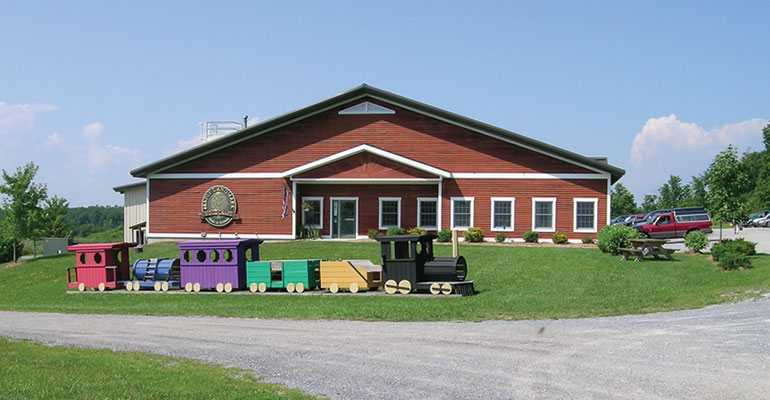
Photo: Maple Landmark toy and game manufacturer in Middlebury. Photos: Maple Landmark.
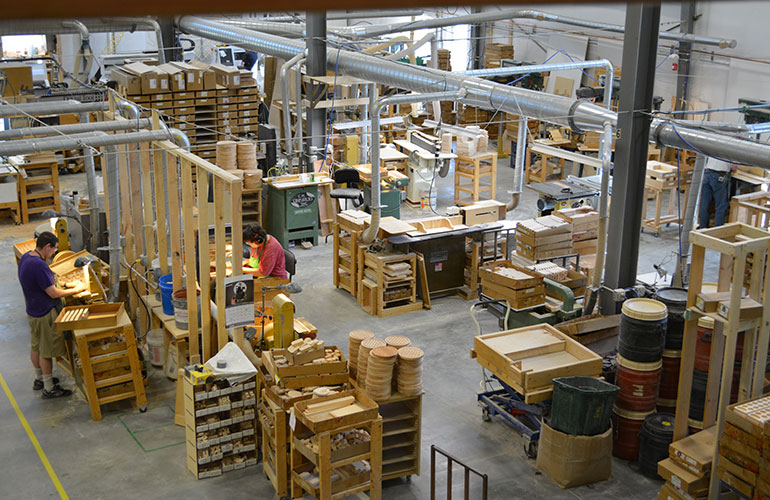
Photo: Maple Landmark shop floor.Photos: Maple Landmark.
At Middlebury College, Provost noted that several businesses in town have either opened or expanded in the past several months. Middleton, a women’s clothing and lifestyle boutique at 66 Main St., and the Crooked Ladle, a catering, bar service, three-day-a-week restaurant and venue space at 51 Main St., are just a few examples of businesses that have found a niche in town and proved popular with customers, he said.
Moreover, popular downtown events like Festival on the Green and Midd Summer Market seem to be drawing pre-pandemic crowds once again, he added.
Ward too, noted that downtown Middlebury is once again flourishing.
“There seems to be a redoubling of efforts to invigorate the downtown,” she said.
She praised the efforts of the Better Middlebury Partnership initiative, which has lent its support to Midd Summer Market; specialty events at Haymaker Bun Co., a bakery, café and restaurant on the banks of Otter Creek River, and the collaboration between Everything Nice and the Crooked Ladle.
“[These] seem to be well-received and are innovative ways to fill spaces and provide opportunities that otherwise might be unrealistic or financially out of reach,” Ward said. “It’s exciting to think that downtown can bounce back from the rail construction project and the economic effects of COVID.”
The rail construction project is a new Amtrak service between Middlebury and New York City, originating in Burlington and stopping in Vergennes.
Middlebury College has not only been a beneficiary of these improvements, it has taken an active role in the town's revitalization efforts. Johnson Hall, for examaple, recently underwent a $17 million renovation led by local developer Naylor & Breen.
In July, the college broke ground on a new residential hall that will provide nearly 300 new student beds. The facility will replace Battell Hall, which will be torn down and replaced with an art museum.
“This $50 million new construction will support many local construction companies and contractors for the next 18 to 20 months,” Provost said.
While many businesses and nonprofits in the county have not yet returned to the stature they enjoyed before COVID-19, officials insisit the future is bright. A return to econimic prosperity seems more a given than a desire in Addison County these days.
Joy Choquette writes from the Franklin County area.