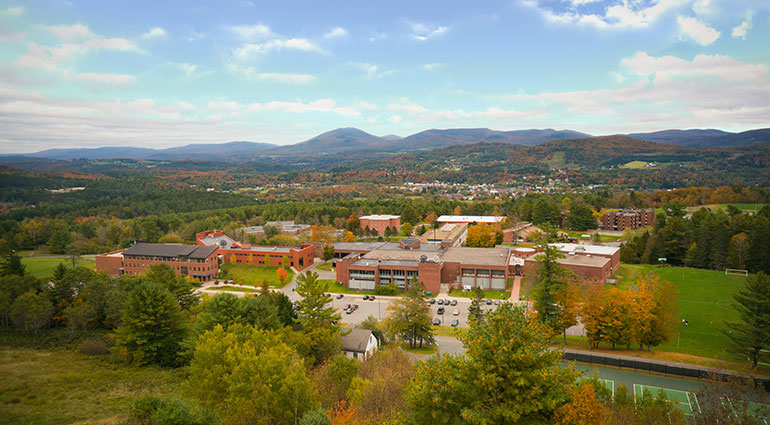
An aerial view of Vermont State University’s Lyndon campus. Courtesy photo.
by Timothy McQuiston, Vermont Business Magazine
Mike Smith has a lot of work to do and not much time in which to do it. But he has a plan on how to lead Vermont State University through an auspicious and difficult nascence.
On April 14, less than three months before the university’s July 1 launch, the man hired a year ago as its first president, Parwinder Grewal, resigned, citing personal reasons. The school’s board of trustees appointed Smith, former secretary of the Vermont Agency of Human Services, as interim president later that day.
Grewal had faced significant pushback for his proposals to implement a digital-only library system, which would have eliminated nearly all its books and many of its staff, and to cut back on university athletic programs. Both plans were borne from a desire to help the state college system overcome financial deficits.

VTSU’s interim president, Mike Smith. Vermontbiz photo.
But many observers wondered how making those changes would have saved significant amounts of money. More importantly, a vocal chorus of students, staff and alumni expressed their dismay with Grewal’s pronouncement, which would have effectively closed the physical libraries and downgraded varsity sports programs. Though Grewal subsequently backed off the proposals to some extent, he failed to quiet the storm.
In a recent interview, Smith told VermontBiz that Sophie Zdatny, chancellor of the Vermont State Colleges System, called him after Grewal gave notice and offered him the presidency. Smith asked for 24 hours before accepting, under the condition he would serve for just six months, or until the end of October.
Smith, a former Navy SEAL, seems uniquely qualified for the job. After leaving the service, he enrolled at the University of Vermont at nearly 30 years old. He was a first-in-family college student, which is one of the state colleges system’s target demographics. His parents are even from Castleton, where Smith lived for a short time before moving to Woodstock and graduated from high school.
Castleton University is one of the founding colleges of VTSU, along with Vermont Technical College (Randolph Center and Williston), Lyndon State College and Johnson State College.

Vermont Tech campus in Randolph. Courtesy photo.
Smith served a term in the Vermont House of Representatives while still a student at UVM. He then began a long career in both the public and private sectors, which included a short stint as interim president at Burlington College.
But Smith is best known for his role at human services under Gov. Phil Scott during the COVID-19 pandemic. The agency — Vermont’s largest — encompasses the Department for Children and Families, the Department of Corrections and the Department of Health, among others.
Similar to the call he got from Zdatny, Smith was enticed by the governor to return to state service in 2020 to a position he had previously held under Gov. Jim Douglas. Just months into the job, the world changed.
Smith retired from that position in December 2021 as a key player in the state’s pandemic response. His decision to once again step out of retirement and take on the VTSU position, he said, was made out of a sense of responsibility
“This university system is too important to the state of Vermont,” he said. “That was the driving force for coming back.
“This university graduates our workforce,” he added.
Smith established four priorities after stepping into the presidency: stabilize the university after a hectic start; get VTSU accredited, which has since been achieved; prepare for the first incoming class, which, as it turns out, required navigating the flood waters that hit Johnson in July; and quickly focus on fall 2024.
On his second day on the job, Smith rescinded Grewal’s previous order to close the libraries and alter the sports programs.
That does not mean, he emphasized, that changes are not coming. But he stressed he would proceed cautiously and prudently before making any recommendations.
Smith asserted, for example, that while the libraries need to leverage today’s digital technologies, the processes for doing so must come up from the library professionals, not down from the administration.
As he thinks about the future of the university’s athletic programs, Smith said he is reminded of the important role sports play in many prospective students’ decision-making process and how they remain key to the school’s recruitment, retention and diversity efforts.
Athletics programs also help build school spirit and are an important way to retain connections with alumni.
Smith understands, however, that VTSU’s academic programs will ultimately determine the future success of the university. Some programs will be enhanced, he said, and others will be cut. Workforce-directed programs will be emphasized.
The University of Vermont in 2020 went through a similar process in which some legacy majors, such as classics, were downgraded or eliminated due to flagging interest, while others were elevated. There was plenty of blowback.
Any future programatic changes at VTSU will undoubtedly favor the health professions. The school’s nursing programs recently received a $6.3 million infusion through a grant backed by former U.S. Sen. Patrick Leahy before he retired. In addition, a dental hygiene program in connection with the University of Vermont Health Network is currently in the works.
With a $200 million commitment from the Legislature, Vermont State’s financial situation has stabilized since former Chancellor Jeb Spaulding considered shuttering the Johnson, Lyndon and Randolph Center campuses.
That earthquake led to Spaulding stepping down and the eventual realigning all five campuses into Vermont State University. (Community College of Vermont remains a separate entity within the Vermont State Colleges System.)
Vermont has seen several small, private colleges close in recent years, among them Green Mountain College, Marlboro College, the College of St Joseph and Southern Vermont College.
Smith has not ruled out the necessity of staff layoffs along with course corrections. But that will take time to figure out and perhaps will come through attrition as majors are reworked.
But the need for those corrections is obvious.
VTSU’s peer colleges in other states typically have an average of 18 students per class. At Johnson and Lyndon, half of classes have fewer than 10 students; at Castleton, about one-third do. The Randolph Center and Williston campuses, with their engineering focus, have been stronger.
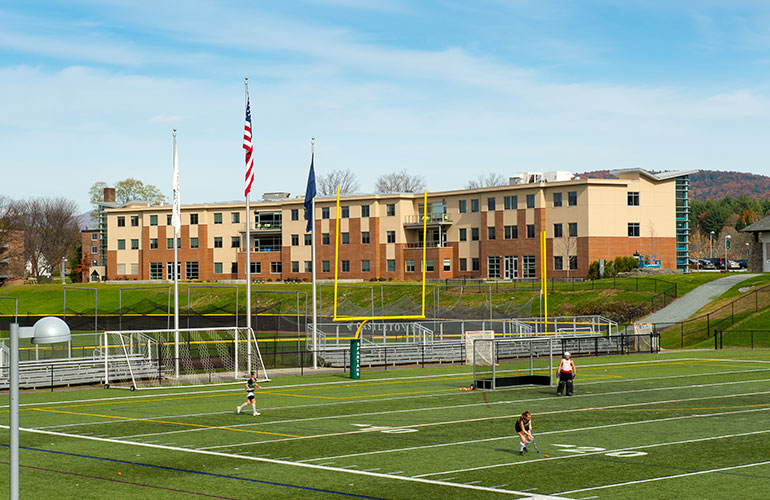
Hoff Hall, Castleton, overlooking the athletic fields. Courtesy photo.
Enrollment is not yet meeting its target goals, but Smith said the critical measure will come not with the current incoming class but with the fall 2024 cohort.
Enrollment was expected to be off by 15% this year due to the restructuring, but is actually down 19%, despite cutting tuition by 15%.
“That’s not good enough,” Smith said.
Online and nontraditional students (as Smith was) are important to the success of the university, Smith said. Some 45% of Vermont high school graduates don’t go on to higher education.
“We need to find the reasons why,” Smith said.
“We have to be flexible with these sorts of students,” he added, if we hope to convince them to continue their education.
As the decision-making process continues, Smith said it is important to optimize the university’s strengths, stay focused on its long-term goals and not pit one department against another.
Beyond the finances, Smith believes the state colleges need to play to their strengths and shore up their brand. This is particularly true of Lyndon, which has lost its focus as a national leader in media and meteorology, Smith said.
Most meteorologists in Vermont and many prominent weather forecasters nationally are graduates of Lyndon, and it is imperative to reestablish the program as a national powerhouse.
Next Step: Another Search
Despite the consolidation of the Lyndon and Johnson campuses into the single Northern Vermont University and an influx of state money, the state college system had been trying to find a way to remain financially viable.
In April 2020, former chancellor Spaulding proposed profound changes to the system that included closing the Johnson and Lyndon campuses as well as the original Randolph Center campus of Vermont Technical College.
Spaulding said at the time that it would help alleviate a $12 million deficit, while eliminating 500 jobs. The cost-cutting measure was rejected, leading Spaulding to resign.
While the three campuses Spaulding had targeted for closing remain open, they were ultimately consolidated under the Vermont State University flag.
The launch of Vermont State University is the culmination of years of work to unify the state colleges, streamline academic offerings and achieve financial sustainability. This has been a partnership with Gov. Scott, lawmakers, faculty, staff, students, alumni and the communities in which the schools reside.
With the exception of Williston, all of the state colleges are situated in rural areas. Smith acknowledges that beyond being institutes of higher learning, they also serve as the economic engines of their respective communities. This gives their ongoing viability even more weight, he said.
“We knew this work would be difficult,” Sophie Zdatny, chancellor of the Vermont State Colleges System, said last April. “In fact, none of this work is simple or easy. But we are making steady progress and will be ready to launch Vermont State University in July.”
She added, “We are grateful to Dr. Grewal for stepping into the role of president and bringing his skills and expertise from a similar higher education unification at this important time, and we appreciate his service.”
Smith was tasked with implementing transformational plans and meeting with faculty, staff, students, alumni and communities, with an eye toward ensuring the successful launch of VTSU in just a few short months.
“It is an honor to take on this role at such a critical time,” Smith said when he was announced as interim president. “I am committed to giving this my all to ensure the overwhelming success of Vermont State University. I am excited to work with the faculty and staff and welcome the inaugural class who will help chart this new path forward. Together, we are making history and securing a legacy that will serve generations of Vermonters.”
The Vermont State Colleges System, per its charter, “provides affordable, high-quality, student-centered and accessible education and career development opportunities for all Vermonters.”
The newly consolidated university, officials said, “will increase access to high-quality educational programs for all learners, fueling Vermont’s economic pipeline and creating greater access to affordable higher education opportunities.”
For all he hopes to achieve, Mike Smith’s six-month tenure will go by quickly. Chancellor Zdatny, meanwhile, has a plan in place:
“Interim President Mike Smith’s six-month term is scheduled to conclude at the end of October 2023,” she told VermontBiz. “Given the short period of time in which to find the next president and the nonalignment of the search process with the academic year, the board of trustees is moving forward with an abbreviated search process to identify and hire an experienced change-management leader to serve as interim president for an 18- to 24-month term.”
During this interim period, she added, the board will conduct “a full, traditional academic search and hiring process” to identify the next president.
Zdatny said the board has created an Ad Hoc Search Committee composed of five trustees to lead the search for the next interim president. The committee’s goal is for the hiring decision to be made at the board’s retreat on Sept. 18 and 19.
Information about the search (agendas, minutes, meeting materials) is available at www.vsc.edu. Meetings will be open to the public, although discussions about potential candidates will occur in executive session.
“I see a path here where every campus can be thriving in a few years,” Smith said.
So, will this be his last job?
“I’m getting close to retirement,” he said with a smile. “But you never say never.”