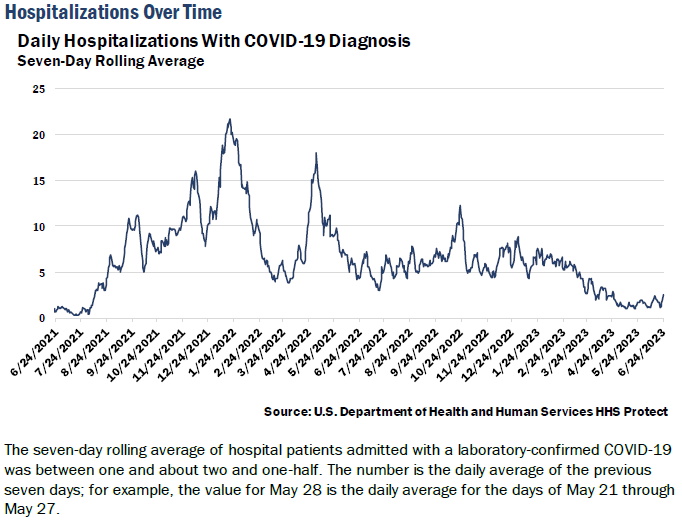
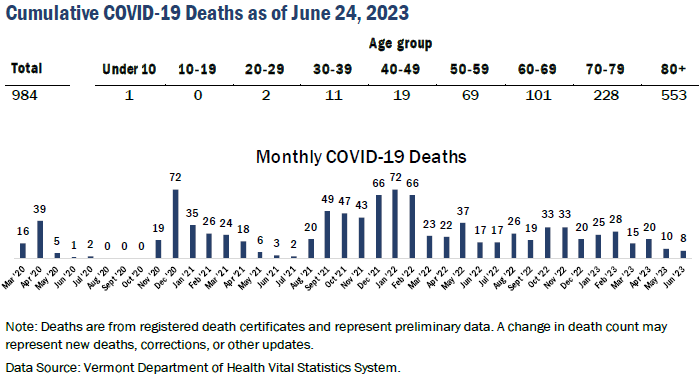
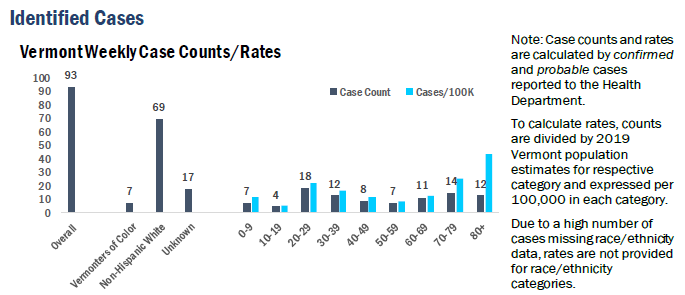
by Timothy McQuiston, Vermont Business Magazine The Vermont Department of Health reported June 28, 2023, that COVID-19 hospitalizations increased by 7 to a statewide total of 18. Total reported cases also increased by 21 to a total of 93. However, COVID-19 activity remains in the "Low" range, according to the VDH. There were 5 COVID-related deaths reported in the last week for a pandemic total of 984 as of June 24 (this is the most recent update). Fatalities have slowed. VDH reported 15 COVID-related deaths in March, 20 in April and 10 in May (the fewest since the summer of 2021) and 8 so far in June.
Of the total deaths to date, 778 have been of Vermonters 70 or older. There have been 3 deaths of Vermonters under 30 since the beginning of the pandemic. There were 28 COVID-related deaths in February and 25 in January, as data was adjusted based on more information. Deaths did not spike this past winter as they had the previous two. (see data above)
Following an analysis of COVID-19 data, the VDH reported in early January a cumulative 86 additional COVID-associated deaths that occurred over the course of the pandemic but had not been previously reported. Most of those deaths occurred in 2022.
Vermont has the second lowest fatality rate in the US (113.5 per 100K; Hawaii 94.5/100K). Mississippi (424.6/100K) and Oklahoma (423.5/100K) have the highest rates. The US average is 283.5/100K (CDC data).
The Delta variant took off in August 2021, which resulted in the heaviest number of deaths before vaccines and their boosters helped alleviate serious COVID cases. Multiple Omicron variants are now circulating and appear more virulent than previous variants, but perhaps not more dangerous, according to the CDC.
AP April 5, 2023: WHO downgrades COVID pandemic, says it's no longer a global health emergency
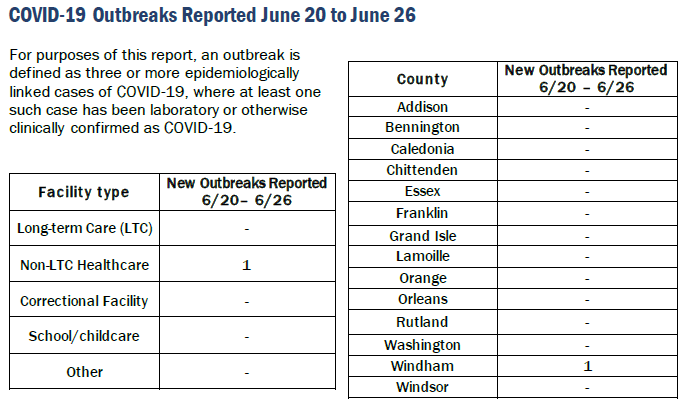
As of this report, there was 1 outbreak last week, and 4 the previous week. Outbreaks have fallen significantly since early fall.
Walk-in vaccination clinics run by the state closed on January 31. Learn more
Vermonters are reminded that all state COVID testing sites were closed as of June 25, 2022. PCR and take-home tests are available through doctors' offices, pharmacies and via mail from the federal government. The federal government officially ended its pandemic response as of May 11, 2023. See more information BELOW or here: https://www.healthvermont.gov/covid-19/testing
Report Timeframe: June 18 to June 24, 2023
Statewide hospitalization levels: Low. New COVID-19 admissions are below 10 per 100,000 Vermonters per day.
• New hospital admissions of patients with COVID-19, last 7 days: 2.88 per 100K (previous week, 1.76 per 100K)
o 18 total new admissions with COVID-19 (increase from previous week, 11)
- Reported cases rose to 93 (previous week, 72; there were 103 reported cases two weeks ago)
Vermont Department of Health recommendations: Preventing COVID-19 (healthvermont.gov)
CDC recommendations: COVID-19 by County | CDC
Starting May 11, 2023, the CDC and Vermont Department of Health will no longer use the COVID-19 Community Level to measure COVID-19 activity in the U.S. and Vermont. Instead, Vermont's statewide COVID-19 level will be measured by the rate of COVID-19 in people being admitted to the hospital, per 100,000 residents.
Focusing on hospitalization data is a better estimate of how COVID-19 is impacting the community now that reported COVID-19 cases represent a smaller proportion of actual infections. This also allows us to compare Vermont’s hospitalization levels with other parts of the country.
There has been a total of 1,133,620 COVID-related deaths to date in the US (CDC) and 6,947,192 globally (WHO).
VDH reports 86 previously unidentified COVID deaths
The Delta variant caused a surge in COVID-related fatalities last fall and into the winter.
The highest concentration of deaths was from September 2021 through February 2022. Overall, December 2020 and January 2022 were the worst months with 72 fatalities each.
Health Commissioner Mark Levine, MD, has said the Omicron variants are highly transmissible and have caused an uptick in cases and hospitalizations across the nation; the Northeast has seen the smallest increase.
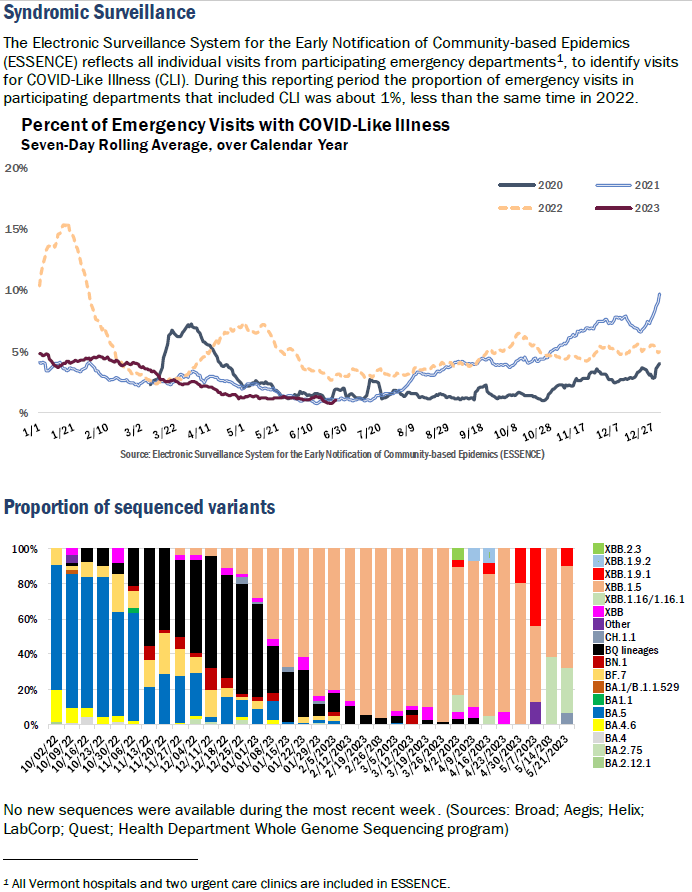
The CDC gave approval to the new Omicron vaccines on August 31. The highly infectious, though less dangerous, BA.4 and BA.5 variants have become dominant this year, though new subvariants of those variants are beginning to appear.
Dr Levine and the FDA believe that vaccines for the COVID virus would likely be an annual event, similar to how there is an annual flu shot that is configured for the particular active strains. He is also expecting an active flu season.
The US confirmed its first case of COVID-19 on January 20, 2020.
The updated booster is for people 12 and older who have completed their primary COVID-19 vaccine series and received their last booster or additional dose at least two months ago. Look for Pfizer Bivalent Booster 12+ and Moderna Bivalent Booster 18+. Bivalent boosters are available at some pharmacies across the state. Contact pharmacies directly for details on available products and scheduling.
On October 12, 2022, the FDA authorized updated COVID-19 booster shots for children as young as 5.
 COVID-19 Vaccine
Vermonters ages 6 months and older are eligible for COVID-19 vaccines. Getting vaccinated against COVID-19 is the safer way to build protection from serious illness–even for those who have already had COVID-19. Learn more about COVID-19 vaccines (CDC)
COVID-19 vaccines are free and widely available. Anyone can get vaccinated in Vermont, including those who live in another state, are non-U.S. citizens, or who have no insurance. See Vermont's current vaccine rates
You can get free COVID-19 vaccines at:
- Your health care provider’s office
- A pharmacy
- Other locations where you get your vaccines
Know your rights when getting free vaccines.
Stay Up to Date with Your Vaccines
You are considered up-to-date if you are over the age of 6 years old and have received a bivalent (updated) COVID-19 vaccine. Learn more about kid vaccines
You may be eligible for additional COVID-19 vaccine doses if:
- You are 65 years of age and older and received your first bivalent (updated) COVID-19 vaccine booster four or more months ago.
- You are moderately or severely immunocompromised and received a bivalent (updated) COVID-19 vaccine booster two or more months ago.
If you are unable or choose not to get a recommended bivalent mRNA vaccine, you will be up to date if you received the Novavax COVID-19 vaccine doses approved for your age group.
Find more on recommended doses from CDC
Important Links
COVID Vaccine Information for Health Care Professionals
More on COVID-19 Vaccines (CDC)
Recommended COVID Vaccine Doses (CDC)
Find a COVID-19 vaccine near you.
Image
Use Vaccines.gov to find a location near you, then call or visit the location's website to make an appointment.
COVID-19 Vaccines for Children
Everyone 6 months of age and older is eligible to get a COVID-19 vaccination. Most children are also now eligible for a bivalent dose that offers increased protection against the original strain and omicron variants.
Children 6 months through 5 years of age who received the Pfizer-BioNTech COVID·19 vaccine are up to date if:
- They are 6 months to 4 years of age and received at least three COVID-19 vaccine doses, including at least one bivalent (updated) COVID-19 vaccine dose.
- They are 5 years of age and got at least one bivalent (updated) COVID-19 vaccine dose.
Children 6 months through 5 years of age who got the Moderna COVID-19 vaccine are up to date if:
- They received at least two Moderna COVID-19 vaccine doses, including at least one bivalent (updated) COVID-19 vaccine dose.
See more on recommended vaccine doses by age group (CDC)
Resources for parents and caregivers
https://www.vermontfamilynetwork.org/ccfk/

Tips for Helping Kids Feel Ready for Any Vaccine (Vermont Family Network)

What Families with Children Should Know About COVID-19 Vaccines (translated)
https://www.youtube.com/watch?v=lWcqHOgQIVg&t=5s
Conversations About COVID-19 Vaccines for Children with Vermont Pediatricians (American Academy of Pediatrics)
Help Getting Vaccinated
If you cannot get vaccines through any of the options above, our local health offices offer immunization clinics by appointment.
Need a ride? If you do not have transportation to get a free COVID-19 vaccine or booster, please contact your local public transportation provider or call Vermont Public Transportation Association (VPTA) at 833-387-7200.
English language learners, or immigrant or refugee community members, who would like to learn about more about vaccine clinics can contact the Association of Africans Living in Vermont (AALV) at 802-985-3106.
New Vaccine Cards and Requesting Vaccine Records
If you lost your vaccine card or your information is wrong:
- You may be able to get a new CDC COVID-19 vaccination card at the pharmacy or health care provider’s practice where you were vaccinated. Not all pharmacies or providers provide this service.
- Vermont Immunization Registry (IMR) can give you a copy of your vaccination record by mail (within a week) or secure email (within two business days). NOTE: The IMR and CDC cannot issue you a new white CDC COVID-19 vaccination card or provide QR codes. Instructions on how to request vaccine records
Recommendations for keeping your vaccination card and record up to date
Videos and Factsheets with Translations
Find more COVID-19 translations
COVID-19 resources for people who are deaf and hard of hearing
State Walk-In Vaccination Clinics Closed (January 2023)
Report your COVID-19 test results