

Northeastern Vermont Development Association NVDA
ENERGY UPDATE June 2023
OPPORTUNITIES
As always, if you have news or events to share -- or a colleague who'd like to subscribe -- email [email protected]. We publish monthly.

NEK EV Charging Survey
Where is EV Charging Needed?
The State is seeking to identify property and business owners interested in supporting plug-in electric vehicle (EV) charging or providing services associated with the installation and management of charging.
Those interested in partnering with the State can fill out the survey to offer their collaboration. The survey will help identify opportunities for potential charging locations or EV charging services. Survey responses will be shared to facilitate potential partnering discussions between property owners/managers, charging service providers, and installation contractors.
NVDA encourages municipalities and local businesses to install EV charging stations at convenient and desirable locations, such as in front of restaurants, stores, tourist and recreation destinations, and community sites such as libraries, where users would want to park for several hours. NVDA also recommends the development of EV charging stations in our regional downtowns, village centers, and opportunity zones, as well as along key interstate and state highway corridors.


Renewable Energy Standard (RES)
Public Engagement Plan & Opportunities to Get Involved
About To Launch:
- Statewide Polling and Engagement Events: The Vermont Department of Public Service (PSD) is working with the MassINC Polling Group to conduct a statewide survey and focus groups. This effort will engage a random, yet equitable, sample of Vermonters to better understand their priorities and preferences for renewable electricity in the state. This effort will begin in early June and wrap up by late July.
In the Works:
- Outreach to Community-based Organizations (CBOs) – PSD is preparing to conduct outreach to CBOs serving Vermonters who may have been historically or are currently disproportionately impacted by our renewable electricity policies and programs. This effort will be informed, in part, by the list of organizations submitted to the Department during last summer’s Request for Information (see slides 16 and 17 from this report recapping the information received). Do you know of any organization that should be reached out to? Email [email protected].
- Regional Listening Sessions – PSD is in the early stages of planning geographically diverse listening sessions and discussion forums on renewable electricity. They expect to partner with Regional Planning Commissions to hold a series of events to hear from and engage in discussion with Vermonters on the next steps for our renewable electricity policies and programs. They don’t yet have a timeline for when these events will occur but expect they’ll be in late summer or early fall. They'll provide details as they are finalized.
- Technical Analyses – The Department is currently in the process of hiring a consultant to help explore the possible impacts of expanding Vermont’s current Renewable Energy Standard (if you’re curious, see this Request for Proposals for more information).They're hoping to convene a Stakeholder Advisory Group to support the process and are currently working to develop an equitable way to recruit participants for this group. They'll also hold at least one public workshop to review and discuss draft results, likely in early fall. Stay tuned for more information!
RFP: Energy Storage Access Program (ESAP)
Proposals due June 23
The Vermont Public Service Department (PSD) invites electric distribution utilities to submit proposals for the Energy Storage Access Program (ESAP). The program will (1) support installation of battery electric storage systems at low- and moderate-income Vermont homes to support their resilience as well as to lower costs for utility ratepayers, (2) support the acquisition by municipal and cooperative utilities of storage management, flexible load management, and/or distributed energy resource management software solutions to manage both batteries and other electric loads; and, (3) support installation of battery electric storage systems at municipal buildings to support community resilience and lower costs for utility ratepayers.


Powering Affordable Clean Energy (PACE) Program
LOIs accepted starting June 30
USDA will be opening a Letter of Interest (LOI) process for the Powering Affordable Clean Energy (PACE) program, which makes $1 billion available in partially forgivable loans to renewable-energy developers and electric service providers, including municipals, cooperatives, and investor-owned and Tribal utilities to help finance large-scale solar, wind, geothermal, biomass, hydropower projects and energy storage in support of renewable energy systems. Loans through this program may be forgiven by 40% of the loan amount, and the maximum loan amount is $100 million. For this program, USDA will begin accepting LOIs starting on June 30, 2023, on a rolling basis until Sept. 29, 2023.
The goal of the PACE program is to make clean energy affordable for vulnerable, disadvantaged, Tribal and energy communities to heat their homes, run their businesses and power their cars, schools, hospitals and more. USDA may be able to leverage nearly $3 billion in projects through this program. This is in line with President Biden’s Justice40 Initiative, which aims to ensure that 40% of the overall benefits of certain federal investments reach disadvantaged communities that are marginalized and overburdened by pollution.
DOE $50M Rural/Remote Energy Improvements
Pre-Application Submissions due July 13
The U.S. Department of Energy’s Office of Clean Energy Deployment (OCED) issued a Funding Opportunity Announcement (FOA) announcing an additional $50 million available through the Energy Improvements in Rural or Remote Areas (ERA) Program funded by the Infrastructure Investment and Jobs Act (IIJA). This program supports community-based energy projects in rural and remote areas across the country, defined as cities, towns, or unincorporated areas with populations of not more than 10,000 inhabitants. To eliminate barriers to accessing this federal funding, there will be a streamlined application process for individual grant awards between $500,000 and $5 million and no cost-sharing requirements. Eligible applicants include state and local governmental entities, Tribes, non-profit entities, for-profit entities, institutions of higher education, and partnerships. Applicants will be required to submit Community Benefits Plans to ensure that the project benefits are equitably reaching historically underserved communities and align with the Justice40 Initiative. Pre-application submissions are due on July 13, 2023, at 5:00 PM ET, with full applications due on October 12, 2023, at 5:00 PM ET.

Empowering Rural America
"New ERA" Program
The U.S. Department of Agriculture (USDA) will be opening a Letter of Interest (LOI) process for the Empowering Rural America (“New ERA”) program, which makes $9.7 billion available to eligible rural electric cooperatives to deploy renewable energy systems, zero-emission and carbon capture systems. Rural electric cooperatives, including current and previous USDA borrowers, are eligible for funding.
To apply, eligible entities must submit their LOI between July 31 and Aug. 31, 2023.
MERP *Free* Building Energy Assessments - Coming Soon!
FREE Energy Assessments for up to 5 Municipally-Owned Buildings:
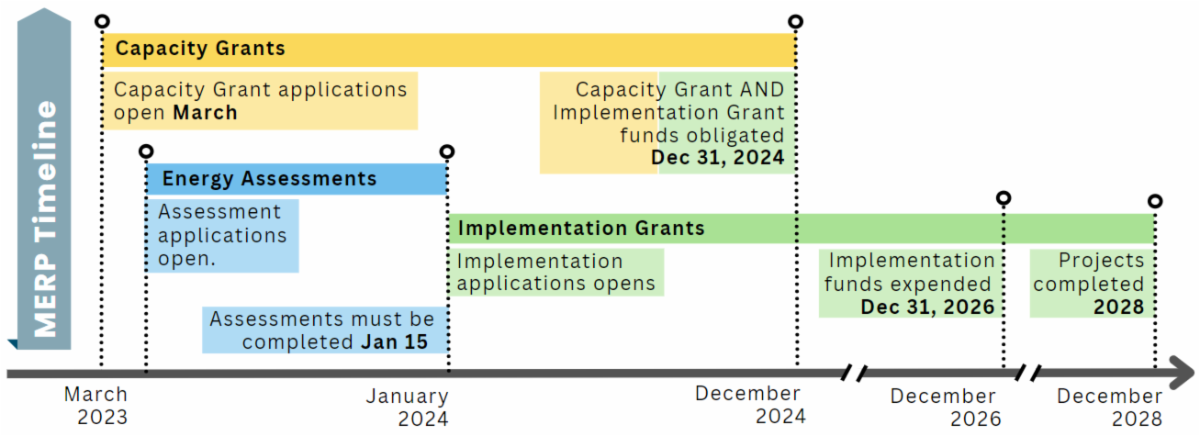
The application for FREE building energy assessments through the Municipal Energy Resilience Program (MERP) will be open soon! There are two levels of energy assessment to choose from, EITHER of which qualify a municipality for the MERP Implementation Grant (up to $500,000). See the BGS one-pager for more information about each type of assessment and make sure your community is receiving MERP assistance from NVDA. Contact Allie Webster, NVDA Energy Planner, for support.
As a reminder, the application for the $4,000 community capacity mini-grant is still available for towns. The MERP mini-grant can be used for energy-related outreach and education or to hire a consultant to help enhance municipal energy capacity.
Source: Northeastern Vermont Development Association | PO Box 630, 36 Eastern Ave. Suite 1, St. Johnsbury, VT 05819