

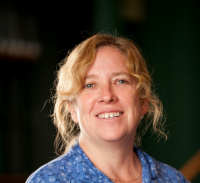
St Michael’s College biology professor and chairperson of environmental studies, Dr. Valerie Banschbach of Jericho, learned Feb. 21, 2013, that she has been named a U. S. Fulbright Scholar. Dr. Banschbach will spend five months in India starting in the fall of 2013 teaching and researching organic versus conventional farms, in collaboration with the Wildlife Institute of India.
Professor Banschbach is the fourth Saint Michael's College professor to receive a Fulbright fellowship in the last year: Art History Professor Amy Werbel spent an academic year in China; Political Science Professor Patricia Siplon spent a year in Jordan, and Education Professor Aostre Johnson is spending this academic in Ireland. And a fifth award for this year has been made, but not yet announced. Political Science Professor Jeffrey Ayres had a Fulbright at Carleton University in Canada in 2003.
Professor Banschbach’s Fulbright topic is titled “Ecology and Conservation of Biodiversity: Ants as Bioindicators to Assess Impacts of Organic Farming in India.” This project came out of a three-year experience working with Indian farming programs. Her Fulbright work will expand her U.S.-based research on ants as bio-indicators for answering agricultural questions.
Focusing on ant diversity, Dr. Banschbach, an entomologist, expects her research to yield theoretical results and practical insights for Indian farmers. Her work evolved from the 2010 launch of the Environmental Studies major at Saint Michael’s, which was inaugurated with a talk by scientist, Vandana Shiva. Professor Shiva is founder of Navdanya’s Farm, an organic training center in the city of Dehradun, India, home to the Wildlife Institute of India.
Professor Shiva reciprocated with an invitation to Dr. Banschbach to visit Navdanya’s Farm and the Wildlife Institute in spring 2011, where she witnessed impressive grassroots efforts of researchers and students to improve their communities through farming advances. Dr. Banschbach returned to India in summer 2012 and taught “Organic Agriculture and Conservation of Biodiversity” for 12 Saint Michael’s students with the participation of two additional SMC professors.
“The experience will leave me well prepared to bring future Saint Michael’s students to India in study abroad courses and to deepen the relationship between Saint Michael’s and India,” she wrote in her proposal.
“Given that the richness of India’s ecosystems is coupled with high human population density and development pressure, the stresses on natural systems are enormous, creating many difficult ramifications for people and non-human species,” Dr. Banschbach wrote in her Fulbright proposal.
India has more than 400,000 organic farms. Ants can provide scientists much information about farms, she says, even though often they are “overlooked in favor of often-celebrated earthworms.”
The Fulbright grant provides Dr. Banschbach with five months’ funding for teaching and research, along with travel, board and schooling expenses allowing her to bring her husband and two daughters, age 12 and 8. “It will be exciting for all of us,” she said.
Fulbright award letter to Dr. Banschbach
“Your selection for a Fulbright award is, in itself, an achievement for which you can be justly proud,” wrote Tom Healy, chair of the selection board, in a letter of Feb. 21. “As a Fulbright grantee, you will join the ranks of distinguished participants in the Program. Fulbright alumni have become heads of state, judges, ambassadors, cabinet ministers, CEOS, university presidents, journalists, artists, professors and teachers. They have been awarded 43 Nobel Prizes. Since its inception more than 60 years ago, approximately 300,000 Fulbrighters have participated in the program.” Goals of the program are to develop international understanding and promote hallmark qualities of service, excellence and leadership, Healy wrote, adding, “We hope that your Fulbright experience will be highly rewarding professionally and personally, and that you will share the knowledge you gain as a Fulbrighter with many others throughout your life.”