

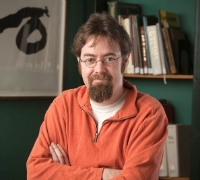
Dr. John O’Meara, Saint Michael's College associate professor of physics, is part of two teams of scientists that together have been awarded close to $1 million in research funds from the National Science Foundation (NSF) and from NASA to study, in ever-greater depth, how galaxies are formed in outer space.
“The student connection is pretty strong,” Professor O’Meara said. “I anticipate involving students in the data analysis which is extensive for both programs.”
Dr. O’Meara is part of a National Science Foundation (NSF) grant titled “Building up and Tearing Down Galaxies: the Impact of Infalling and Outflowing Gas on Galaxy Evolution.” The other participants are Principle Investigator Chris Howk at Notre Dame University, Nicolas Lehner at Notre Dame, and Ben Oppenheimer at the University of Colorado. The total award for the grant is $460,058 to fund telescope observations, supercomputer simulations, and data analysis.
Dr. O’Meara described the NSF grant this way: “The primary goal of this work is to combine existing space-based data from the Hubble Space Telescope with new-ground based observations from the Keck and Large Binocular Telescopes to characterize the environments surrounding galaxies, and to see how those environments affect and are affected by those environments. Our goal,” he said “is ultimately to understandhow galaxies get the gas they need to fuel stars, and how that process changes with time.”
The second grant, titled “A COS Legacy Study of Circumgalactic Baryons” from NASA through The Space Telescope Science Institute is for $407,781. The scientists receiving the grant include Professor O’Meara, Principal Investigator Nicolas Lehner, and Professors Howk and Oppenheimer. The grant will fund a large archival program to study data from the Hubble Space Telescope, and to create one of the largest databases of space-based quasar absorption line data in the world.
Dr. O’Meara described the NASA/Space Telescope Grant this way: “The goal of this grant is similar to that of the NSF grant, but relies entirely on existing data from the Cosmic Origins Spectrograph (COS) onboard the Hubble Space Telescope. By using COS spectra of hundreds of quasars, we hope to understand the amount and distribution of gas in and around galaxies, and how that gas is affected by star formation within the galaxies.”
In both grants, said, “We also intend to perform cosmological simulations using supercomputers to model the gas-galaxy interface, and to place our observational results on a firmer theoretical foundation.”
The Edmundite Catholic liberal arts college,www.smcvt.edu . Saint Michael's provides education with a social conscience, producing graduates with the intellectual tools to lead successful, purposeful lives that will contribute to peace and justice in our world. Founded in 1904 by the Society of St. Edmund and headed by President John J. Neuhauser, Saint Michael's College is located three miles from Burlington, Vermont, one of America's top college towns. Identified by thePrinceton Review, 2013 as one of the nation’s Best 377 Colleges, and included in the Fiske Guide to Colleges 2013, Saint Michael's has 1,900 undergraduate students and 500 graduate students. Saint Michael's students and professors have received Rhodes, Woodrow Wilson, Pickering, Guggenheim, Fulbright, and other grants. The college is one of the nation's top-100, Best Liberal Arts Colleges as listed in the 2013 U.S. News & World Report rankings.