

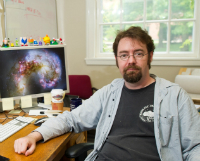
Saint Michael's College physics professor Dr. John O'Meara of Essex Junction, Vt. and two colleagues at the University of California, Santa Cruz published an astronomical break-through discovery in Science, the premier journal for all science on November 10, 2011.
Using the giant 10-meter Keck I telescope in Hawaii, these three astronomers have discovered two giant clouds of intergalactic gas whose chemical composition has been unaltered since the dawn of time. The clouds, located over 11 billion light years from Earth, offer direct supporting evidence for the Big Bang model of cosmology.
O’Meara explained that in the Big Bang model, only the very lightest elements such as Hydrogen and Helium were created during the first few minutes of the history of the universe. As cosmic time progressed over billions of years to the present, gas containing these few elements form stars and galaxies. As part of the life cycle of stars, the remaining elements, such as carbon, nitrogen and oxygen, are produced and recycled into the gas within and outside of galaxies. Until now, astronomers have always detected these heavy element remnants wherever they’ve looked.
Gas with no trace of heavy elements was the break-through discovery
“These clouds are exciting for both what they do and don’t have” Saint Michael’s Professor O’Meara said. “Specifically, they represent the first detection of pristine gas: gas with no trace whatsoever of heavy element absorption. What the gas does contain, however, is hydrogen and its isotope deuterium in the levels predicted by Big Bang models”
O’Meara co-authored the study along with Dr. J. Xavier Prochaska and his graduate student Michele Fumagalli of the University of California, Santa Cruz. Their work will appear in the Journal Scienceand will be released online on November 10.
The clouds were discovered by looking at extremely distant and bright objects called quasars. As the light from the quasar travels through the universe, it is often absorbed by intervening material. When the light enters the instruments at the telescope, it is broken into its constituent colors, producing a spectrum. The intervening absorbers produce features in the spectrum at wavelengths specific to their atomic content. “We can see the lines in the spectrum where the light was absorbed by these clouds, and that allows us to show that it contains no heavy elements,” said Fumagalli. “Previous experiments had always shown a minimum amount of absorption by heavy elements of about one one-thousandth the level found in the Sun,” said Prochaska. “In these clouds, the amount is significantly below that minimum level. It’s pristine.”
Although the discovery is a triumph for the Big Bang cosmology, O’Meara points out that it raises new questions.
“A good overall model of cosmology, but plenty of work to do,” O’Meara said.
“These clouds have been uncontaminated by heavy elements for over two billion years since the Big Bang. This means that our understanding of how galaxies return heavy elements to their environments is incomplete. Although we’ve provided great evidence that our overall model of cosmology is a good one, we still have plenty of work left to do.”
The Edmundite Catholic liberal arts college, Saint Michael's provides education with a social conscience, producing graduates with the intellectual tools to lead successful, purposeful lives that will contribute to peace and justice in our world. Founded in 1904 by the Society of St. Edmund and headed by President John J. Neuhauser, Saint Michael's College is located three miles from Burlington, Vermont, one of America's top college towns. Identified by the Princeton Review as one of the nations Best 376 Colleges, and included in the 2012 Fiske Guide to Colleges, Saint Michael's has 1,900 undergraduate students and 500 graduate students. Saint Michael's students and professors have received Rhodes, Woodrow Wilson, Pickering, Guggenheim, Fulbright, and other grants. The college is one of the nation's top-100, Best Liberal Arts Colleges as listed in the 2012 U.S. News & World Report rankings.