

Daily Update on Novel Coronavirus (COVID-19)
December 18, 2020
New or updated information is in red and bold.
This update is available online at healthvermont.gov/covid19
Click the “See the Latest Update” button.
Please visit the Vermont Department of Health’s COVID-19 web and data pages healthvermont.gov/covid19
Officials give vaccination update, urge Vermonters to stay safe for the holidays
Health Commissioner Mark Levine, MD, said at Friday’s press conference that all hospitals have now received their allocation of COVID-19 vaccine for the first week and have been busy vaccinating their higher risk healthcare staff.
Meanwhile, the state pharmacy partners — CVS, Walgreens and HealthDirect/Kinney Drugs — are scheduled to begin clinics at long-term care facilities next week.
“We need to be patient as we wait to make sure those at highest risk are protected right now,” Dr. Levine said. “While we won’t get to watch all the vaccinations that continue over the coming months like we saw the very first one, we can keep this in mind: every time a Vermonter gets vaccinated, all of us benefit.”
Before finalizing the next priority group for vaccination, we are awaiting recommendations from ACIP, which will be meeting this weekend, and our own Vaccine Implementation Advisory Group which met today.
As important as the vaccine is, we must stay focused on preventing the spread of COVID-19, Dr. Levine said, especially with the holidays that begin next week.
“The guidance that is currently in place still calls for us to avoid social gatherings, and the CDC has also said: the safest way to celebrate is to celebrate at home with the people you live with,” Dr. Levine said.
We need to remind anyone who does get together with others, to keep gatherings as small as possible, wear masks, keep a 6-foot distance, go outside if you can. And always stay away from others if you’re sick.
Plan ahead to get tested — right afterward, and seven days later. And if you gather or travel, plan to quarantine — stay home and away from others, either for 14 days or seven days with your negative test result (as long as you don’t have symptoms).
“The fact is, we need to acknowledge that some people will choose these higher risk activities, but if we can encourage them to take these steps, we can still help protect our communities from further spread,” Dr. Levine said. “And please strongly reconsider any gathering that involves a person with underlying medical conditions or an older person.”
Questions about the COVID-19 vaccine?
The COVID-19 vaccine is now here in Vermont, and hospitals have begun vaccinations.
If you’re looking for the latest information about who can get the vaccine now, where and when people will be vaccinated, visit healthvermont.gov/covid19-vaccines. Check back often, as we update this web page with new information. And sign up for our Weekly COVID-19 newsletter to stay up to date.
While we wait for vaccine to become more widely available to Vermonters, we must keep up our prevention practices, including physical distancing, mask-wearing and handwashing. This is still the best protection from getting and spreading COVID-19.
New at healthvermont.gov
- The Holiday Messaging Toolkit for Schools has been updated with messages to share with families for the winter holidays and break. The toolkit contains social media posts plus images, sample newsletter drop-in text and information to help schools share with staff and parents. You can find it, and other resources, on our PreK-12 schools page under “Guidance.”
- Each county in Vermont has a 2% or lower percent positivity since March. Since October 1, percent positivity has increased in every county except Chittenden. Learn more about the percent positivity by county in the latest Weekly Data Summary Spotlight.
- Vermonters who are Black, Indigenous and people of color (BIPOC) represent 6% of the state’s population but 18% of COVID-19 cases. BIPOC Vermonters with COVID-19 have significantly higher hospitalization and chronic disease rates, relative to white non-Hispanic people with COVID-19.
- A new data brief delves deeper into how BIPOC Vermonters have been disproportionately impacted by the pandemic, due to systemic and structural racism affecting the conditions in which people are born, grow, live, and work.
Case Information
Current COVID-19 Activity in Vermont
As of 12 p.m. on December 18, 2020
|
Description |
Number |
||
|
New cases* |
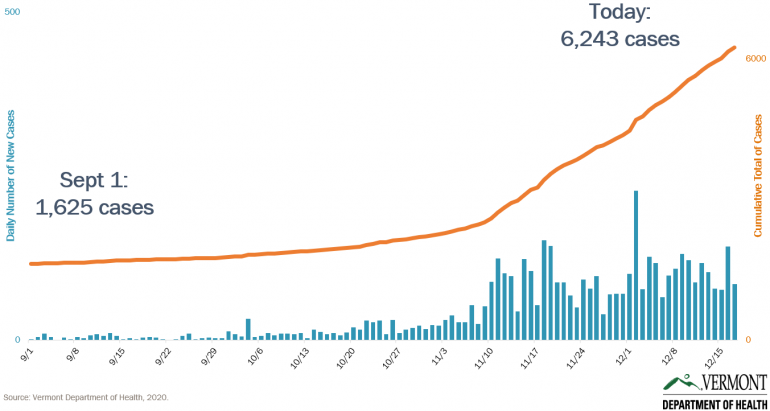
86 (6,243 total) |
||
|
Currently hospitalized |
27 |
||
|
Hospitalized in ICU |
10 |
||
|
Hospitalized under investigation |
2 |
||
|
Percent Positive (7-day average) |
2.2% |
||
|
People tested |
248,986 |
||
|
Total tests |
640,896 |
||
|
Total people recovered |
3,970 |
||
|
Deaths+ |
107 |
||
|
Travelers monitored |
214 |
||
|
Contacts monitored |
191 |
||
|
People completed monitoring |
11,400 |
* Includes testing conducted at the Health Department Laboratory, commercial labs and other public health labs.
+ Death occurring in persons known to have COVID-19. Death certificate may be pending.
Hospitalization data is provided by the Vermont Healthcare Emergency Preparedness Coalition and is based on hospitals updating this information.
Find more data at: healthvermont.gov/currentactivity.
COVID-19 Testing
Testing is an important tool to help prevent the spread of COVID-19. Learn more about who should get tested and find a site near you at healthvermont.gov/covid-19/testing.
Guidance for Vermonters and Businesses
Health information, guidance and data: healthvermont.gov/covid19
Sector guidance: accd.vermont.gov/covid-19
Modeling: dfr.vermont.gov/about-us/covid-19/modeling
Governor’s actions: governor.vermont.gov/covid19response
Get the information you need at our Frequently Asked Questions.
School & Child Care Guidance
- Strong and Healthy Start: Safety and Health Guidance for Vermont Schools
- Mental Health: A Strong and Healthy Start: Social, Emotional and Mental Health Supports During COVID-19
- Child care: Health Guidance for Child Care and Out of School Care
More resources on the Your Community web page.
Take Care of Your Emotional and Mental Health
If you or someone you know is in crisis or needs emotional support, help is available 24/7:
Call your local mental health crisis line.
Text VT to 741741 to talk with someone at the Crisis Text Line.
Call the National Suicide Prevention Lifeline at 1-800-273-8255.
For more information visit healthvermont.gov/suicide.
Visit our Coping With Stress web page.
Get connected to Alcohol and Drug Support Services at VT Helplink.
Get self-help tips and connect to mental health services at COVID Support VT.
Food resources
If your financial situation has recently changed, you may now qualify for Vermont nutrition and food programs, including WIC program (Women, Infants and Children), 3SquaresVT/SNAP, and more. Newer programs such as Farmers to Families and Everyone Eats are helping to fill the gaps. Contact the Health Department, Hunger Free Vermont, or call 2-1-1 for more information.
Find Opportunities to Support the COVID-19 Response
Vermonters can now step up and help with the COVID-19 response in long-term care facilities and other areas. Visit www.vermont.gov/covid-staffing for more information.
Stay Informed with VT-ALERT
Stay up to date on the latest COVID guidance and information by registering for Vermont Alert (VT-ALERT), the State’s emergency notification system. Visit www.vtalert.gov and select the alerts they would like to receive (COVID information is listed under “Health Alerts”). Current subscribers can also update their notifications. Notifications are available via email, text, phone and the Everbridge mobile app.