

Outstanding curriculum, proximity to medical center, and association with Center for Biomedical Innovation set UVM’s BME degree apart.
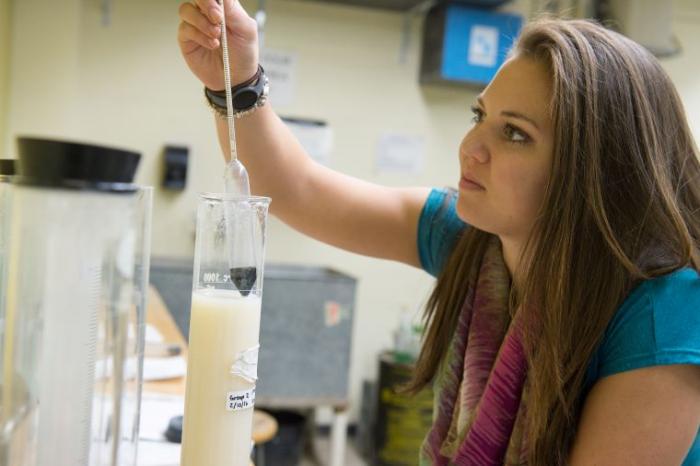
A Biomedical Engineering student works in one of the state-of-the-art labs in the College of Engineering and Medical Science at UVM. (Photo: Sally McCay)
Vermont Business Magazine The Bachelor of Science in Biomedical Engineering (BME) degree program at the University of Vermont was recently granted ABET accreditation. ABET is the ISO 9001 certified organization that accredits college and university programs in applied and natural science, computing, engineering, and engineering technology.
UVM’s BME program is now one of a handful of accredited BME programs co-located on the same campus as a medical school. UVM’s program and the Larner College of Medicine (LCOM) are a quarter mile apart and some of the faculty in Biomedical Engineering have labs in LCOM. ABET recognized this valuable asset in its evaluation, in particular noting the unique opportunities that UVM students have had for coursework, design projects, internships, and research experiences in collaboration with the medical school faculty.
According to Linda Schadler, dean of the College of Engineering and Mathematical Sciences (CEMS), the ABET accreditation affirms the BME program’s excellence and vitality. “Not only did we receive accreditation, we have created a unique curriculum with an outstanding design sequence, access to the Center for Biomedical Innovation, and opportunities for entrepreneurship, as well as medical school experiences. I am thrilled to see the program reach this mature status,” Schadler says.
Students are also proud to be part of this program. “As a direct result of UVM BME and my experiences in the program, I was selected for a highly competitive year-long co-op at MIT Lincoln Laboratory, a summer internship at Merck, and a Bioengineering PhD program at Stanford University,” recent graduate Lara Weed said. “The ability to walk from the engineering building to the medical school and hospital made getting involved with real research and engineering as an undergrad incredibly accessible. This in an invaluable opportunity that distinguishes UVM from other programs.”
Started in 2016, the BME program has already grown to be UVM’s second largest engineering program. Its students have graduated to join companies like Medtronic and GE Health Care or have gone on to pursue graduate degrees at schools such as Duke, UCLA, and Stanford. While at UVM, students have conducted research with the BME faculty in engineering and medical researchers in LCOM. Several have held internships at UVM’s Instrumentation and Modeling Facility, where they have designed and fabricated custom instrumentation for researchers.
With accreditation, UVM is doubling down on its investment in BME. The program has recently hired an expert in neuroengineering and brain-computer interfaces to join its faculty and is introducing a new project- and design-intensive curriculum. This new curriculum takes advantage of the Center for Biomedical Innovation (CBI), a partnership between CEMS, LCOM, the College of Nursing and Health Sciences (CNHS), and the Grossman School of Business (GSB), to develop new technologies and devices that improve the delivery of high-quality health and wellness care.
CBI is a design studio that opens its doors to design projects for students starting in their first year. When innovations in CEMS, LCOM, and CNHS have been prototyped, commercialization efforts are supported by entrepreneurship faculty from GSB. Example CBI projects include the “Vermontilator” – a low cost emergency use ventilator – and PanicMechanic – an app to manage panic attacks, and a new virtual reality interface for children undergoing surgery. These projects have been covered by The New Yorker and CBS News and are already helping to improve human health across the world.
Through the curriculum, BME students have opportunities to solve real biomedical engineering problems starting in their first year. These projects help students develop the skills and experience needed to apply engineering principles to improving human health. This is another way that a student’s experience in UVM’s College of Engineering and Mathematical Sciences is not about solving for X, but about acquiring the skills to make a positive impact.
Relevant Links:
University of Vermont’s Bachelor of Science in Biomedical Engineering (BME) degree program:
https://www.uvm.edu/cems/ebe/biomedical_engineering_bs
The “Vermontilator”:
https://www.uvm.edu/uvmnews/news/vermont-team-invents-emergency-ventilator
PanicMechanic:
The New Yorker article on UVM’s ventilator research and development:
https://www.newyorker.com/magazine/2020/05/18/the-engineers-taking-on-the-ventilator-shortage
CBS News story on PanicMechanic:
https://www.cbsnews.com/video/panic-mechanic-app-could-help-americans-with-panic-attacks/#x
“Bionic Growth” of UVM’s Biomedical Engineering program:
https://www.uvm.edu/cems/news/bionic-growth
About the University of Vermont (UVM) College of Engineering and Mathematical Sciences (CEMS):
At the UVM CEMS, faculty and students don’t just solve for X; they are part of a larger equation and the CEMS community reflects that. Students view each other as collaborators, not competitors; stellar professors are also active scientists who bring new knowledge to the classroom and welcome undergrads into their labs. Team-based, hands-on learning and faculty mentoring, along with dedicated professional career advising are among the reasons 97% of CEM’s students are employed or continuing their education within six months of getting their degrees. Many also take advantage of UVM’s ten Accelerated Master’s options in STEM disciplines—earning a B.S. plus M.S. in just five years.
Source: UVM 11.10.2020