

Daily Update on Novel Coronavirus (COVID-19)
October 7, 2020
New or updated information is in red and bold.
This update is available online at healthvermont.gov/covid19
Click the “See the Latest Update” button.
Please visit the Vermont Department of Health’s COVID-19 web and data pages
healthvermont.gov/covid19
Check out our new contact tracing resources!
Eight months into the pandemic, terms that were once unfamiliar have become a part of our everyday language — contact tracing, infectious periods, serology, quarantine. We are always working on resources to help Vermonters understand exactly what these terms mean.
Start by checking our new video How Contact Tracing Slows the Spread of COVID-19. The video explains what contact tracers do and why it’s important to answer their call!
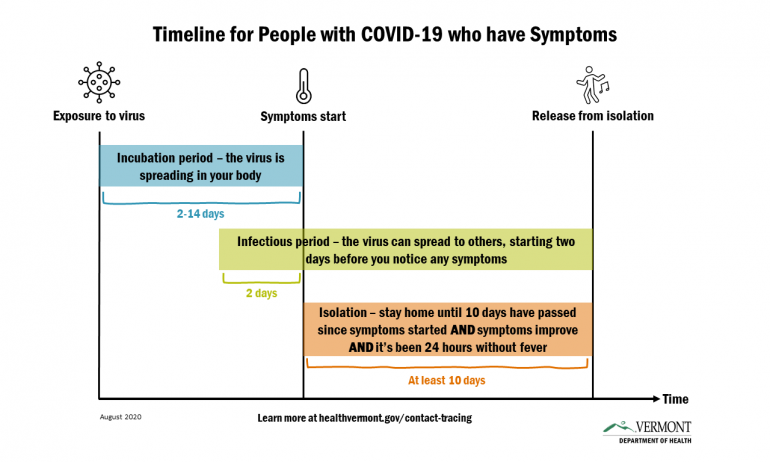
We’ve also added three different visual timelines to the contact tracing section of our website that show important dates for cases and close contacts:
- Timeline for people who test positive and have symptoms
- Timeline for people who test positive but do not have symptoms
- Timeline for people who are close contacts with someone who has tested positive
New on healthvermont.gov
Collecting data from emergency departments and urgent care centers can identify potential COVID-19 clusters or spikes in the community early on. In our latest Weekly Data Summary Spotlight on Syndromic Surveillance, learn more about this data, including when we’ve seen such increases and who is visiting emergency departments and urgent care centers for COVID-like illness.
Time to Get Your Flu Shot
Flu vaccine continues to arrive in the state, and your local pharmacies and providers don’t yet have a supply, they will soon.
It’s especially important this year for everyone who can get their flu shot, to do it ─ when both flu viruses and the new coronavirus may be spreading at the same time.
Who should get a flu shot?
- Anyone over 6 months old, with rare exceptions
- People in a high-risk group or who has underlying health conditions
Where can I get my flu shot?
- From your health care provider
- At your local pharmacy
- At a flu clinic near you
Go to healthvermont.gov/flu to learn more about the flu, the vaccine and find where to get a flu shot near you.
Case Information
Current COVID-19 Activity in Vermont
As of 12 p.m. on October 7, 2020
|
Description |
Number |
||
|
Total cases* |
1,827 (6 new) |
||
|
Currently hospitalized |
1 |
||
|
Hospitalized under investigation |
0 |
||
|
Total people recovered |
1,635 |
||
|
Deaths+ |
58 |
||
|
People tested |
168,021 |
||
|
Travelers monitored |
565 |
||
|
Contacts monitored |
54 |
||
|
People completed monitoring |
9,207 |
* Includes testing conducted at the Health Department Laboratory, commercial labs and other public health labs.
+ Death occurring in persons known to have COVID-19. Death certificate may be pending.
Hospitalization data is provided by the Vermont Healthcare Emergency Preparedness Coalition and is based on hospitals updating this information.
Find more at the data dashboard: healthvermont.gov/currentactivity.
Guidance for Vermonters and Businesses
- If you are having a medical emergency, call 9-1-1 or go to the hospital.
- If you think you have symptoms of COVID-19, call your health care provider.
- Maintain physical distancing of at least 6 feet and wear a mask when near others.
Key Resources:
- Health information, guidance and data: healthvermont.gov/covid19
- By sector guidance: accd.vermont.gov/covid-19
- Travel map and modeling: dfr.vermont.gov/about-us/covid-19/modeling
- Governor’s actions: governor.vermont.gov/covid19response
Get the information you need at our Frequently Asked Questions.
Return to School Guidance
- Strong and Healthy Start: Safety and Health Guidance for Vermont Schools
- Mental Health: A Strong and Healthy Start: Social, Emotional and Mental Health Supports During COVID-19
- Sports: Fall Sports Programs for the 2020-2021 School Year
- Child care: Health Guidance for Child Care and Out of School Care
More resources on our Schools, Colleges and Child Care Programs web page.
Traveler Information
Visit our Travel to Vermont web page for continually updated information and guidance.
The cross-state travel map is now updated each Tuesday.
Getting Tested for COVID-19
Anyone can get tested, but not everyone needs to get tested.
Talk with your health care provider If you think you should be tested for COVID-19.
- If you don’t have a provider, dial 2-1-1, or contact the nearest federally qualified health center or one of Vermont's free & referral clinics.
Visit our testing web page for more guidance and where to get tested if you do need it.
Take Care of Your Emotional and Mental Health
If you or someone you know is in crisis or needs emotional support, help is available 24/7:
- Call your local mental health crisis line.
- Call the National Suicide Prevention Lifeline at 1-800-273-8255.
- Text VT to 741741 to talk with someone at the Crisis Text Line.
- For more information visit healthvermont.gov/suicide.
Get self-help tips and connect to mental health services at COVID Support VT.
See ways for Coping with Stress.