

Leonine: Legislature takes on budget, climate change, hazard pay

BUDGET WEEK

Leonine Public Affairs The House Appropriations Committee voted unanimously to approve the full FY2021 budget this week. The bill, H.969, passed the House on Friday. The Senate Appropriations Committee spent much of the week reviewing the bill and will officially start work on it next week. Senate policy committees including Health and Welfare and Economic Development, Housing and General Affairs are preparing their recommendations for Senate Appropriations on how to allocate the almost $200 million in remaining Coronavirus Relief Fund dollars.

The deadline for the budget to pass and lawmakers to wrap up their work is September 25. With the House and Senate working concurrently on the budget, legislative leaders have indicated it’s possible they could adjourn earlier. Legislators and their staff are exhausted from a legislative session that has gone on for months longer than usual. By the time they adjourn, lawmakers will have little over a month to campaign for reelection, which is another reason they are eager to wrap up the session.

The budget is not the only bill still in play. Lawmakers are considering bills that expand hazard pay benefits and another that would provide undocumented workers with stimulus payments. The legislature recently sent the Global Warming Solutions Act to Governor Phil Scott, who is likely to veto it because it would allow lawsuits against the state if climate goals are not met. More on this bill later in the newsletter. It is unclear whether the legislature will schedule a veto override session and if so when it would take place.

All said, it appears the marathon that is the 2020 legislative session may be nearing its end. In the months leading up to the 2021 legislative session the Joint Fiscal Committee, which includes the chairs of the House and Senate money committees, will likely be charged with making any budgetary decisions that need to be made in the interim. This puts an unusually large amount of decision making authority on the committee, but it is deemed necessary as reconvening the legislature would be a logistical nightmare.

Finally, at his weekly press conference today, Governor Scott extended the State of Emergency declaration to October 15.


MONEY AND CLIMATE

This week the House passed two major bills and one could result in a veto showdown with the governor and surprisingly with state revenues tanking it wasn’t the state budget but a bill to address climate change.

The House passed the FY21 budget bill this week by an overwhelming 140-4 vote. The four Progressives who voted against the bill did so because the bill failed to raise taxes on the wealthy to address the inequities the COVID-19 pandemic brought to light. The bill appropriates $7.1 billion in state and federal funds for the full fiscal year. House Appropriations Committee Chair Kitty Toll, D-Danville, called it a “steady state budget in an uncertain time.” The budget is balanced, uses no reserves and appropriates the remaining $224 million in one-time federal Coronavirus Relief Fund (CRF) dollars. The downside is the bill uses a lot of one-time funding so depending on what happens with the economy there could be a big hole in future budgets.

Click here for a link to all the new CRF appropriations in the bill.

After a heated debate and despite strong opposition from Republicans, the House adopted the Senate Proposal of Amendment to H.688, the Global Warming Solutions Act, by a veto proof vote of 102-45. The bill will head straight to the Governor, who has publicly expressed concerns about the bill, and all eyes are on him to see if he will veto it. H.688 turns Vermont’s greenhouse gas reduction goals into mandates. It creates a 23-member Vermont Climate Council, chaired by the Secretary of Administration, which must adopt a Climate Action Plan by December 1, 2021. The Republican Caucus argued that lawmakers were abdicating their legislative duties to the unelected Council and the state is opening itself up to lawsuits if the state is unable to meet the mandates. On Friday House Energy & Technology Chair Rep. Tim Briglin successfully offered a floor amendment to the budget bill, H.969, providing for an additional $586,000 for three new positions at ANR related to the work that will have to be done in implementing this legislation and for consulting services. The amendment passed on a 100-42 mostly party line vote. Here is a link to the bill as it passed the House and Senate.


STIMULUS EQUITY PROGRAM

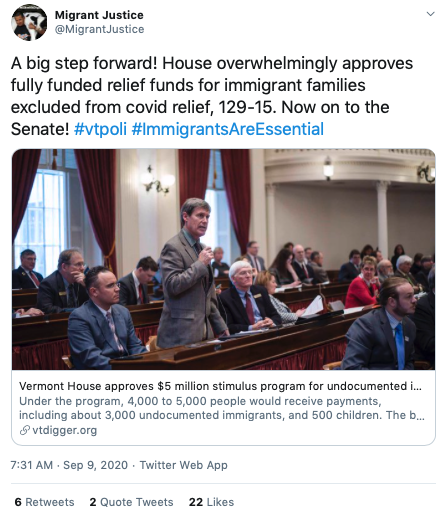
On Wednesday the House gave final approval to H.968, which creates the Vermont Coronavirus Economic Stimulus Equity Program. The bill allocates $5 million to a fund for stimulus payments to Vermont residents left out of the federal government's stimulus program due to their immigration status. This program would give eligible adults a one-time payment of $1200 and $500 for every child 17 or under in their household.

HAZARD PAY

On Friday the House Commerce Committee advanced legislation approved by the Senate last week to expand the Front-Line Hazard Pay Grant Program for essential workers in Vermont. S.352 increases the funding for FY21 from $28 million to $30.5 million and makes technical changes to clarify eligibility for the program. On Tuesday the House Commerce Committee will begin looking at S.353, a second hazard pay bill that was also approved last week by the Senate. S.353 expands the Front-Line Hazard Pay Grant program to include certain other essential employees who performed work with an elevated risk of exposure due to COVID-19. The expanded list of eligible positions includes retail and grocery workers store workers, pharmacists and wholesale distributors. When the program was initially established by the legislature in May, these workers were left out due to concerns that their inclusion would not be eligible under the federal guidance for use of CRF dollars.


TOP #VTPOLI TWEETS


TO OUR READERS

Leonine Public Affairs Please visit our website for our in-depth reporting on COVID-19 throughout the United States. This site is courtesy of Leonine FOCUS, our 50-state legislative regulatory, tracking and reporting service. The site is frequently updated and includes information on executive orders, legislation, regulation, tax deadlines and more from across the country.
Source: Leonine Public Affairs, Montpelier, Legislative Report Fall Session - Week 3 - September 11, 2020. leoninepublicaffairs.com.
Through a special arrangement with Leonine, Vermont Business Magazine republishes Leonine's legislative report on vermontbiz.com