

by Timothy McQuiston, Vermont Business Magazine Vermont Secretary of State Jim Condos last week explained the just-implemented process of universal mail-in voting and the enthusiastic response to it. The number of requests for mail-in ballots is far exceeding the state’s experience with absentee ballots by more than 12-fold. But those who still want to go to the polling place to vote in-person will still be able to for the primaries in August and the general election in November. As of Monday morning, there have been 108,721 requests. Requests have now surpassed total votes cast for the 2018 Primary elections.
The Legislature this session gave Condos one-time powers to implement several voting changes in the wake of COVID-19. After somewhat of a political tussle with Governor Scott over how this would proceed and after Scott stepped away from the process, Condos has quickly organized the process.
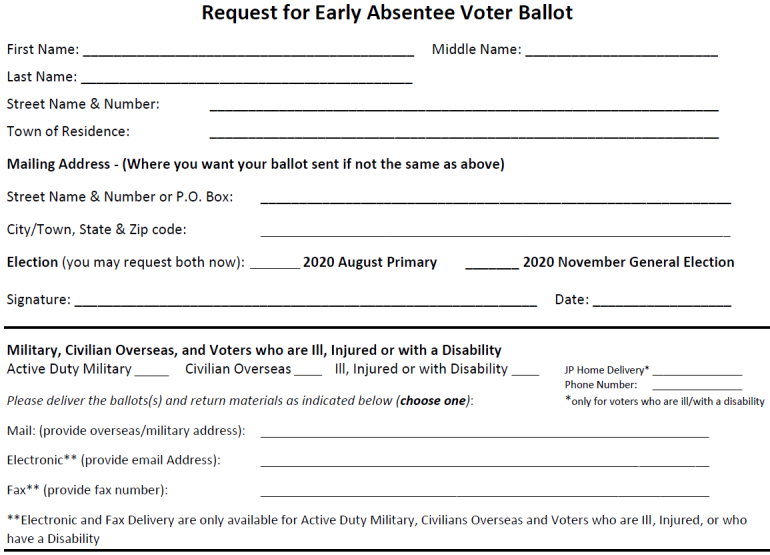
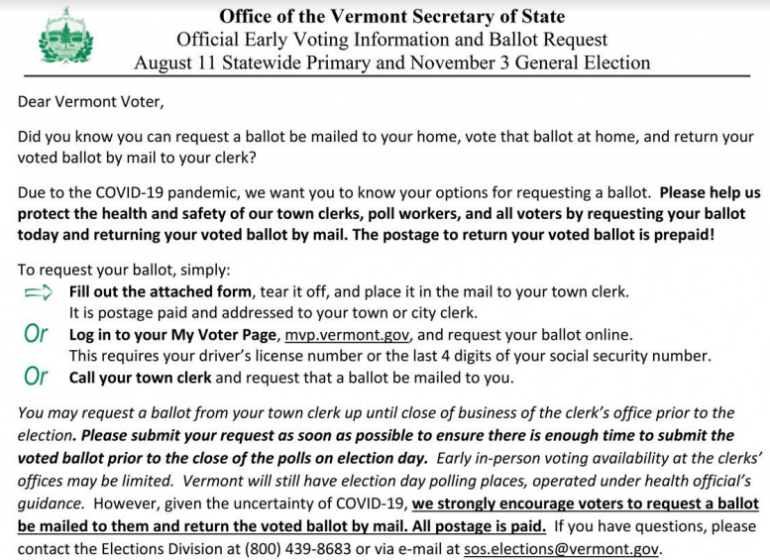
Already, voters that are already on their local checklist, and even those who should be, have been sent a postcard informing them of the mail-in option.
Voters can also go directly to their town clerk or go onto the website (mvp.vermont.gov) in order to obtain a mail-in ballot.
Primary Election - Tuesday, August 11, 2020 | General Election - Tuesday, November 3, 2020
Two questions have dogged the mail-in process: Potential for voter fraud and cost.
Condos (see his remarks below) said there is little chance the process will be plagued by fraud. A recent case in New Jersey, he said, proves his point that any attempt to commit fraud will be discovered and prosecuted.
He said that threats to the electoral process in recent years have come mainly from outside the country by nefarious agents from places like Russia.
“It’s more likely you’ll be struck by lightning than you will commit voter fraud,” Condos said.
While there might be some errors with the checklist or postcards sent to deceased individuals, as there always are, a long history of absentee ballots shows little in the way of fraudulent voting.
By Wednesday alone, there had been 95,704 requests for mail-in ballots for the primary election. In 2018, there were 3,560 as of the same day and in 2016 there were 7,966.
As for the cost, Condos said the federal CARES Act money is picking up all the costs. The CARES Act is funding everything from the PPP loans to businesses to health care to economic recovery grants resulting from the coronavirus pandemic.
Vermont received over $1 billion in CARES-related funding. About $3 million is earmarked for the election and there also was some additional funding provided last February from the organization Help America Vote.
As the state has done in the past, two outside vendors will be employed to print and send out the mailings, one from inside Vermont and another from outside. This is intentional, Condos said, to avoid the of a catastrophic event – natural or otherwise – that could disrupt the electoral process.
The ballots are then mailed directly to the town clerks.
Another noticeable change the Legislature made to the process is that candidates no longer will be able to collect and return ballots, as they had been, surprisingly, in the past with absentee ballots.
Historically, especially with older or infirm voters, friends and neighbors would routinely help out by carrying the ballot to the town clerk. Party operatives traditionally would organize to drive people to the polls.
But this new law only addresses the candidates themselves, not their staff, who could still act as a courier of ballots.
Condos said the Legislature could change that for the general election when they get back from their recess after the primary in late August.
The town clerks will then count the ballots as they always have.
About 80 percent of the vote in Vermont is machine counted. The state will issue machines to towns that request them, though Condos said there are not enough to go around.
In all, 135 towns have machines and 111, mostly small towns, do not, Condos said.
The ballots returned early are counted for how many come in but are then put in a lock box and are not tabulated until election day.
Unlike past years when the municipalities had to bear the cost of postage, even that cost will be picked up by the state via CARES money.
Condos said that for in-person voting, protocols are being developed to ensure the safety of voters and of volunteers and staff.
The protocols will develop with guidance from the secretary of state’s office.
For those using the mail-in ballots, they must be in the hands of town clerks by election day.
For the primaries, each voter who requests a mail-in ballot will receive three: one for each party. They must return all three, ether by mail in a postage paid envelope or by hand to the town clerk or on election day at the polling place.
“What ballot you use is your little secret,” Condos said.
He said the main purpose of the universal mail-in ballot is to get more people to vote, even though the impetus was in response to COVID-19.
CONDOS MESSAGE, July 13, 2020
Good afternoon - and thank you to all of those who are joining us to cover this important election.
I am Jim Condos, VT’s Sec of State, and Chief Elections Official.
Today I will be discussing the upcoming 2020 VT Aug 11th Primary Elections, in hopes of further educating VT voters about the process.
1st, we need to acknowledge that we are in extraordinary, trying times.
The COVID-19 pandemic & health crisis has challenged many aspects of our society & of our lives - unfortunately our elections are not immune.
We have seen the challenges other states have experienced trying to conduct elections while our country is experiencing a highly contagious and deadly disease.

We’ve all heard the stories of long lines, voter confusion, voter suppression and even COVID contact at the polls.
We have also heard many success stories, particularly in states that have expanded vote by mail, which has been shown to be a safe, simple, effective & secure method of ballot delivery for years.
Fortunately, VT is already in an excellent position due to our existing election procedures and laws.
My focus for today’s discussion is on the Aug 11th Statewide Primary Elections, as they are right around the corner, just 4 weeks away.
I am sure you will also have questions on the Gen Election, and how VT voters can exercise their right to vote while we all work together to slow the spread of COVID-19. I’ll be happy to answer those after, but our primary focus, pun intended, is on the upcoming Primaries.
As the state’s Chief Election Official, I have had two guiding principles in my planning process when it comes to elections this year:
- Preserve every VT voter’s right to vote, and
- Protect the health/safety of every voter, TClerk, & election worker.
To that end, for the Aug Primaries, the ONLY MAJOR CHANGE for voters from years past is that we mailed a postcard to every active registered voter, which included a tear-off, pre-addressed postage paid ballot request form that voters can use to request an early ballot by mail from their Town or City Clerk.
It’s important to understand that voting by mail is not new here in VT or across the nation – nearly all states have some form of voting by mail. And 5 states (WA, OR, CO, UT, & HI) have been voting universally by mail for some time.
VT has what is called Early/no-excuse absentee voting, which means that, unlike some states, voters do not need a reason, like being homebound, or being out of state on Election Day, as a reason to request a ballot and vote early.
Tens of thousands of VTers have voted early, many by mail, in every recent election cycle – typically 25 to 30 percent of voters do so in a given election.
For years voters have been using a number of different ways to request their ballot.
This year, they have one more optional tool: the prepaid postcard.
Filling out the postcard and mailing it back to their Clerk is one way a voter can request a ballot by mail this year.
However, just like every other year, there are other ways a voter can request their ballot:
- Online at mvp.vermont.gov, where registered voters can log in, verify their information, request their ballots, view a sample ballot, find contact information for their Clerk, and even find their polling location.
- Directly from their Town Clerk, in writing or email, by phone, or in-person pending open office hours.
It’s important to check office hours and procedures of the Clerk’s office before going by in-person.
When using the postcard, or when requesting through other means, it is important that voters verify both their registration address AND the mailing address where they would like their ballot sent.
While voting early or by mail isn’t new for every voter, for some it is, so I want to cover what a voter needs to do with their ballot once they have it.
1) Voters need to follow the instructions provided with their ballot carefully. I cannot stress this enough.
2) For the Aug Primary Elections, every voter will be receiving 3 ballots: one for each of the major parties (Democrat, Republican, and Progressive) – essentially, we are running 3 different Primary elections - all at the same time.
3) You can only vote ONE of those 3 ballots: It’s your choice which Primary - Dem, Rep, or Prog - that you want to vote in.
Which Primary you vote in will be your little secret, unless you decide to share it with others.
4) When you vote your ballot, DO NOT write your name (unless you are doing so as a write-in vote) or any other personal information on your ballot – this will render the ballot defective and it won’t be counted.
5) Follow all instructions on how to fill out the ovals on your ballot, making sure your ballot selections are marked clearly in the circles, and that you do not fill out more ovals than is allowed in each race.
6) Once you are satisfied with your ballot selections, place that ballot in the certificate envelope, which is the envelope that asks you to print your name, your Town, and to sign under penalty of perjury that you are who you say you are, and that you have not been unduly influenced.
7) Make sure to complete all fields on the certificate envelope, including your signature, and seal your voted ballot inside.
8) Then, place your two other unvoted ballots in the unvoted ballots envelope and seal the envelope - you must return your two unvoted ballots in order for your vote to be counted.
9) If you have requested and been mailed a local election ballot, please follow the instructions your Clerk has included to vote that ballot.
Not all towns have a local election on Aug 11th.
10) Place the certificate envelope and the unvoted ballot envelope inside the mailing envelope, which should be pre-addressed to your Clerk, and for this year should include pre-paid postage.
11) As in previous elections, you have several options to return your ballot:
- Mail your ballot back,
- Hand deliver your ballot to the Clerk’s office any day during business hours, or
- Bring your ballot to the polls with you on Election Day.
12) Be sure to give your Clerk plenty of time to receive that ballot if you are putting it in the mail. Your ballot must be received by the Town Clerk by 7pm on August 11th for it to count.
13) POLLS WILL BE OPEN AS USUAL ON ELECTION DAY! Voters who do not vote early can still show up to vote in-person on Election Day.
Make sure to check online at mvp.vermont.gov, or with your local Clerks office, to verify where your polling location is.
Some polling places, for the protection of poll workers and voters, may move to accommodate social distancing requirements during COVID-19 and we are working with the Department of Health to develop polling place guidelines based on CDC recommendations.
Occasionally, we receive questions about election integrity, & the safeguards we have in place here in VT, so I will quickly cover that:
It is illegal to impersonate, bribe, or otherwise unduly influence a voter.
This is true whether voting by mail, or at the polls.
VTers voting by mail must sign their certificate envelope under the pains & penalties of perjury that they are who they say they are, & haven’t been influenced.
There are severe penalties for committing fraudulent activity.
When their ballot is received by the Town Clerk, the Clerk records them as having voted.
Once checked off the checklist, that person cannot return another ballot or vote again on Election Day - i.e. One person, one vote.
Using the My Voter Page, voters can check the status of their ballot, including when:
- Their request was received,
- When their ballot was mailed, and
- When their returned ballot was received.
To those skeptics concerned about the integrity of by-mail voting, I welcome their skepticism: we should all care deeply about the integrity of our elections.
I only ask that people look to the facts and the evidence, and not secondhand anecdotes or baseless claims and rhetoric.
Non-partisan studies have shown repeatedly that widespread voter fraud, including by-mail, just doesn’t happen.
Data from the non-partisan Brennan Center for Justice demonstrates that a voter is more likely to be struck by lightning than they are to commit mail voting fraud.
That has also been our experience here in Vermont.
Thousands of VT voters have been voting early by mail every election for years, including citizens living overseas, and our military service members serving our country abroad, all without issue.
In fact, military personnel have been voting by mail since the Civil War.
In red & blue states which have implemented 100% vote by mail programs for years, rates of fraud remain infinitesimally small.
Can it happen? Anyone can point to a few cases out there, but they are incredibly rare, were detected, and prosecuted.
The true voter fraud is to deny any eligible voter their right to cast a ballot, which is why we cannot take any chances when it comes to our upcoming elections during 2020.
It is my job to make sure your voting rights are protected, and I take that job seriously.
One quick and final note about the postcard: they went out to two different groups of registered voters:
- Active voters, and what are called challenged voters.
- Active voters are voters who have not been challenged by the local Board of Civil Authority (called a BCA), who are responsible for maintaining the local voter checklists under the guidance of the Town Clerk.
- Voters who are challenged are placed on the challenged list.
They must affirm their eligibility to be registered at their VT residence before they are eligible to vote again.
For this reason, some VTers may have received postcards for people who have moved away, or who have passed away.
This is a normal part of the process, and in fact will help the BCAs update information to make our local checklists even more accurate.
I would encourage anyone who receives a postcard for someone not at their residence to notify their local Clerk.
With that, I will just let you know that as of 9am today:
- 74,907 voters have requested an early ballot,
- Compared to:
- 3,560 on this same day in 2018, and
- 7,966 in the 2016 Election.
To put these in perspective, that is 21X the number of requests vs. 2018 – and 9X the number for 2016.
TOTAL turnout for 2016 was around 120,000, so the number of requests we have this year so far is significant.
We’re encouraging voters to find us on Facebook or Twitter to stay up to date with trusted information about our elections in Vermont.
I realize this is a lot of information, but with such an increase in requests for mail ballots & with the uncertainty about the course COVID-19 will take in the coming months, we want to be sure every VT voter is allowed to cast their vote and have it counted, even under these circumstances.
And with that, I’ll turn it back over to Eric for us to take questions.