

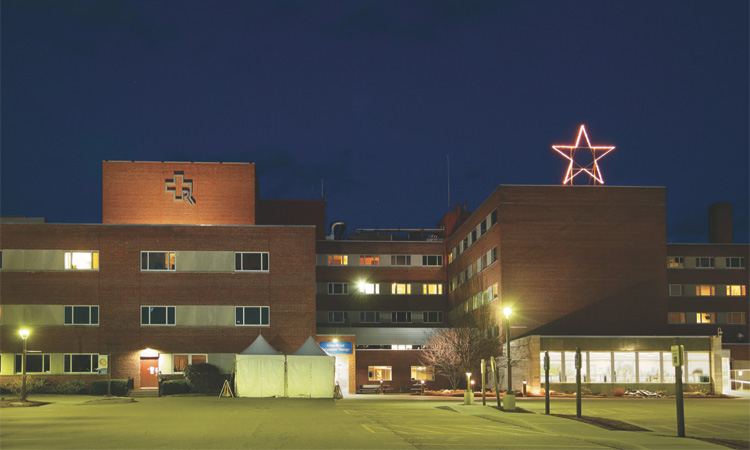
Photo: The Star of Hope atop Rutland Regional Medical Center during the Covid-19 pandemic. Courtesy photo.
by Bruce Edwards, Vermont Business Magazine Rutland Regional Medical Center was prepared for the worst - a surge in patients infected with the Covid-19 virus.
It was a surge that for now hasn’t materialized but the hospital was ready just the same, closing one of its specialty procedure suites and converting it into a 10-bed, negative pressure COVID ward.
“We did have some sick COVID patients but nowhere near the amount of patients we feared,” said RRMC President Claudio Fort.
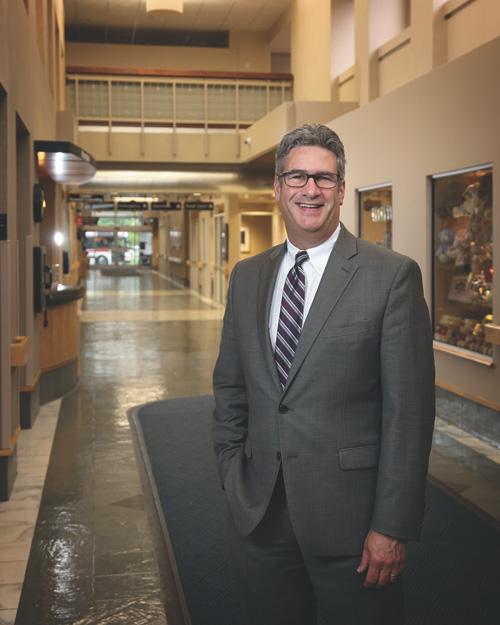 Photo: Claudio Fort is president and CEO of Rutland Regional Medical Center. Courtesy photo.
The hospital is slowly returning to normal but to prepare for an influx of patients required the hospital to take some painful steps.
Those steps included suspending elective surgeries, which resulted in a substantial loss of revenue. In turn that forced the hospital to furlough dozens of employees.
“Our (patient) volumes were down for the month of April by 60 percent and our revenues were down by $19 million for the month(s) of March and April,” Fort said.
The losses were offset by federal grants totaling $13 million for a net loss of $6 million, Fort said.
He said there is another $75 billion in the pipeline for health care providers but how that money will be distributed is an unknown.
To cut costs, the hospital furloughed 150 of its approximately 1,763 employees. The effected employees were support and administrative staff as well as medical assistants.
Fort said as the hospital began rescheduling elective surgeries all but 50 workers had been recalled (as of mid-May) with additional employees being brought back on a daily basis.
Asked whether all furloughed workers would be brought back, Fort said, “We would like to but I don’t know for sure whether will be able to.”
With hospitals across the state in an unenviable financial position because of the pandemic, Fort said a rate increase to cover losses won’t solve the problem. He said those rate increases wind up being paid by employers and their employees. “We can’t put all of this on local businesses who are already struggling,” Fort said. “There’s going to be very little that I see at this point will be able to recoup through rates,” he said.
He said what’s likely is a nominal rate increase to account for inflation. “But I don’t see us pass on a double-digit rate increase this year,” he said. “We can’t put that burden on our local business community who is already struggling.”
Fort said that means the hospital has to find other ways to “balance the books and to serve our community.”
Like other community leaders, Fort praised the Scott administration for its handling of the pandemic.
He also gave high marks to the hospital and staff which he called its “finest hour.”
“I’m really, really proud that here at Rutland Regional we did that very well,” Fort said. “I think we were well prepared. I think we were as prepared as any hospital in the country for this.”
The pandemic closed many businesses in the state, including construction, which are now slowly starting to reopen.
As a result, completion of the hospital’s $24 million, 3,700-square-foot, two-story, Thomas W. Huebner Medical Office Building has been delayed.
It’s now scheduled for completion in the fall.
It will be the home of the ears, nose and throat practice and audiology clinic; the medical staff for physical medicine and rehabilitation; and the Vermont Orthopedic Clinic.
HP Cummings is the general contractor.
Bruce Edwards is a freelance writer from Southern Vermont. Thsi story first appeared in the june issue of Vermont Business MAgazine.