

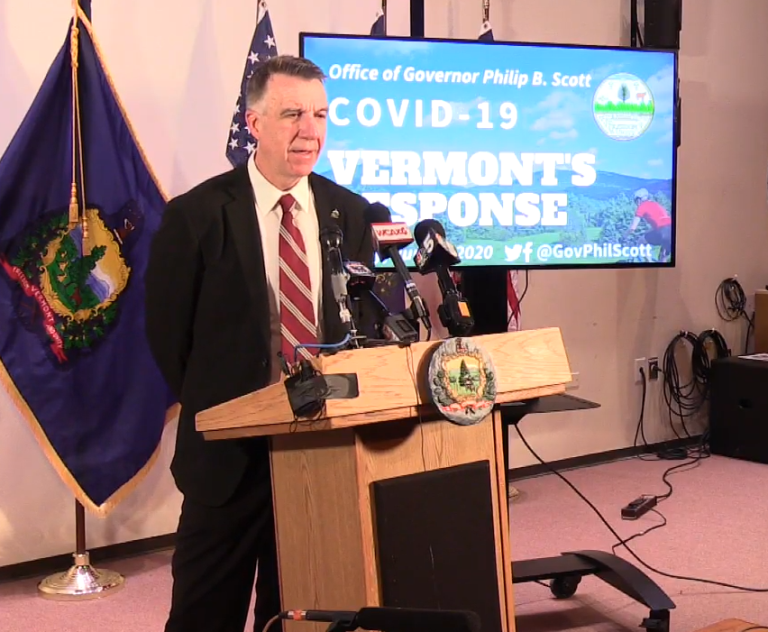
Governor Scott answers a question at Friday's press briefing.
by Timothy McQuiston, Vermont Business Magazine Draft legislation developed in the House and presented Thursday would initially cut in half the emergency aid to businesses proposed by the Scott Administration. Of the $310 million Governor Scott had proposed, $150 million was to be rushed to the most vulnerable businesses, like restaurants and retail, and the rest targeted for other businesses. The legislative proposal basically would cut that in half initially with $50 million going to restaurants and retail and another $20 targeted for general business to expedite the process.
The whole package would be passed by the end of June when the Legislature will go into recess. The governor said at today's press briefing he does not have a problem with that schedule as long as the money is distributed quickly and the whole $400 million package is enacted by the end of the month.
Agriculture, especially dairy, would be given priority as would dairy product producers. The $400 million package would include aid to nonprofits as well. Phase one would distribute $310 million (see plan below) with another $90 held for a phase two.
The money comes from the federal CARES Act federal stimulus. Vermont received $1.25 billion.
"We want to get the money out as quick as possible, whatever means that takes," Scott said.
"I would like to see them pass the whole package as quickly as possible, but if that is not possible, and they can only get half done right now, immediately, then let's do that first.and then continue to work on the second half, Scott said.
Scott called the package "essential" to help businesses stave off bankruptcy now and then thrive going forward.
"I don't want to save this money for anything else," he said.
He said he would accept a plan that would get half of the money out sooner and the rest by the end of June.
Restaurants were among the first businesses required to close in mid-March as the COVID-19 pandemic closed in on Vermont.
Scott announced today indoor table service at restaurants and pubs can resume June 8 to 25 percent of capacity and six-foot distancing and no bar service, while the lodging industry will benefit with capacity limits increased to 50 percent capacity.
Cross-boarder travel also will be allowed starting Monday without quarantine, but only from New York and New England and only from counties exhibiting low COVID-19 counts, which excludes all the urban areas and nearly all of southern New England and the New York City area.
For Scott's aid package, Katherine Levasseur, chief of staff for Speaker Mitzi Johnson, told VBM earlier this week that she expects the House Appropriations will have the recommendations from the policy committees next Wednesday, June 10. She said the bill will get through the Legislature before they recess at the end of June.
On the Senate side, Tim Ashe, Senate President Pro Tem, told VBM he could see a two-step process to hasten the distribution of emergency funds: "I think we’d like to get some of the grant money for businesses out quickly while working on the rest (of the package by the end of June)."
What Ashe suggested appears to be what is taking shape.
DRAFT
Sec. 1. DEFINITIONS
As used in this act:
(1) “CARES Act” means the Coronavirus Aid, Relief, and Economic Security Act, Pub. L. No. 116–136, as amended, and any guidance and regulations issued under that act.
(2) “Governor’s Order” means Executive Order 01-20 and any addenda and directives issued under that order.
(3) “Eligible business” means:
(A) The business is a non-public, private organization that:
(i) is domiciled in Vermont; and
(ii) has one or more employees in Vermont.
(B) The business is:
(i) organized and operated on a for-profit basis, including a sole proprietor, partnership, limited liability company, business corporation, cooperative, or mutual benefit enterprise; or
(ii) organized and operated on a nonprofit or low-profit basis, including a mutual benefit corporation, public benefit corporation, and a low-profit limited liability company.
(C) The business was in operation on or before February 15, 2020.
(D) The business:
(i) is open for business at the time of application; or
(ii) is closed for business due to the COVID-19 public health emergency but has a good faith plan for reopening.
(4)(A) “Eligible use” means a use of loan or grant funds permitted under the CARES Act to assist a business in addressing the costs of business interruption during the COVID-19 public health emergency, including:
(i) working capital;
(ii) payment of fixed costs;
(iii) accounts payable;
(iv) payroll;
(v) other bills that were ordinarily paid from ongoing operations prior to the COVID-19 public health emergency; and
(vi) costs incurred to changes business strategy, delivery method, or other operational changes in response to the COVID-19 public health emergency.
(B) “Eligible use” does not include:
(i) business expansion that is not in response to the COVID-19 public health emergency;
(ii) physical repairs;
(iii) acquisition of real property;
(iv) construction of renewable energy projects;
(v) payment of bonuses or dividends;
(vi) debt consolidation or refinancing of long-term debt;
(vii) payments for taxes, public utilities, or other government services or fees that qualify as revenue replacement to the government recipient under the CARES Act; and
(viii) payments for expenses for which the business has or will receive reimbursement from another federal source, State source, or insurance.
Sec. 2. Restart Vermont Emergency Action Grant
Program
(a) Authorization; appropriation. Of the funds available to the State of Vermont under the CARES Act, the amount of $50,000,000 is appropriated to the Department of Taxes to establish a Restart Vermont Emergency Action Grant Program, in coordination with the Agency of Commerce and Community Development.
(b) Requirements for grant applicants. An eligible business may apply for a grant for an eligible use if:
(1) The business is:
(A) a vendor registered to collect sales and use tax pursuant to Title 32, Chapter 233; or
(B) is an operator registered to collect meals and rooms tax pursuant to Title 32, Chapter 225, but this does not include operators who are only operators because they conduct business as a booking agent under Title 32, Chapter 225.
(2) The business files its sales and use or meals and room taxes on a monthly or quarterly basis.
(3) The business experienced a 75 percent or greater reduction in taxable sales in any one-month period from March 1, 2020 to September 1, 2020 as compared to the same one month period from March 1, 2020 to September 1, 2019.
(c) Grant amount; terms.
(1) The amount of a grant shall equal the lesser of:
(A) $62,500; or
(B) 5 percent of the business’s average annual sales subject to sales and use, and to rooms and meals taxes, from calendar years 2018 and 2019.
(2) For purposes of calculating a business’s sales pursuant to this subsection, if the business was not open in any month during 2018 and 2019 other than for normal seasonal or holiday closures, then the sales equal the average monthly sales for the months the business was open, and then calculated on an annualized basis.
Sec. 3. RESTART VERMONT GRANT PROGRAM
(a) Authorization; appropriation.
(1) Of the funds available to the State of Vermont under the CARES Act, the amount of $20,000,000 is appropriated to the Agency of Commerce and Community Development to establish a Restart Vermont Grant Program, in coordination with the Department of Taxes.
(2) The Agency shall identify local, regional, and State economic development organizations with whom it may partner to most efficiently distribute grants under the Program, which may include the Vermont Economic Development Authority, regional development corporations, community action agencies, and private institutions.
(b) Requirements for grant applicants. An eligible business may apply for a grant for an eligible use if the business experienced a 75 percent or greater reduction in revenue in any one-month period from March 1, 2020 to September 1, 2020 as compared to the same one month period from March 1, 2020 to September 1, 2019.
(c) Grant amount; terms.
(1) The amount of a grant shall equal the lesser of:
(A) $62,500; or
(B) 5 percent of the business’s average annual revenue from calendar years 2018 and 2019.
(2) For purposes of calculating a business’s revenue pursuant to this subsection, if the business was not open in any month during 2018 and 2019 other than for normal seasonal or holiday closures, then the revenue equals the average monthly revenue for the months the business was open, and then calculated on an annualized basis.
Sec. 4. GUIDELINES; REPORTING
(a) Guidelines. On or before June 15, 2020, the Department of Taxes and the Agency of Commerce and Community Development shall publish guidelines governing the implementation of their respective programs, which at minimum shall:
(1) establish application and award procedures;
(2) seek to ensure a need-based, equitable distribution of funds among regions and among business types, sizes, and sectors;
(3) ensure that all grant awards comply with the requirements of the federal CARES Act and any guidance and interpretation issued under the Act;
(4) require sufficient application information and maintain adequate records to demonstrate compliance with the Act;
(5) adopt procedures to prevent, detect, and mitigate fraud, waste, error, and abuse; and
(6) ensure that grant applicants are in compliance with State and federal employment laws.
(b) Reporting. The Agency and Department shall:
(1) provide regular updates and information concerning grant guidelines, awards, and implementation to the committees of jurisdiction of the General Assembly; and
(2) submit a report to the General Assembly on or before September 1, 2020 detailing the implementation of this section, including specific information concerning the amount and identity of grant recipients, which shall be publicly available.
VERMONT ECONOMIC RECOVERY AND RELIEF PACKAGE
On May 20, Governor Phil Scott announced his proposal for a $400 million economic relief and recovery package, using funds from the $1.25 billion the state received from the Federal CARES Act.
The two-phase proposal will start with $310 million for immediate relief to the most impacted sectors and businesses to be followed by $90 million for long-term recovery efforts.
The Agency of Commerce and Community Development and the governor will work with the Legislature towards passage of this historic relief package.
The Phase 1 relief package will involve four areas of distinct action to support businesses and Vermonters as they resume their operations.
They include:
- Financial assistance: Emergency Action Grants for food and accommodation services, retail, and agriculture, Vermont Economic Injury Disaster Loan and Grant program, and small business focused Vermont Restart loans and grants. ($250MM)
- Housing assistance: Rental Housing Stabilization Fund for property owners and a Re-Housing Recovery Fund to address homeless need. ($50MM)
- Technical assistance: Restart Vermont Recovery Guides created through a network of business and community assistance providers, and Employee Assistance Program to support the mental health and wellbeing of business owners and their families. ($5MM)
- Marketing support: Promotional marketing campaign to promote Vermont to Vermonters and deliver a toolkit of creative assets to be used by local communities, and regional marketing and consumer stimulus grants to encourage local spending, with implementation strategies to be proposed by local entities. ($5MM)

PHASE 1 PROGRAM $310 MILLION
FINANCIAL ASSISTANCE
$250 MILLION
Restart Vermont Emergency Action Grants $150 million
Who is in need: Food and accommodation services, retail and agriculture businesses that were severely impacted by closure or business disruption.
What will be done: Provide cash disbursement to individual businesses in the most vulnerable sectors. Funding will be directed to lodging, restaurant, retail and agriculture businesses that have been closed or lost significant revenue and are struggling to meet fixed costs. Funding will help prevent wide-scale foreclosures, bankruptcies and deterioration of the sectors and the communities in which they operate. These vulnerable sectors were among the first to close and may be the last to reopen. They require help to pay fixed costs that existing federal programs and state programs have not addressed. Grant proceeds may be used for rent, mortgage interest payments, utilities, inventory, and other essential operating expenses. Designed as a payment to operators based on a formula utilizing their last three years of revenue.
How will program be administered: Businesses will file an online form with the Tax Department demonstrating impact and need. The Tax Department will distribute payments to restaurant, lodging and retail operations based on meals, rooms and retail tax history to businesses with a gross annual revenue of $2.5 million or less. Businesses that can demonstrate need will be eligible for a grant based on their gross revenue and estimated fixed costs. The Agency of Agriculture will disburse agriculture and value-added food operation payments based on Agency of Agriculture funding distribution plan.
Vermont Economic Injury Disaster Loan and Grant Program $80 million
Who is in need: Businesses and non-profit organizations that closed or had significant revenue drops due to COVID-19, including, but not limited to, personal services businesses, manufacturers and creative economy businesses.
What will be done: The Vermont Economic Development Authority will utilize funding to provide existing borrowers impacted by COVID-19 with interest and principal relief and create a new loan and grant program designed to help businesses address fixed costs with which existing federal and state programs have been unable to help. VEDA will offer loans of up to $150,000 amortized up to 20 years with deferred interest for 12 months and a 2 percent interest rate in year two. Applicants will be eligible for a grant that may be used to cover three months of fixed costs incurred during closure or partial shutdown due to COVID-19.
How will program be administered: The State will grant VEDA $80 million. VEDA will use its loan application process to vet and approve applicants.
Vermont Restart Loan and Grant Program $20 million
Who is in need: Sole entrepreneurs, microbusinesses and other small businesses with annual gross revenue of less than $1 million and fewer than 5 full-time employees impacted by COVID-19 closures or partial shut-downs.
What will be done: Funding will be used to backstop loans, provide interest rate buy downs to loans made by non-profit lenders, and provide grants to businesses and non-profits impacted by COVID-19. Businesses and non-profits may apply for loans of up to $20,000 at zero percent for five years and grants of $15,000 (or three months of fixed costs, whichever is less) through the non-profit lenders. The grant and loan proceeds may be used for the restart of business operations. Organizations must take a loan to receive a grant.
How will program be administered: The state’s non-profit and municipal lenders will accept a common loan and grant application. They will utilize approximately $15 million in existing available capital to make loans. $5 million of the funding will be granted to the Vermont Community Loan Fund to provide loan loss reserves. $15 million will be granted to non-profit lenders to enable them to make up to $15,000 subgrants to businesses and non-profits approved for a loan.
HOUSING ASSISTANCE
$50 MILLION
Rental Housing Stabilization Fund $42 million
Who is in need: Landlords and Tenants
Due to COVID-19 response, many tenants have seen the loss or reduction of income and are unable or struggling to pay rent. Consequently, landlords across the state are not receiving full rental payments necessary to cover the costs of building ownership and upkeep.
What will be done: Provide direct financial assistance to stabilize the rental housing industry and prevent tenants from experiencing eviction and possible homelessness.
The program will provide up to 3 months of emergency rental assistance and rental arrearage payments to property owners suffering from non-payment of rent to eliminate rental arrearages and ensure tenants maintain their current housing. Payments will be limited to a maximum of 20 rental units per property owner. At proposed funding levels it is anticipated this program can assist approximately 15% of the rental housing stock.
How will program be administered: Payments will be disbursed through housing service provider(s) selected through the RFP process with oversight authority through the Department of Housing and Community Development.
Re-housing Recovery Fund $8 million
Who is in need: Families and individuals experiencing homelessness and owners of existing, substandard housing stock.
Service providers throughout Vermont have done an incredible job interrupting homelessness and providing non-congregate shelter during the COVID-19 outbreak. To continue this necessary step in maintaining public health, additional units will need to be quickly made available. Simultaneously, there exist numerous potential rental units throughout the state that remain in a substandard condition due to a lack of resources to bring units up to minimal rental housing health code.
What will be done: Provide emergency housing rehabilitation grants and forgivable loans to make up to 250 units of housing available to re-house families and individuals experiencing homelessness during the COVID-19 outbreak.
How the program will be administered: Grants and forgivable loans will be disbursed by housing service provider(s) selected through an RFP process with oversight authority through the Department of Housing and Community Development.
TECHNICAL ASSISTANCE
$5 MILLION
Restart Vermont Recovery Guides $4.75 million
Who is in need: Those businesses and organizations that have been most damaged by the closures and are at limited capacity upon reopening. In some cases, it will be businesses which have received government assistance and need to understand the best way to utilize the funds.
What will be done: Deliver appropriate level of professional assistance to businesses to enable them to re-emerge from the crisis in a viable way.
How will it work: ACCD will issue an RFP to service providers who will submit information on their qualifications including but not limited to:
• Operational expertise: Their ability to help modernize some of the current operating practices of businesses.
• Digital Strategy: How could the retailers establish a more robust and competitive online presence?
• Architecture: Physical Space design for optimal flow: How could restaurants adjust their model and space to accommodate more takeout and less seating? Space for meal preparation, assist with food delivery logistics, assist manufacturers who are reconfiguring operations to produce PPE, accommodation of safety measures.
• Technology or software consultancy: How could agricultural producers utilize technology to help solve problems? Same for manufacturing and others.
• Legal and/or Turnaround Experience/Advice: How to restructure debt for a business. What is the prioritization of their payables? If they need to unwind the business what is the most orderly methodology?
This work is crucial for businesses to survive. Even with government support they will need to shift business models and professional assistance can help them do that. In addition, the Recovery Guides could offer business and financial planning as well as grant and loan writing support.
Wellbeing for Small Businesses Employee Assistance Program $250K
Who is in need: Vermont employers and their employees.
The State of Vermont’s “Invest EAP Centers for Wellbeing ” is an employee assistance program based in the Division of Vocational Rehabilitation, which provides important services to support the health and wellbeing of the Vermont workforce at over 250 businesses that elect to pay for this service. The EAP provides counseling, resources, and referrals to help employees at these companies with issues such as depression, anxiety, PTSD, workplace issues, family and relationship issues, legal problems, substance issues, elder care, and childcare. For $250,000, the Wellbeing for Small Businesses Employee Assistance Program (EAP) can extend services to businesses with 50 or fewer employees over three months.
What will be done: Wellbeing for Small Business, would be made available to support both small business owners and their employees. EAP services are provided by a team of highly skilled, licensed mental health counselors located throughout the state, all of whom currently provide services through videoconferencing.
The program would offer two access points: one for business owners and the other for their employees. This will enable the EAP’s management consultation staff to receive initial calls from business owners who may have resource questions in addition to seeking counseling support. Employees would be directly referred to counseling staff.
MARKETING
$5 MILLION
Who is in need: All Vermont Communities
The tourism and hospitality sector, including lodging, restaurants and cultural attractions, has been one of the hardest hit by COVID-19. With travel restrictions, mandatory closures, bans on large gatherings and uncertainty on when out-of-state visitors will be welcome again, the industry has been brought to a complete halt and will be negatively affected for perhaps the longest of any other sector. Tourism is critical to rebuilding local economies and the fabric of community life Vermont residents enjoy.
Restart. Respect. Rediscover. Promotional Marketing Campaign $1.25 million
What will be done: A promotional marketing campaign, first directed at Vermonters, will encourage in-state travel, recreation and local spending by inviting residents to rediscover Vermont. Consumer spending throughout the state will provide an immediate boost to restaurants, downtowns, and tourism properties, directly support communities and small businesses and generate tax revenue. The campaign would revolve around the themes of respecting each other, renewing our relationship with our community, and rediscovering what our local regions have to offer as the economy reopens.
How will program be administered: The Department of Tourism and Marketing will manage the statewide promotional campaign and provide access to a marketing toolkit of creative assets for communities, organizations and individuals to utilize so we can speak with a unified voice.
Regional Marketing and Consumer Stimulus Grants $3.75 million
What will be done: Stimulus grant funding for regional destination marketing organizations, including chambers of commerce and downtown organizations, to encourage consumer spending in local communities. Funding would be made available for marketing or incentive programs to be determined by each region to best fit that area’s needs. Each program will encourage Vermonters to direct spending to local businesses, such as through buy-local challenges, loyalty affinity or gift card programs, incentives to local businesses (lodging, restaurants, retail, etc.) to create discounted packages or opportunities for Vermonters, or direct outreach and marketing.
How will program be administered: Grant funds to be disbursed by the Department of Tourism and Marketing. Through an RFP process, we would encourage each region to apply for funding through one organization that works in collaboration with others (chambers, downtown organizations, business leaders, etc.).
For additional detail on this relief and recovery package, visit https://accd.vermont.gov/covid-19/vermont-economic-recovery-and-relief-package.