

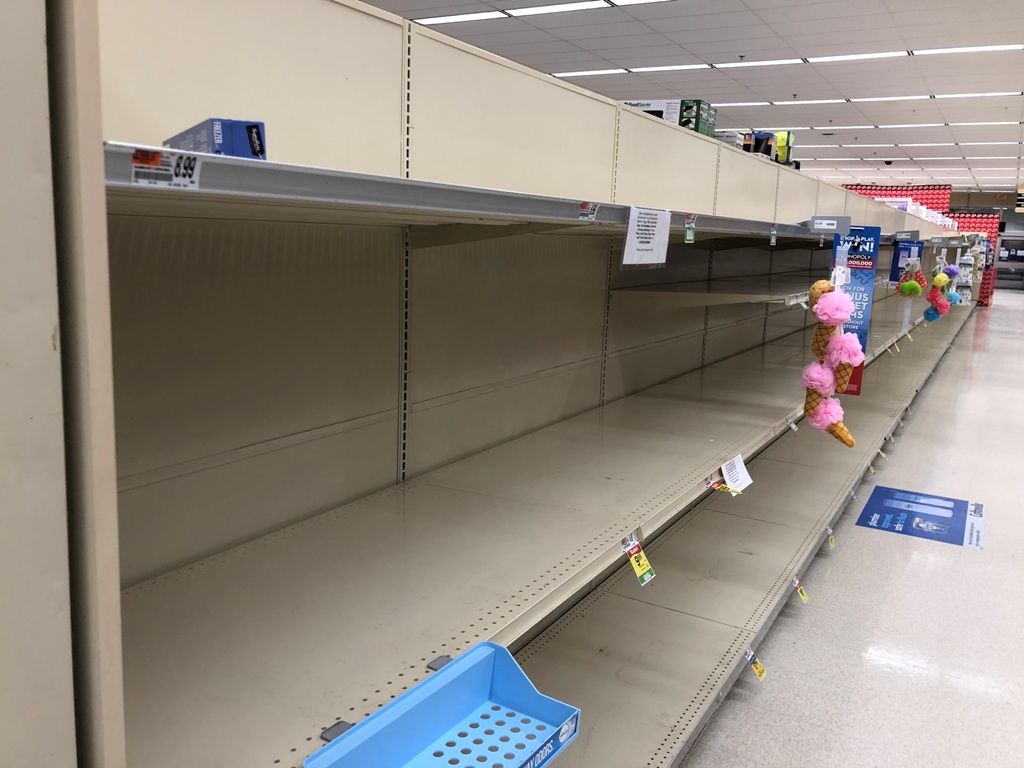
An empty supermarket aisle of toilet paper and paper towels has become a common sight across the state and around the country. VBM photo from late March at Shaw's in Williston.
by C.B. Hall, Vermont Business Magazine "Devastating," said Joe Tisbert, president of the Vermont Farm Bureau, describing the impact of the coronavirus pandemic. "This whole thing has been devastating to agriculture across the board."
The same adjective depicts the state of Vermont's food retailers: In big-box supermarkets and village stores, the impact has been extreme, although not without some silver linings in the cloud.
The descriptor carries special force when it comes to the dairy farms that are so embedded in everything that Vermont is. After some four years at levels well below the break-even point, prices paid to farmers for their milk had begun to surge late last year, gradually approaching the $19.50 per hundredweight that is widely viewed as the break-even benchmark for conventional, as opposed to organic, milk.
Early this year, prices began to slip again, however, and the Boston blend price, the reference point for how milk checks are computed, is now expected to plummet under the blow that the virus has delivered to the market.
Figures compiled by the Agri-Mark cooperative, which includes the Cabot Creamery Cooperative, anticipate that the blend price for conventional milk will bottom out at $12.34 for product shipped in May, with a slow recovery thereafter.
In an interview for this article, Anson Tebbetts, secretary of the Agency of Agriculture, Food and Markets (AAFM), called attention to an April 8 letter sent by him and his counterparts in six other northeastern states.
It urged the US Department of Agriculture (USDA) to consider, among other measures, guaranteeing farmers that $19.50 for conventional milk and $35 for organic milk in May, June and July – at which point, at least according to Agri-Mark's numbers, the price is expected to have recovered to $13.49, with a further increases projected thereafter.
USDA responded to the situation on April 17 in a press release announcing new measures it would take nationally.
The release stated that USDA will "provide $16 billion in direct support based on actual losses for agricultural producers where prices and market supply chains have been impacted and will assist producers with additional adjustment and marketing costs resulting from lost demand and short-term oversupply for the 2020 marketing year caused by COVID-19."
The release also said USDA would purchase $3 billion in fresh produce, dairy, and meat, for distribution to foodbanks and other charities.
"We will begin with the procurement of an estimated $100 million per month in fresh fruits and vegetables, $100 million per month in a variety of dairy products, and $100 million per month in meat products," the announcement read.
Tebbetts and his fellow signatories thus did not get everything they asked for, but some relief at least is on the way.
"We are looking closely at the USDA program for more details," he wrote in an April 20 email. "We are pleased there will be direct payments and hope there will be enough funds to keep our farmers viable through this crisis... We will follow this program closely in the coming weeks."
"The big issue across the board has been the loss of the restaurant market, the institutions, the schools," the ag secretary said in an April 15 interview.
That loss has led some Vermont farmers to dump milk they cannot sell.
Agri-Mark spokesman Doug DiMento likewise noted the huge hole left in the market by the suspension of on-premises food service across the entire Northeastern region that his cooperative serves.
"We're making as much as we can for retail businesses, but it's not offsetting the loss of 30 to 40 percent of the market. That's the bottom line."
Cabot's big Middlebury plant, he said, was "running full bore, because we have so much milk in the market."
And at Cabot's packaging plant in Cabot, he said, "We're expecting to have a record month for cutting and wrapping cheese and getting it out the door."
They were even running help wanted ads in order to keep up.
But such an uptick in business, of course, is not the prevailing story, as the virus continues to perform its dirty work on Vermont's economy – and the world's.
An AAFM survey on the economic impact among farmers, cheese-makers, specialty food manufacturers, and other small- to medium-size players in the food economy found that the 118 enterprises responding lost $11.6 million in income over a three-week period in late March and early April, Tebbetts reported.
Certain sub-sectors of the food and agriculture sector appear however to be salvaging some benefit from the crisis.
Tebbetts, for one, noted that enterprises that operate through direct producer-consumer contact, such as farm stands and CSA (community-supported agriculture) farms, have been "very active. Those appear to be the bright spots."
RELATED VBM STORY: What about farmers' markets?
The scene is thus one of dramatic losses intermingled with some hopeful developments. Meat plants remain open and are busy, Tebbetts said, noting "tremendous demand for local meats." His agency's efforts to facilitate marketing, he said, have meanwhile meant that, in the week preceding the interview, Essex Junction's Reinhart Foodservice had sold 1000 more cases of milk than on average before the crisis hit.
But, he added, "these gains aren't enough to make up for the losses in the restaurants."
With its 124,000 cows producing 220 million pounds of milk monthly, "Vermont is an export state," he said. "Vermonters can't eat their way out of this."
"I think we need to be honest with ourselves. If the forecasts are correct, we're going to lose some dairy farmers."
Asked how her farm was faring, Jane Clifford, who with her husband Eric milks about 220 cows in Starksboro, said, "When you have 35 to 40 percent of your market dry up overnight, what do you think it does? When you have a perishable product, it's very challenging."
"I think all are rediscovering how important farming is to our everyday life. Farmers are working hard to keep food on the table under extraordinary challenges," Tebbetts said.
The AAFM secretary also spoke in terms of what attracts people to Vermont – the Vermont brand, that is - noting the crisis's "ripple effect on the landscape, on tourism, on small communities... All that stuff could be at risk if we don't have a healthy, working farm community."
But, he continued, "a lot's happening" right now in Vermont's local food economy. That's encouraging."
Given that people don't want to go far for their shopping, he said, "I have heard of local mom-and-pop stores doing better. The community is supporting them."
That's the case at Pierce's Store in tiny North Shrewsbury. Reopened as a cooperative in 2009, after the original village store had stood empty for 17 years, the establishment has responded to the crisis by shifting to a preorder basis:
Customers call in their shopping lists and pick up at the store on the old frame building's porch a day or two later. The cafe that occupies a back room of the building has meanwhile been closed down and is being used as a staging area for produce orders, manager Sally Deinzer told VBM.
The store implemented its new business model immediately upon issuance of Governor Phil Scott's March 24 "Stay Home/Stay Safe" order. Walk-ins are not served. Deliveries are provided on a limited scale.
"We're selling toilet paper one roll at a time," Deinzer continued. "That's one of the advantages of being a small store" relative to supermarkets, where breaking open toilet paper packages is problematical.
"We've been taking special orders, too. We've essentially become a fulfillment center. We had to work out the process but, I mean, our business is booming. I expect that this month will show record business," she said in an April 18 interview.
"It isn't the way we want to continue, though, because it's much higher payroll costs," she added, explaining that each day's total payroll costs had increased by as much as 50 percent.
"We've had to build this on the fly. Our customers have been so incredibly understanding about that. From the standpoint of a small community store this - similar to Irene - has been generating a lot of good feeling in the community."
Asked who is facing a more severe challenge with the pandemic - the chains or the mom-and-pops – Vermont Retail and Grocers Association (VRGA) President Erin Sigrist said, "I think that they're all facing challenges – they're just different challenges... We're definitely seeing that the independent retailers are significantly challenged. Most of them have shut their doors and shifted their business model to curbside service."
While village stores may adapt quickly and even increase business because their patrons want to keep their lives local amid the crisis, it's a different ballgame for supermarkets.
"A supermarket can't shift totally to preorder models or rip open packages of toilet paper so that it can be rationed to one roll per customer," Sigrist said, responding to VBM's mention of two of the adaptations at Pierce's Store.
Big grocery chains have however shown some flexibility with hours, establishing times of day specifically for patrons, such as the elderly, who are especially vulnerable to infection.
"VRGA urged its members to implement these designated hours... We've heard that the public absolutely appreciates that. Overall it's been a very positive implementation."
At supermarkets, she said, "Revenues are up, because they're selling more products, but they're also spending more to do more cleaning. They've also cut their hours."
That reduces each employee's possibility of exposure to the virus and gives workers more time for home-schooling their children, for example.
"I have heard that some retailers are paying more in the form of bonuses and what has been called hero pay - and that is true of the large grocery stores as well as the small independents."
"What we're hearing now is that [supermarkets] are having trouble keeping employees, because, after all, they are on the front lines in this pandemic. Some of them may not be comfortable ... which may mean some employees stay home, so hiring becomes a necessity to fill their positions."
Supermarkets "are searching [for help] – but that doesn't translate into hiring."
"I think that [the sector's response to the crisis] is going as well as we could hope... Obviously there have been issues along the way. Face masks and cleaning supplies have been limited, but overall the grocery sector has taken steps as quickly as possible to ensure the safety of the public."
"We continue to see positive forward movement back to some sense of normalcy," she said, but added, "It may be a while before we see the paper aisles back to full stock."
And meanwhile there's plenty of competition from big national players that boast the advantage of established delivery services, say nothing of financial resources.
I believe that Amazon is getting a leg up," Sigrist said. "This pandemic has only bolstered their business. It's become a significant issue for brick-and-mortar stores."
As of April 2, Amazon had hired 80,000 new workers in response to the crisis, with more in the hiring pipeline, according to The Wall Street Journal.
In the midst of the economic turmoil, Sigrist retained a sense of hope.
"It's promising to see that our outcome thus far has been much better than we'd anticipated, and I think that speaks to the spirit of Vermont."
But while Vermont's food sector has changed its business models hastily to meet the immediate challenge, the difficult question of what the future may hold – a year from now, a month from now, even next week – remains to be addressed. What changes will endure, and what additional changes lie ahead in the long-term?
"How is this going to change society?" the Farm Bureau's Tisbert put the question rhetorically.
"This is all new territory," Agri-Mark's DiMento commented. "We don't know which way this is going."
Grace Oedel, executive director of the Northeast Organic Farmers Association – Vermont, pointed out near-term upsides and downsides.
"It's positive for some," she said, noting the "record demand" being experienced by CSAs and other direct farmer-to-consumer modes; but for farms that add social elements to their offerings, such as community dinners or agritourism, the summer looks bleak.
"A lot of that won't be happening, and that puts these farmers in a really dangerous position."
She saw the localization of supply, as with CSAs, in a positive light, as an answer to the failings of the national food distribution system.
The latter, she said, "is very brittle and relies on corporate-owned industrialized supply chains."
But will localized supply systems continue to burgeon, or will those national and international supply chains reassert their ascendancy as people revert to pre-coronavirus purchasing habits?
"We have a simultaneous need to mitigate the real harm coming to impacted communities, while also using this moment to shift our economy to a strong, resilient local community that stewards the land and values the people," she responded.
"We will survive this," Jane Clifford, the Starksboro dairy farmer, predicted, noting that her farm had been in the family since the late 1700s. "We're all in this together."
C.B. Hall is a freelance writer from southern Vermont.