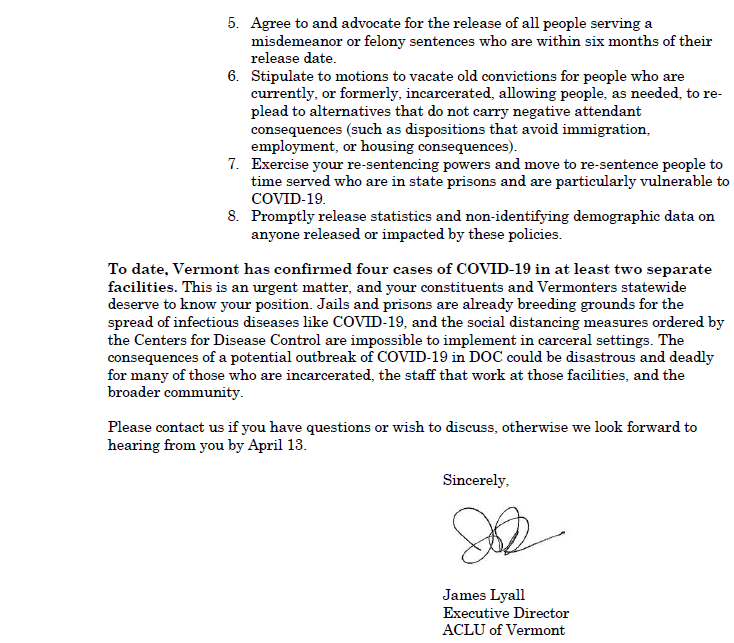
Vermont Business Magazine Today, the Department of State’s Attorneys and Sheriffs, on behalf of Vermont’s 14 State’s Attorneys, provided its response to the American Civil Liberties Union of Vermont (ACLU – Vermont,) request for criminal justice policy reforms during the COVID-19 pandemic. In his April 7, 2020 letter, James Lyall, Executive Director of ACLU Vermont, submitted recommendations to State’s Attorneys requesting them to exercise their powers and discretion to protect public health and to reduce the spread of the virus among our communities and those involved with the criminal justice system.
In their letter of April 13, 2020, the State’s Attorneys described the steps that they have taken to assist the Department of Corrections with its response to the outbreak and to reduce the prison population in a manner consistent with public safety. The State’s Attorneys also called on ACLU – Vermont (see Lyall letter below) to work with Vermont’s communities to ensure that proper resources are in place to support the well-being of the citizens and those being released, alike.
STATE OF VERMONT
DEPARTMENT OF STATE'S ATTORNEYS & SHERIFFS
April 13, 2020
Mr. James Lyall
Executive Director
ACLU of Vermont
PO box 277
Montpelier, VT 05601
Dear Mr. Lyall,
We thank you for your letter of April 7, 2020 and are pleased to know that you share our concern for the health and welfare of our community members, especially our health care personnel and first responders during this historic global pandemic. As public servants, we wish to do all we can to reduce the spread of the pathogen, COVID-19.
We also are pleased to know that you support the recent recommendations of our Attorney General intended to help reduce the number of individuals housed by the Department of Corrections (DOC). These recommendations were largely a memorialization of steps already taken by the State’s Attorneys at the start of the COVID-19 outbreak in Vermont.
One of our initial actions was to review the DOC list of detainees who were being held at the time to assess which of those folks could be reintegrated into their communities without posing an unreasonable risk to the public, or themselves. This action resulted in the release of detainees around the state. As I am sure you are aware, the current number of pre-trial detainees is the lowest it has been in over a decade. Unfortunately, this exercise also highlighted some of the most challenging obstacles facing these folks as they returned to their communities: lack of critical resources such as housing, basic healthcare, and mental health and substance abuse treatment.
At the same time, we reached out to local law enforcement in our communities and advised them to only take into custody those individuals who pose a threat to themselves or others. Those arrested on other charges were to be issued citations to appear at a future date when the COVID emergency has subsided.
Following this initial work with DOC, we entered into discussions with members of the defense bar and Prisoner’s Rights Office on other cases. We first looked at whether the inmate or detainee could or should be eligible for release back into the community. After consulting with the victims, we determined what, if any, conditions of release were necessary and appropriate. Where there was agreement, we stipulated, which resulted in the release of many individuals that were either detained or serving a carceral sentence.
Our offices are part of the essential workforce operating during this crisis, and as such, it has placed incredible pressures on our time. In order to maximize the time in which we are serving the public we have thought it best to provide you with a collective answer to whether we have already implemented or will commit to implement, the following steps:
1. Decline to bring new low-level charges and dismiss all pending cases for low-level offenses immediately.
Response: It is difficult to respond to this question because you fail to define essential terms such as, “low-level charges” and “low-level offenses.” It also fails to recognize the purpose behind our role in the criminal justice system as it relates to the filing of charges, regardless of their level. Not only are we tasked with safeguarding our communities by holding people accountable when then they violate the law, but we also work with community partners to determine the optimal outcome based on the individual circumstances of an offender. It would be an abrogation of our duties as law enforcement officers to issue blanket policies like the one suggested. With that said, we look at the charge, the circumstances surrounding the charge, and broader circumstances such as the individual’s motivation and likelihood to reoffend when making our charging decisions. We also fear that a message of this nature could prompt some without law enforcement authority to take enforcement matters into their own hands. There is no good ending in such a scenario. People need to be confident that the law enforcement community is there to protect them.
2. Work with defense attorney to review and reopen bail hearings for all those detained pending trial who do not pose a risk to public safety if released, particularly those who are medically vulnerable to COVID-19.
Response: As stated above, we have worked, and will continue to work, with the defense bar and DOC to identify individuals that may be eligible and appropriate to be released during the COVID-19 crisis.
3. Do not seek the detention of defendants solely due to FTA’s (Failures to Appear) during this time.
Response: Consistent with our adopted policies, we do not seek to detain individuals based on FTA warrants during the pendency of COVID-19 crisis.
4. Advocate for people not to be detained and either be released on their own recognizance or without conditions that could risk spread of COVID-19, including drug testing, AA meetings, and in-person check-ins at pretrial services.
Response: We will continue to seek detention of individuals where appropriate, that is, where an individual has committed a violent crime, the evidence of guilt is great, and no combination of conditions of release can adequately protect the public. Of course, minimizing the risk of spreading COVID-19 will be taken into consideration in every decision the State’s Attorneys make during this state of emergency.
5. Agree to and advocate for the release of all people serving a misdemeanor or felony sentences who are within six months of their release date.
Response: As stated above, we have worked, and will continue to work, with defense bar and DOC to identify individuals that may be eligible and appropriate to be released during the COVID-19 crisis.
6. Stipulate to motions to vacate old convictions for people who are currently, or formerly, incarcerated, allowing people, as needed, to re-plead to alternatives that do not carry negative attendant consequences (such as dispositions that avoid immigration, employment, or housing consequences).
Response: This recommendation does not seem to be related to the minimizing the spread of COVID-19. That said, it should be pointed out that we have led the nation in our support of expunging and sealing old criminal records. The Department of State’s Attorneys and Sheriffs advocated strongly in support of Act 32 (2019) that expanded sealing and expungement eligibility to hundreds of thousands of old convictions and provided for petition-less sealing and expungement of certain criminal charges. The result of our efforts is a 485% increase of the number of expungements orders granted between 2018 and 2019 and a projected doubling of expungement orders granted in 2020. Despite A.O. 49, the State’s Attorneys will continue to review and, where appropriate, stipulate to expungement and sealing petitions during this state of emergency.
7. Exercise you re-sentencing powers and move to re-sentence people to time served who are in state prisons and are particularly vulnerable to COVID-19.
Response: Perhaps you meant to pose this question to the Judiciary.
8. Promptly release statistics and non-identifying demographic data on anyone released or impacted by these policies.
Response: Neither the Department of States Attorneys and Sheriffs nor the individual county offices aggregate these statistics. The Department of Corrections frequently updates it website with current population data. Court orders to release or re-sentences individuals are all public record and can be accessed through the Court Administrators Office.
In closing, we would urge ACLU Vermont to use its advocacy and financial power to join our efforts to ensure that our communities are given the resources to provide access to housing, mental health care and treatment, and essential programming that is so necessary for individuals who are reintegrating back into their communities upon the completion of their carceral sentence. These items are critical needs in the battle against recidivism and the reduction of criminality itself.
Sincerely,
Jennifer Barrett
Sarah George
Douglas E. DiSabito
Ward Goodenough
Jim Hughes
Vincent Illuzzi
Rosemary Kennedy
Erica Marthage
Will Porter
Todd Shove
Tracy Shriver
Rory T. Thibault
Dennis Wygmans
Jessica Zaleski
*** Your request of April 7, 2020 to have our response to you by April 13, 2020 while carrying out critical duties brought on by a global medical crisis (and, over a major religious holiday week for the Jewish and Christian communities) has prevented us from physically signing this letter. However, we each acknowledge and approve this collective response.