

If you need to leave your home, wear a cloth face covering
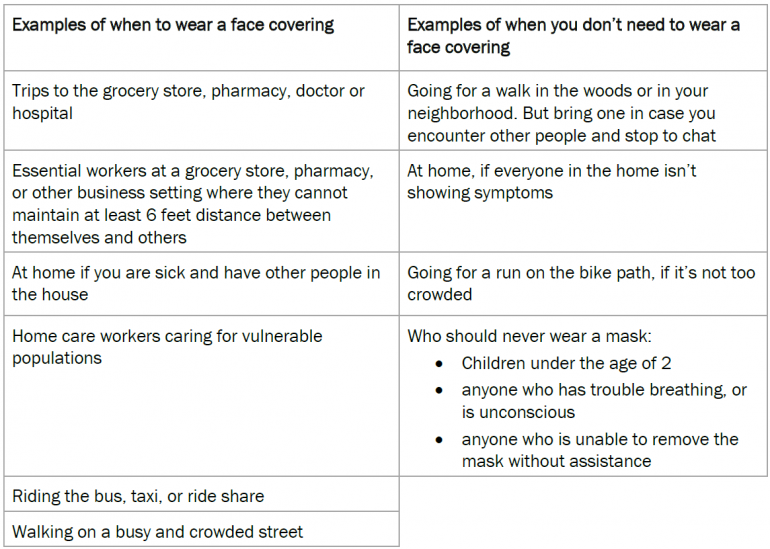
Vermont Business Magazine The Vermont Health Department recommends that all Vermonters wear cloth face coverings when outside of the home to help slow the spread of COVID-19. This advice is based on new data about how COVID-19 can spread before a person has any symptoms. A mask helps protect others around you if you are infected and don’t know it. The VDH offered this recommendation today.
A face covering is one more precaution we can take to help slow the spread of COVID-19 – and is not a substitute for physical distancing and other prevention measures. You still need to stay at least 6 feet away from people, even when wearing a face covering.
The cloth face coverings recommended are not surgical masks or N-95 respirators. These types of masks are critical supplies that must be reserved for our health care workers and first responders. Please make your own face coverings with household items.
What is a face covering?
A face covering is any well-secured cloth (like a bandana or scarf) that covers your mouth and nose.
Why are you recommending this now?
There is a lot we are still learning about COVID-19. However, there is increased evidence that people without symptoms may be able to spread the virus, and that droplets produced when breathing, speaking, or clearing your throat may spread COVID-19 from person-to-person. We continue to think staying home and practicing physical distancing and good hand hygiene are the most important ways to stop the spread of COVID-19. By recommending that Vermonters use a face covering, we are adding one more action to help reduce the spread.
How to wear a cloth face covering:
Cloth face coverings should —
• fit snugly but comfortably against the side of the face.
• be secured with ties or ear loops.
• include multiple layers of fabric.
• allow for breathing without restriction.
• be able to be laundered and machine dried without damage or change to shape.
Clean cloth face coverings daily, by hand or machine, using detergent.
A washing machine should suffice to properly wash a cloth face covering. Make sure it’s completely dry before using. You should have a few on hand so you can rotate for washing.
Remove and store it properly and safely.
• Do not touch your eyes, nose and mouth when removing it.
• Immediately wash your hands after removing it.
• Don’t put it where others can touch it or on counter tops or tables.
Make your own.
CDC has instructions on making your own coverings in several different methods, including machine or hand-sewn, a no-sew method with a t-shirt and scissors, and a no-sew method with a bandana.
For more information, visit www.healthvermont.gov/COVID-19.