

by C.B. Hall, Vermont Business Magazine Contrary to earlier expectations -- from another era, two weeks ago – Vermont's road construction season has been pushed back because of the coronavirus pandemic.
Expectations had been high at the Agency of Transportation (VTrans). In a letter dated March 19, the agency and Associated General Contractors of Vermont announced that "the date for the start of the Construction Season for all contracts is moved from April 15, 2020 to March 23, 2020 with the intent to add 3 weeks to every contract."
April 15 is the traditional starting date for VTrans's road construction season. While the letter acknowledged the growing coronavirus crisis, it was reacting to the warm late-winter weather that, other factors being normal, would have allowed for a head start on the projects planned.
But on March 24, after VBM's annual article on road construction had been filed for April publication, the state changed course: A "Stay Home, Stay Safe" order issued by Governor Phil Scott put a stop to all construction across the state at least until April 15, with an exception for "construction necessary to maintain critical infrastructure."
On April 1 Scott indicated that Vermonters should be prepared for an extension of the order. But in response to VBM's request for clarifications, Erik Filkorn, speaking for the state's Health Operations Center, wrote in an April 2 email that, "We don’t have anything new on the timeline."
In an April 2 interview, Jeremy Reed, state construction engineer at VTrans, said that only one state-supervised project was continuing - the emergency rehabilitation of a culvert on I-89 in Georgia. As to when the ban on construction might be lifted, he said, "We don't have any bigger sense of when this may end than anyone else. . . . We're just treading water, basically."
Given, among other things, recent statements from U.S. surgeon general Jerome Adams to the effect that federal social distancing guidelines would "in general" remain in effect into May, further delays in the road construction season's launch appear likely, however.
When the backhoes and paving machines finally get going, there will be plenty to do on the state's roads, bridges, and other transportation infrastructure. Work on no fewer than 56 projects will have a significant impact on the motoring public.
The agenda includes everything from routine repaving jobs to the massive remake of I-89's Exit 16 in Colchester. That will transform one of the state's worst traffic bottlenecks into a so-called diverging-diamond interchange that, in the VTrans website's graphic conception, resembles three overlapping infinity symbols framed by attractively landscaped traffic islands and, of course, a lot of macadam. The reconfiguration will improve traffic flow through the area by facilitating left turns onto the I-89 ramps without left-turn phasing of traffic signals. Upgraded traffic signaling and new turn lanes will also improve flow at other points in the project's one-mile corridor.
But for people who've spent 10 minutes just to get out of the nearby Costco parking lot, relief remains a ways off. In addition to whatever postponements that the coronavirus pandemic may cause, project work has already endured protracted delays because of multiple legal challenges by R.L. Vallee, Inc., owner of the Maplefields gas station just north of the interchange, and just up the road from potential competition in the form of Costco's already built but still unopened gas station. Planning for the project has already dragged on for the better part of a decade, without a shovelful of dirt being turned over.
"We have a pretty solid case," Michael Lacroix, project manager for VTrans, R.L. Vallee's adversary in the latter's appeals of the project's environmental permits, assessed the litigation. "While the bulk of the road work won't happen in calendar 2020, it will start in calendar 2021... There won't be enough time to get the contracts out this year."
In the meantime, he added, "We are working very hard to get utility companies to move their lines out of the way this year." That will likely lead to some traffic disruptions.
And while that $10 million project struggles to leave the starting line, prospects are more certain for another big undertaking, the $35.6 million remake of the twin bridges that carry I-89 across the Connecticut River between Vermont and New Hampshire. According to VTrans, work will begin in July and continue year-round until the project winds up, likely in 2023. The finished product will be a single structure: the gap between the existing bridges will be used to expand the roadway from two to three lanes in both directions, including new entry-exit lanes to serve the interchanges immediately beyond both ends of the crossing. Traffic disruption is expected to be relatively minor this construction season as preliminary work unfolds.
Some other big jobs already under way were expected to continue this spring, until the state's March 24 order intervened. Notable among them is the $72.5 million project that will replace two bridges over the Vermont Railway (VTR) in the heart of Middlebury. That effort was on schedule to enter its key phase this year: demolition of the bridges, installation of a tunnel in their place, and lowering of the railbed to allow VTR to haul taller cars along the route. Once the state's order is lifted, there will be occasional road closures along Main Street (Route 30/125) and adjacent Merchants Row. The plans also called for a 10-week closure of the rail line to begin on May 27. VTR's rail traffic between Rutland and Burlington was then to be diverted to a roundabout detour via Bellows Falls and White River Junction.
According to VTrans project manager Jon Griffin, speaking in mid-March, "all parties have been able to work really well together" on the project - including affected businesses that had feared a loss of business because of the disruptions of the construction itself. Now, of course, the coronavirus has shut down much of the town's economic life in any case.
In March that shutdown led the Middlebury selectboard to ask VTrans "if any of this summer’s construction can be moved up," according to Jim Gish, community liaison for the project - but that hope has already gone a-glimmering.
The project was expected to wrap up in 2021, in time for the anticipated launch late that year of Amtrak service between Rutland and Burlington, with a stop in Middlebury just north of the project area. Sources for this story did not suggest that the suspension of the work in Middlebury will push that service launch back - but the only certainty, given the unprecedented upheaval that the virus has occasioned, is that anything might happen.
Projects in their final phases this year include the $49 million replacement of the I-91 bridges over the Williams River in Rockingham; that work was scheduled to wind up in July, according to VTrans project manager Carolyn Cota.
The multiyear reconstruction of Route 7 in the heart of Brandon is also close to the finish line. That project is giving the Rutland County community a whole new face, with utilities buried, the roadway completely rebuilt, and new parking areas, sidewalks and street-side green spaces added to the village's amenities. In a mid-March interview, Brandon economic development officer Bill Moore said the undertaking is now 96% complete. "Most of the plantings are done, and little landscape fill-ins need to done this spring," he said, adding that a couple of side streets still need construction work, but Route 7's remake is complete. The finishing touches should all be in place by fall, he reported. Moore could not immediately be reached for an update on the pandemic's impact.
The $30 million Brandon project has an analog in the re-creation of Waterbury's main street - which is also U.S. Route 2 and Vermont Route 100 - but that work is not so far along, and motorists can expect disruptions once it resumes. The ingredients are similar to Brandon's - full-depth reconstruction of the roadway, placement of utilities underground, new sidewalks, historic streetlamps with flower baskets, curb bump-outs to facilitate pedestrian crossings. And, as in Brandon, the federal government is covering most of the price tag - $26 million, in this case.
"It's certainly going to be transformational for the community, making it a really attractive place to walk around," Waterbury economic development director Alyssa Johnson told VBM. "It's also a great long-term investment in infrastructure, with water and sewer utilities being over a hundred years old... They even found some wooden pipes when they were excavating."
In both projects, one objective has been to include more than motor vehicles in the realm of transportation, and the same holds true for a series of projects in Bennington. The overall scope there appears smaller, and limited to largely residential neighborhoods, however, with the downtown business district and major roads mostly unaffected. The four projects, carrying a total price tag $3-4 million, will all include bicycle-pedestrian paths, according to Mark Anders, planner at the Bennington County Regional Commission.
"It's kind of one project, creating a network in a part of town that really needs it," he said. "The goal is really to make Bennington a more appealing place to live for families."
While Bennington and Waterbury are thus aiming for a better integration of transportation into community life, that goal appears more elusive in Vergennes, where the plans call for repaving of Route 22A and certain other streets within the city limits. The project, whenever it starts, will do little to console residents who have wrung their hands over the truck traffic that traverses the community along the full length of Main Street - Route 22A, that is. A 2019 study commissioned by the Addison County Regional Planning Commission found that 430 tractor-trailers, on average, ply the route every 24 hours, and posited three alternatives for alleviating the nuisance. The upcoming project will only implement mitigations recommended by the most modest, "in-line" alternative - and only some of those measures at that, so as to calm traffic and give bicyclists more room, for example.
VTrans project manager Brandon Kipp wrote in an email that some of the in-line alternative's proposals "simply did not work from an engineering perspective and they fell too far outside of the scope" of the paving project. The 2019 study also raised the possibility of truck bypass routes that would avoid downtown Vergennes altogether. But since both of those alternatives present their own challenges - notably including much higher costs - Vergennes will have to contend with its heavy truck traffic for the foreseeable future.
And for the foreseeable future, everyone in the state will have to wait for the pandemic to ease and allow the road construction season to begin.
Richard Wobby
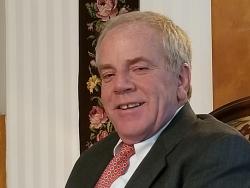 Two weeks ago it appeared that the Vermont Agency of Transportation's road construction season would not be greatly disrupted by the coronavirus, even as it was turning so many sectors of activity upside down here in Vermont and around the world. The warm late-winter weather had brightened the prospects for an early start, and Richard Wobby, executive vice president of Associated General Contractors of Vermont, was among those raring to go.
He anticipated that the construction season would get under way well ahead of the traditional April 15 start date.
"Our work force right now looks strong and plentiful," he told VBM then. He noted that, for road crews, social distancing isn't the problem that it is in so many other sectors of the economy. He anticipated added hiring in construction, as workers laid off from jobs more dependent on physical proximity sought work in still-active, safer sectors .
Since then, the world seems to have shifted under all our feet.
But when VBM caught up with Wobby on April 1, he remained optimistic in spite of Governor Phil Scott's March 24 order forbidding, until at least April 15, all construction work not essential to "maintenance of critical infrastructure."
"It is our goal to be up and running by April 15. If the governor should feel something different is needed, then we'll certainly be following his lead," Wobby said.
At an April 1 press conference Scott indicated that Vermonters should be prepared for an extension of the "Stay Home, Stay Safe" order beyond the 15th. As of this writing, however, state officials consulted by VBM had no specific information on such a prolongation.
While they place no specific prohibitions on any economic sector, construction included, federal social distancing guidelines have been extended to April 30, and may well be extended further as the pandemic continues to spread - hardly a policy environment in which Vermont would act less cautiously.
"We will start a few days late, but we will have started a few days late to ensure the safety and health of our workers," Wobby said.