

Vermont Business Magazine The Vermont Department of Environmental Conservation (DEC) released several per- and polyfluorinated substances (PFAS) reports today. The reports will help DEC continue to investigate PFAS in landfill leachate, to evaluate the impact of landfill leachate on PFAS concentrations at wastewater treatment facilities, and to evaluate treatment alternatives for PFAS leachate. The study concluded that while substantial PFAS entered the Coventry landfill and 95 percent of the samples found it, "the data indicate that a small fraction of the PFAS entering the landfill in wastes leave it in leachate." (see Executive Summary below).
The reports will also help DEC begin to evaluate other potential sources of PFAS releases into the environment from residential, industrial and wastewater treatment facilities and how to manage sludges and biosolids produced by these facilities.
The first report, a continuation of the state’s investigations since 2016, includes testing results from 19 wastewater treatment facilities (WWTFs), select industrial discharges, and landfill leachates.
According to the report, "The data collected to date indicate that PFAS are present in all landfill leachate and WWTF influent, effluent, and sludge tested. Relative WWTF influent and effluent PFAS concentrations are greater at facilities handling landfill leachates. The type of PFAS observed include the 5 Regulated PFAS and numerous currently unregulated PFAS that are reported to be replacement compounds for PFOA and PFOS. In many cases, the concentrations of non-Regulated PFAS exceed the 5 Regulated PFAS concentrations."
The Weston & Sampson report states that PFAS were detected in all landfill leachate, WWTF influent, effluent, and sludges/biosolids sampled. The studies sites were Chittenden Solid Waste District Landfill (CSWD) – Closed and Capped; City of Burlington/Rathe Cell IV Landfill (Rathe Cell IV) – Closed and Capped; New England Waste Services of Vermont Landfill (NEWSVT, Casella, Coventry) - Active; Randolph Landfill (Randolph) – Closed and Capped.
The statistical range of the sum of 5 PFAS in the leachate from the NEWSVT, and Randolph facilities are much higher than at the CSWD and Rathe facilities. Additionally, the concentration fluctuations seen at NEWSVT and Randolph are greater than those seen at CSWD and
Rathe.

Weston & Sampson Charts
Wastewater Treatment Facilities (WWTF)
Review of the individual PFAS concentration data indicates that PFAS are present in every influent and effluent sample collected. Generally, average influent and effluent PFAS concentrations were similar at each facility. Some exceptions are observed at the Montpelier, Northfield, Rutland, and Randolph WWTFs.
Single sample event influent concentrations of the 5 Regulated PFAS range from 3 to 900 ppt. The highest influent and effluent concentrations were observed in the Montpelier WWTF.
Weston & Sampson offered the following observations:
· The highest concentrations of the 5 Regulated PFAS are seen at facilities which accept landfill leachate daily (Montpelier and Newport).
· Potential industrial discharge-accepting facilities have the next highest concentrations followed by facilities with no major industrial discharges.
- Leachate-accepting facilities have higher influent than effluent concentrations.
- Facilities which do not accept leachate have effluent concentrations similar to, or slightly higher, than influent concentrations.
- The PFAS concentrations in the influent and effluent of leachate-accepting facilities may be artificially low, as these facilities may not have received leachate on a regular basis during the study period. This may have resulted in sample collection on days when leachate was not being treated.
- The range of 5 Regulated PFAS concentrations observed in both influent and effluent are greatest at leachate-receiving facilities.
The PFAS concentrations are highest at the WWTFs receiving landfill leachate regularly (Montpelier and Newport). The sum of 5 Regulated PFAS in the industrial discharge-receiving WWTFs is lower than the leachate-receiving WWTFs and higher than the primarily domestic-receiving WWTFs.
Surface waters sampled upstream and downstream of the Montpelier WWTF outfall indicate no detectable levels of PFAS based upon the data collected to date.
For WWTFs, Weston & Smapson concluded that The data collected to date indicate that influent and effluent PFAS concentrations are elevated at facilities handling landfill leachate. The type of PFAS observed include the 5 Regulated PFAS and numerous currently unregulated PFAS including reported “replacement” compounds for PFOA and PFOS. In many cases, the concentrations of non-regulated PFAS exceed the Regulated PFAS concentrations.
Difficulties with collecting representative sludge samples and analysis make determination of landfill leachate impacts on sludges uncertain. The reduction in PFAS concentrations between WWTF influent and effluent samples implies that sorption to sludges may be an important mechanism. However, sludges analyzed as solids show no significant difference in the average 5 Regulated PFAS concentrations at leachate accepting facilities compared to those facilities that do not accept leachate.
NEWSVT Landfill
The second report, obligated by the solid waste permit to open new cells at the NEWSVT landfill facility and required by Act 21, presents landfill leachate management options. The third report includes a plan to develop water quality standards for Vermont’s lakes and rivers.
To expand understanding of the PFAS within landfill leachate and at WWTFs, DEC conducted sampling studies throughout 2019. This included sampling WWTF influent (waste coming into the facility), effluent (discharge from the treatment facility), and solid byproducts produced by WWTFs. Nearly 400 samples were tested for 24 PFAS chemicals. Detectable PFAS was found in influent, effluent and solid byproducts collected at all facilities, including at WWTFs that do not accept industrial wastewater, indicating that residential materials can also contribute PFAS to WWTFs.
The report also found that facilities accepting large volumes of landfill leachate have higher concentrations of PFAS in their effluent when compared to facilities that do not accept this leachate. The sampling results are outlined in Weston and Sampson: Poly- and Perfluoroalkyl Substances at Wastewater Treatment Facilities and Landfill Leachate
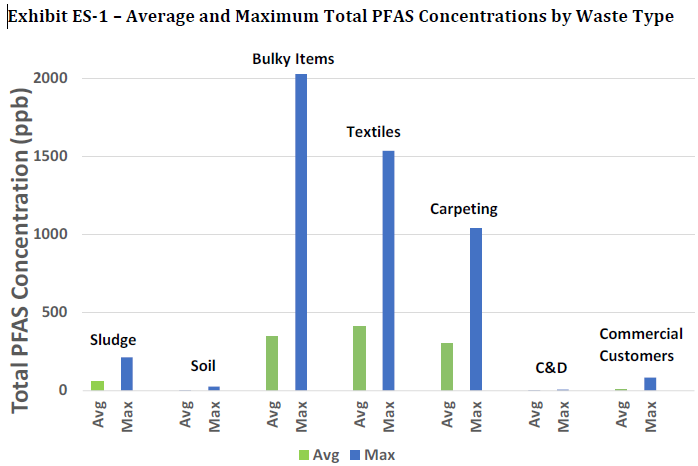
In two reports: PFAS Waste Source Testing Report and Conceptual Leachate Treatment Scoping Study for New England Waste Services of Vermont (NEWSVT) Landfill Report, NEWSVT summarizes its sampling work and presents landfill leachate management and treatment options to reduce or eliminate the discharge of PFAS from leachate at WWTFs. After taking over 100 PFAS samples from waste at the NEWSVT landfill, NEWSVT found PFAS in all landfill waste materials sampled. These materials included WWTF and industrial sludges, contaminated soils, bulky waste, textiles, carpeting and commercial customer wastes. The report concludes that the most significant contributors of PFAS are residential materials, such as textiles, furniture and carpets.
Treatment options are available and continue to evolve for reducing or eliminating contaminants of emerging concern, including PFAS, from landfill leachate and WWTF effluent. However, these treatment options create a concentrated waste residual that also must be disposed of or destroyed. The science and technologies available for managing the waste residuals and potential air emissions from these treatment options are still developing. The DEC is contracting with an independent third party to advance our understanding of the treatment options presented in this report.
DEC is reviewing landfill leachate treatment options and will be evaluating alternatives to address the risk of PFAS contamination when implementing regulatory programs responsible for permitting industrial and commercial discharges, such as leachate, to municipal wastewater collection systems and treatment facilities, and when permitting the discharge of effluent from WWTFs.
PFAS concentrations in NEWSVT leachate will continue to be tested as part of the semi-annual monitoring required by the facility’s Solid Waste Facility Certification. At this time, DEC does not recommend initiating a pilot landfill leachate treatment system independent of the regulatory processes.
Knowledge gained from these reports and DEC’s site investigations will help inform 2020 sampling plans and will assist in evaluating alternatives for addressing PFAS. All three reports, as well as additional technical information, can be found at https://dec.vermont.gov/pfas. For more information on Vermont’s PFAS Sampling Plan, visit https://dec.vermont.gov/
PFAS WASTE SOURCE TESTING REPORT
NEW ENGLAND WASTE SERVICES OF VERMONT, INC.
Coventry, Vermont. October 2019
EXECUTIVE SUMMARY
Pursuant to the requirements of Permit Conditions 74 and 85 of the October 12, 2018 Solid
Waste Management Facility Certification for the New England Waste Services of Vermont,
Inc. (NEWSVT) Landfill in Coventry, Vermont, NEWSVT contracted a study of potential perand
polyfluoroalkyl substance (PFAS) sources in waste streams disposed at the NEWSVT
Landfill.
On behalf of NEWSVT, Sanborn, Head & Associates, Inc. (Sanborn Head) implemented a
waste testing program that was conducted between April 3, 2019 and August 19, 2019 in
accordance with the Testing Plan approved by the Vermont Department of Environmental
Conservation (VTDEC) on February 5, 2019.
Sanborn Head collected 100 samples from waste streams suspected to contain PFAS
compounds, including sludges from municipal wastewater treatment plants (WWTPs) and
other industrial sources, sewer grit, contaminated soil, textiles from bulky wastes, carpeting
and other construction and demolition (C&D) waste, and targeted wastes from commercial
customers such as food packaging. The samples were analyzed by Alpha Analytical of
Mansfield, Massachusetts for both linear and branched PFAS isomers using a modified U.S.
Environmental Protection Agency (USEPA) Method 537 with isotope dilution for a 24-
compound analyte list. Waste materials that were considered unlikely or not known to
contain PFAS compounds were not included in the sampling program. In addition, Municipal
Solid Waste (MSW) from residential sources was also not included in the sampling program.
PFAS compounds were detected in 95 percent of the waste samples at concentrations
ranging over many orders of magnitude, from approximately 0.043 to 2,030 parts per billion
(ppb) of total PFAS.
The highest concentrations were measured in samples collected from
bulky items, textiles, and carpeting. Results for WWTP sludge samples ranged from
approximately 20 to 214 ppb of total PFAS, which is generally consistent with sludge testing
conducted by the VTDEC in 20181.
Exhibit ES-1 presents the results of the average and maximum total PFAS concentrations by waste type.
A preliminary data evaluation for this testing program was performed to support ranking
(by PFAS concentration and mass of waste accepted by NEWSVT) the waste streams with
the highest potential to contribute PFAS to the NEWSVT leachate. While there is uncertainty
with respect to the mass disposal rate of certain PFAS waste streams (e.g., bulky waste
textiles), a mass flux evaluation (i.e., an evaluation of the PFAS mass input to the landfill)
using 2018 waste characterization data from the VTDEC indicates that textiles and carpeting
potentially contribute the largest PFAS mass influxes to the NEWSVT Landfill (of the wastes
included in the study)2. There may be other sources, such as residential MSW, that also
contribute a significant amount of PFAS to the landfill.
To help evaluate what fractions of the PFAS compounds potentially leach from the waste
materials versus what is sequestered (i.e., what is held on to) in the landfill, the mass flux
results were used to derive an estimate of PFAS influxes for comparison of PFAS waste input
to PFAS leachate output. Comparison of the mass of PFAS leaving the landfill in leachate
(estimated with data from leachate sampling conducted by the VTDEC in 2018 and NEWSVT
in 2019 and leachate generation data provided by NEWSVT) and the mass of PFAS entering
the landfill in wastes indicates a mass imbalance. This imbalance consists in aggregate of less
PFAS mass leaving the landfill in leachate compared to the PFAS mass entering the landfill in
waste streams that were sampled as part of this study; therefore, the data indicate that a
small fraction of the PFAS entering the landfill in wastes leave it in leachate.
Exhibit E-2 presents the estimated total PFAS mass flux into the landfill for each waste category from
the study and the estimated PFAS mass flux out of the landfill in leachate.

It should be noted that the imbalance also consists of differing PFAS compounds being
detected in the wastes sampled and the leachate. Based on the mass balance estimates,
approximately 89 percent of the mass of PFHpA, 88 percent of the mass of PFHxS, 94 percent
of the mass of PFOA, 95 percent of the mass of PFNA, and 99 percent of the mass of PFOS (the
five PFAS compounds included in the Vermont Health Advisory for Drinking Water) that
enters the landfill in accepted wastes appears to be sequestered in the landfill, while sampled
wastes could account for (at most) approximately 50 percent of the PFBA and 37 percent of
the PFBS in the leachate flux. Longer-chain PFAS are more prevalent in the wastes sampled
in this study and appear by compound-specific imbalances between waste influx and
leachate outflux to be less prone to release and leaching from MSW. The apparent
sequestration of these longer-chain PFAS is consistent with their generally lower aqueous
solubilities and higher organic carbon-water partition coefficients relative to shorter-chain
PFAS. This imbalance suggests that (1) landfills sequester a large fraction of PFAS loadings
from various wastes included in the study, and (2) there are other sources, such as
residential MSW, that are responsible for the PFAS in leachate that were not accounted for
by the wastes sampled during this study, particularly for the short-chain PFAS that are
detected in leachate. Also, since all wastes were not sampled as part of the study, the PFAS
inputs to the landfill (left side of Exhibit ES-2) are likely higher than indicated.
There are considerable uncertainties inherent in the estimates of PFAS mass fluxes, including
variability in sample results, necessary assumptions concerning waste disposal rates and
composition, and the impracticality of sampling all types of wastes.
Although mass flux into the air has not been considered in this analysis, the contribution is assumed to be small to
negligible. Even so, the results of the study suggest numerous sources of PFAS to the
NEWSVT Landfill, and that the landfill retains most of the PFAS that enters it, especially the
longer-chain compounds such as PFOA and PFOS that are subject to regulation in Vermont.
1 “Wastewater Treatment Facility and Landfill Leachate PFAS Sampling, Various Locations, Northern Vermont”,
prepared for VTDEC by Weston and Sampson and dated May 3, 2018.
2 “2018 Vermont Waste Characterization”, prepared for VTDEC by DSM Environmental Services, Inc. and dated
December 14, 2018.
Source: Montpelier, Vt. - Vermont Department of Environmental Conservation. 2.5.2020