

Advocates Urge Governor Scott to Enact, Make Permanent No-Cost School Meals
Vermont Business Magazine The Vermont Legislature today gave its final approval to H.165, An act relating to school food programs and universal school meals, the Universal School Meals bill, in a 122-25 vote — sending it to Governor Phil Scott’s desk for enactment.
This is 22 more votes than needed to override a veto, should Governor Phil Scott choose to exercise such authority.
Advocates from Hunger Free Vermont thanked Vermont’s legislators who worked tirelessly to make this bill a reality, as well as the dedicated educators, parents, students, school nutrition professionals, and communities across the state who have long championed this effort.
Permanent Universal School Meals will ensure that all students in Vermont have continued access to healthy and nutritious meals while at school, regardless of their families’ income level.
"We are thrilled to see the Vermont legislature take this bold step in addressing child hunger in our state," Anore Horton, executive director of Hunger Free Vermont, said Wednesday. "Hunger Free Vermont thanks every legislator who has worked to make Vermont’s Universal School Meals Program permanent, because they know that providing breakfast and lunch at no cost to all students is a critical investment in the health and life-long success of Vermont’s future leaders."
Providing access to healthy meals is vital to improving educational outcomes, reducing absenteeism, and promoting the students’ overall health. According to the Department of Vermont Health Access, 25,000 students (fully 30% of all children in Vermont schools) live in families with incomes that make them ineligible for free and reduced-price school meals, yet are still eligible for Vermont’s Medicaid program, meaning that they are unable to meet basic needs according to the Joint Fiscal Office. When H.165 is enacted, these children will be guaranteed access to two meals every day at school.
The bill will now go to Governor Scott. Hunger Free Vermont calls on Governor Scott to enact this bill and ensure Universal School Meals continue to be a reality for all Vermont students.
The Vermont bill is unlike any other in the country, as it is written to ensure the maximum draw-down of federal funds for Vermont’s school meal programs, as well as incentivizing schools to increase their local food purchasing.
JFO Bill Summary
May 8, 2023
This bill creates ongoing State funding of school meals (breakfast and lunch) to all publicly funded students at no charge to students or families. Schools will be reimbursed for the provision of meals through funds from the Education Fund that will be appropriated as categorical aid. The current draft of the bill does not appropriate any funds for the program in fiscal year 2024.
Fiscal Impact
JFO estimates this bill will cost $29 million from the Education Fund in fiscal year 2024. Absent any other changes in policy, the base homestead yield and/or base non-homestead tax rate will need to be adjusted to account for the anticipated cost of this program.
As passed by the Senate with proposal of amendment, the bill appropriates $29 million in fiscal year 2024 from the Education Fund to the Agency of Education for the funding of the universal meals supplement (the reimbursement amount paid to school districts by the State).
Background and Details
The following sections have a fiscal impact.
Section 2
Section 2 mandates that each public school provide daily breakfast and lunch to attending students at no cost to the students or their families. Section 2 also requires approved independent schools to provide daily breakfast and lunch at no cost to each student attending on public tuition if the independent chooses to participate in the universal meals program to drawdown the state funds.
JFO estimates the annual cost for the provision of the universal school meals supplement to be between $20 million and $31 million per year.
The actual cost heavily depends on four factors:
1. the percentage of students eligible for free and reduced lunch through the federal free and reduced school meal programs,
2. the average participation rate of students eating meals,
3. the difference between federal school reimbursement rates and
4. the number of eligible entities to receive the universal meals supplement.
The following are a few examples of how changes in these four factors would impact the cost of the program:
• A lower percentage of federal government program-eligible students would increase costs for the State because fewer federal dollars would be available.
• A higher participation rate of students eating meals would increase costs for the State.
• A larger difference between the federal reimbursement rate for meals and the local per meal cost would result in higher costs to the State.
• A higher number of eligible entities to receive the universal meals supplement would result in higher costs to the State.
For Fiscal Year 2024, JFO estimates the provision of universal breakfast and lunch to cost approximately $29 million. This estimate assumes 38% of students eligible for free and reduced-price meals programs and assumes participation rates of 45% for breakfast and 65% for lunch.
Section 3
Section 3 establishes the universal school meals supplement as an ongoing expenditure from the Education Fund in the form of categorical aid. Absent any other changes in policy, the base homestead yield and/or base non-homestead tax rate will need to be adjusted to account for the anticipated cost of this program.
Without adjusting any non-property tax revenue streams, establishing a universal school meals program as an ongoing obligation of the Education Fund would require increasing property taxes to fund the program and keep the Education Fund balanced. All else equal, funding universal school meals through property taxes would result in an approximate $0.03 increase on both the homestead and nonhomestead property tax rate.
Section 3 also outlines the eligible entities that would be available for the universal meals supplement. The more entities that are eligible for the universal school meals supplement, the higher the potential cost. Public school districts shall be eligible for the universal school meals supplement as long as the Agency of Education determines that the district “draws down the most possible federal funding for meals served in that program”. Nonprofit prequalified private prekindergarten providers that operate food programs shall also be eligible for the supplement if the provider operates a food program under a public-school school food authority. Approved independent schools that maximize access to federal funds for the cost of the school breakfast and lunch program shall also receive the reimbursement for students attending on public tuition.
Appendix:
The cost of the universal school meals program is dependent on several factors and assumptions. In its estimate the Joint Fiscal Office made assumptions regarding primary cost factors which include:
• The percentage of students eligible for the federal free and reduced school meals programs,
• the average participation rate of students eating meals, and
• the number of eligible entities that are eligible for the universal meals supplement influence the overall cost of the universal school meals program.
A lower percentage of students eligible for the federal programs leads to higher costs to the State. A higher participation rate also leads to higher costs to the State. A higher number of eligible entities also leads to higher costs to the State. The following table outlines the range of costs associated with different assumptions of these cost factors:
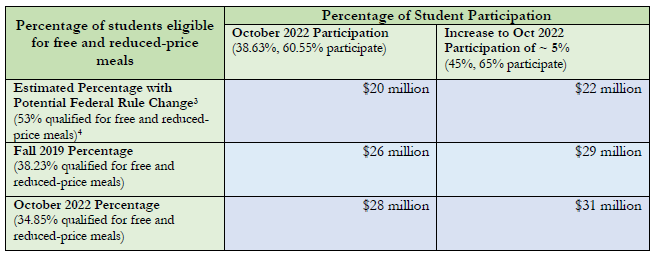
Note: The more students that qualify for free and reduced lunch, the more federal funding available to support the universal school meals program. The more students that eat school meals, the higher the cost of the universal school meals program. The modeling includes steady enrollment of nonprofit prequalified private prekindergarten providers that have been included in public school food authorities in recent years.
1) https://legislature.vermont.gov/Documents/2024/Docs/BILLS/H-0165/H-0165%...
2) https://legislature.vermont.gov/Documents/2024/Docs/BILLS/H-0165/H-0165%...
3) On March 23, 2023, U.S. Department of Agriculture’s Food and Nutrition Service published a proposed rule in the Federal Register “with the intent to expand access to the Community Eligibility Provision (CEP) by lowering the minimum identified student percentage (ISP)1 participation threshold from 40% to 25%”. This decrease in the threshold would result in more schools being eligible to participate in CEP. Participating in CEP makes schools eligible to use the 1.6 multiplier, leading to more meals claimed at the federal free reimbursement rate. If estimates of direct certification for free meals through Medicaid are accurate, the 1.6 multiplier could result in a free claiming percentage of 53%, if applied statewide. The proposed CEP rule change is not likely to go into effect for FY 2024 but may go into effect for FY 2025. Proposed rule change: https://www.fns.usda.gov/cn/community-eligibility-provision-summary-prop...
4) The estimated percentage of 53% was calculated using DVHA estimates for the number of 5–18-year-olds from households with incomes below 130% of the federal poverty limit and receiving Medicaid. This number was divided by the total number of students enrolled in the state and multiplied by the CEP multiplier of 1.6%. Any changes to these assumptions would impact the estimates.
Source: MONTPELIER, Vermont (May 10, 2023) — Hunger Free Vermont. Joint Fiscal Office JFO.
