

Today, Agency of Natural Resources Secretary Deb Markowitz and Commissioners David Mears, Patrick Berry and Michael Snyder were joined by staff and members of the environmental community for the release of a report on the health of Vermontâ s Environment.
Secretary Markowitz said, â In light of the catastrophic floods Vermont experienced this past year, we decided to look at the health of Vermontâ s environment using the lens of resilience.’ â Research shows that people with strong social networks will be better able to bounce back from catastrophic events.’ Markowitz said, â The same holds true for our ecosystems. For that reason it is important for us to consider what we can do to make our ecosystems and our communities more resilient in the future, not only to extreme flooding, but also to other environmental threats that could affect Vermontâ s future.â
Commissioner Mears said, â This report relies on sound scientific information to help us understand the challenges facing Vermont and the steps we might take to meet them. It also recognizes the close ties between the quality of our environment, the quality of our lives, the strength of our economy and our health.â
The report (LINK) covers ten topics: addressing climate change, reducing air pollution, reducing flood damage, cleaning up Lake Champlain, protecting lake shores, enhancing forest resilience, conserving habitat, minimizing waste, building resilient infrastructure and getting children outdoors.
Commissioner Snyder said, â The ANR report highlights something environmental scientists, and foresters already know ‘that everything is connected. When we lose our forests, it adds to our problems with water pollution, makes us more vulnerable to flooding and we lose the habitat connectivity that is so important for our wildlife to be resilient to climate change.’ Commissioner Berry said, â Vermontâ s fish and wildlife a generally pretty good at adapting to and recovering from environmental change. But they can use our help. This report is important because it identifies steps we need to take to ensure that Vermontâ s ecosystems remain strong for future generations.â
Each year between 1994 and 2003 the Agency of Natural Resources published a report on the health of Vermontâ s water, air, forests and wildlife. This administration decided to revive the practice. Consequently, this report was prepared with help from staff across the agency and includes data on key indicators of the health of Vermontâ s environment. It took nearly a year to complete.
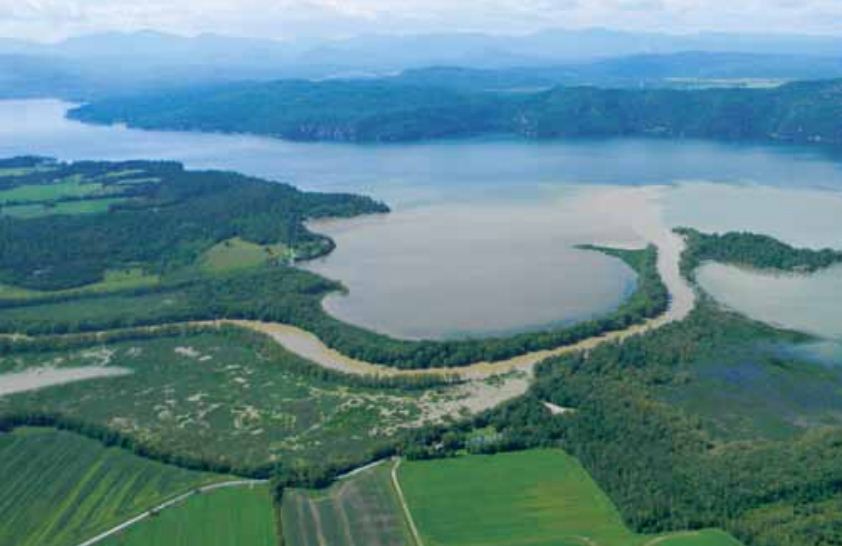
Photo top: Otter Creek and many other streams carried sediment and phosphorus pollution toLake Champlain after Irene.
ANR 4.23.2012