

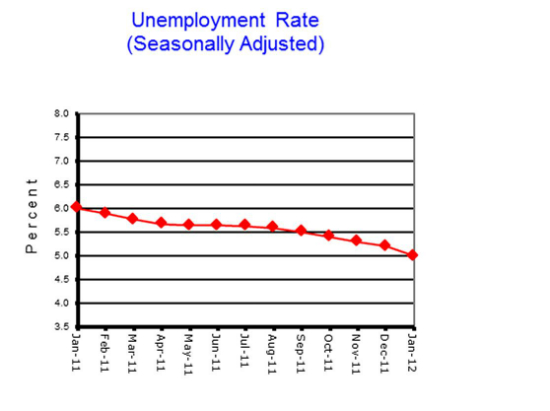
Vermont jobs and total labor force are up, while the number of jobless is down. The Vermont Department of Labor has announced that the seasonally-adjusted statewide unemployment rate for February 2012 was 4.9 percent, a decrease of two-tenths of a percent from the revised January rate. At 4.9 percent, Vermont’s seasonally adjusted unemployment rate is below 5.0 percent for the first time since October 2008. The comparable national rate for February 2012 is 8.3 percent; which held steady from the previous month.The seasonally adjustedVermontdata show the totalVermontlabor force increased by 100. Total employment increased by 600 while total unemployment decreased by 400.
‘Vermont’s latest numbers for our unemployment rate - at 4.9 percent- places our state at the 4th lowest unemployment rate in the country. That’s great news, but we must still focus on helping job seekers in those counties where regional unemployment numbers are still too high, such as Caledonia, Bennington, Lamoille, Grand Isle, Rutland and the Kingdom. VDOL will be contacting the regional workforce development groups to see what can be done to help stimulate job opportunities. Could we convince employers to hire people
Vermont Labor Force Statistics (Seasonally Adjusted)
Changes From
February
2012
January
2012
February
2011
January
2012
February
2011
Total Labor Force
360,700
360,600
360,200
100
500
Employment
342,900
342,300
339,000
600
3,900
Unemployment
17,800
18,200
21,200
-400
-3,400
Rate (%)
4.9
5.1
5.9
-0.2
-1.0
Vermont’s labor force, employment and unemployment statistics are produced from a combination of a Statewide survey of households and statistical modeling. The data are produced by the Local Area Unemployment Statistics Program (LAUS) a cooperative program with the US Department of Labor, Bureau of Labor Statistics and the Vermont Department of Labor.
through ‘On the Job Training’ programs where the worker’s salary costs can be paid by federal money? Can we help place Vermont Veterans or long-term unemployed Vermonters into jobs and match the employer up with the tax incentives or hiring bonus programs? Can we put college students and recent graduates into internships whereby the employer has a chance to see the student on the job and make an offer if they think it’s working out well? We have to move the agenda on job creation in all areas of the state, to ensure that all Vermonters have a secure and decent paying job,’ said Department of Labor Commissioner Annie Noonan.
State of Vermont Overview
February unemployment rates for Vermont’s 17 labor market areas ranged from 3.3 percent in Warren-Waitsfield to 9.4 percent in Newport (note: local labor market area unemployment rates are not seasonally adjusted). For comparison, the February unadjusted unemployment rate for Vermont was 5.5 percent which reflects a decrease of two-tenths of a percent from the January level and a decline of nine-tenths of a percent from a year ago.
Analysis of Job Changes by Industry
The preliminary ‘not seasonally adjusted’ jobs estimates for February show an increase of 2,750 jobs when compared to the revised January numbers. This reported over the month change does not include the 550 job decrease between the preliminary and the revised January estimates due to the inclusion of more data. The broader economic trends can be detected by focusing on the changes between February 2012 and February 2011 as detailed in the preliminary ‘not seasonally adjusted’ February data. Within the last year, Total Private industries have increased by 1.9 percent (4,700 jobs) while Government has shed employment (-1,400 jobs or -2.5 percent). Per the over the year changes, Professional & Business Services (+2,000 jobs or +8.6 percent) and Education & Health Services (1,700 jobs or 2.9 percent) have reported above average growth.
The seasonally adjusted data for February reports an increase of 1,300 jobs from the revised January data. As with the ‘not seasonally adjusted’ data, this over the month change is from the revised January numbers which experienced a downward revision from the preliminary estimates by 300 jobs. A review of the seasonally adjusted February numbers reflects that Vermont’s Private Industries reported an increase of 1,100 jobs while Total Government reported an increase of 200 jobs. Professional & Business Services had the largest nominal over the month job change reporting an increase of 700 jobs. Manufacturing reported an increase of 300 jobs while Leisure & Hospitality declined by an equal amount (-300 jobs).
State unemployment data show continuing positive trends
State-level employment and unemployment data released today by the Bureau of Labor Statistics continue to show improving labor market conditions throughout the United States. From November 2011 to February 2012, unemployment rates in 46 states and the District of Columbia declined. Unemployment increased in only two states: New York (+0.3 percentage points) and New Mexico (+0.1 percentage points). However, these increases reflect growth in the labor market, as both states have had positive employment growth over the same period. Maine’s and South Dakota’s unemployment rates stayed unchanged. (Click here for interactive state maps)
Over the past year, unemployment rates have decreased at least 1 percentage point in 17 states. Unemployment has declined by 1.5 percentage points or more in five of those states: Alabama, Michigan, Missouri, Tennessee and Utah. During this period, there was positive job growth in all but seven states: Mississippi, Montana, Nebraska, Nevada, Oregon, Rhode Island, and Wisconsin. Wisconsin experienced the largest employment loss of 16,900 jobs ‘ larger than the other six states’ job losses combined.
While the latest figures are an encouraging sign that a broader economic recovery is underway, unemployment still remains high in many parts of the country. Three states (California, Nevada, and Rhode Island) continue to have unemployment rates above 10.0 percent, while 10 states plus the District of Columbia have rates of 9.0 percent or more.
State-level economic conditions are always vulnerable to policy choices in Washington, DC. The Ryan budget proposal and the Congressional Progressive Caucus Budget for All offer starkly different paths forward for state economies. The former would shift health care costs onto states, reduce federal support of state unemployment insurance and cut funding for critical investments in state infrastructure. The latter offers a plan that would protect the middle class, provide sound economic stewardship and maintain the federal support needed for all states to experience a full recovery.
EPI posts this and other economic indicators on The State of Working America web site, updated when new data are released.
About EPI
The Economic Policy Institute (EPI) is an independent, nonprofit think tank that researches the impact of economic trends and policies on working people in the United States.
VTDOL 3.28.2012