

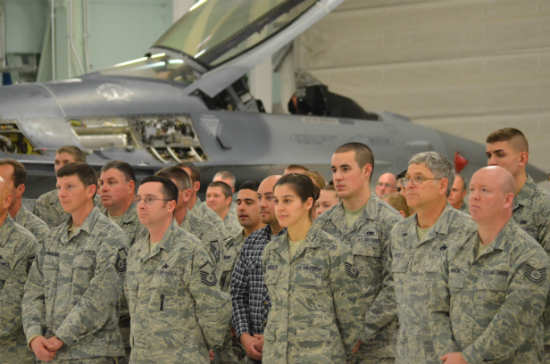
by Timothy McQuiston Vermont Business Magazine With a beaming Senator Patrick Leahy at his side, General Steven Cray of the Vermont National Guard announced Tuesday afternoon that Vermont would be the "beddown" for 18 F-35A fighter jets. The 158th Fighter Wing is expected to start to receive the planes in 2020. The F-16s now deployed at the base attached to the Burlington International Airport will remain in service until the F-35s arrive and then they will be retired.
At just after 1 pm the contingent of soldiers were ordered to attention and the dignitaries walked into the hangar, in a rather solemn march to the podium, given the hubbub just prior. The announcement was about four years in the making. The Vermont Air Guard has been an important Wing for the Air Force. Immediately after the attacks of 9-11, the Vermonters patrolled the skies over New York City.
Speaking directly to the guardsmen standing in long rows behind the TV cameras, Cray said: "I'm here to announce that the Secretary and the Chief of Staff of the Air Force have selected Burlington as the first Air National Guard base for the F-35. Congratulations!"
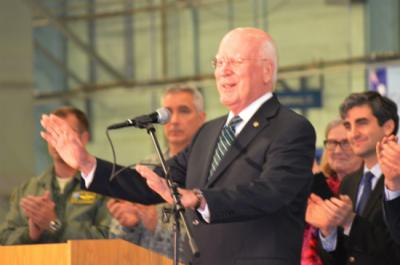 Much applause followed, especially for Leahy when he had his chance to speak.
"I have one question for the men and women of the Guard," Leahy asked as he looked at the several hundred Guardsmen, "We Vermonters are very proud of you, very proud of what you do, I know you are proud of your service, are you especially proud today?"
Leahy has been a loud and constant proponent of both the Vermont National Guard and the Air Wing. Leahy said the secretary called him Tuesday morning to confirm that Vermont would be the first Air National Guard F-35A Operational Base for the new jet fighter. Hill Air Force Base in Utah already was the first regular Air Force operational F-35A Lightning base and Vermont won its Guard basing over sites in South Carolina and Florida.
The announcement, covered by two score of news media, was held at Hangar 3 at the base in South Burlington, across the airstrip from the Burlington International Airport terminal. Leahy has made the Vermont National Guard and the development of BTV as a ‘first class’ airport major economic development priorities during his long tenure in the US Senate.
Cray said that while the new Wing could have been up to 24 airplanes, he said 18 is what they were expecting because that is what they have now. He said that while there would need to be $3-4 million in upgrades, staffing would remain about the same, at around 1,100.
‘Four years ago when Burlington was being considered, up to the point they said Burlington was a preferred location, I’ve been saying all along, I knew it was the right decision for the Air Force and certainly for the Vermont Air National Guard,’ Cray said.
Governor Peter Shumlin, who is the commander of the Guard up to the point it is called to duty by the president, said: ‘I am so honored today, as your commander in chief’¦ For every single Vermonter, this is a great moment.’’
Shumlin pointed out that the Guard was among the first on the scene after Tropical Storm Irene devastated several parts of Vermont and was called to protect New York City after 9-11.
‘When our nation is in harm’s way, when we’re facing huge challenges, I’m proud of the fact that it is the Vermont Air Guard that is first to be called, that is first on the scene, as we were on 9-11.’
While no protesters were seen at the announcement or even outside the base (media and others had to be escorted onto the base), they were present through the many questions reporters asked of Cray, Leahy, Burlington Mayor Weinberger, South Burlington City Council Chair Pam Mackenzie (an ardent supporter of the F-35) and Winooski Mayor Michael O'Brien (a reluctant one). ‘
O'Brien voted with the City Council last July in opposition to the F-35, has maintained that he supports the F-35 and the Guard's contribution to the community. O'Brien has been walking the tight-rope of understanding the benefits on the one hand, and his city's overwhelming opposition to the new jets, on the other. Winooski lies directly on the flight path for military and commercial aircraft using BTV.
Opponents already have filed suit against basing the F-35s in Burlington and have put the state and the Air Force on notice that they will continue to do so. The opposition has centered on the noise levels, which they say are too high now and which will only get louder with a louder airplane. Opponents also claim that the noise not only creates environmental problems, but also health problems. They also say they have safety concerns, especially since this is a new aircraft.
Cray said the legal issues have a separate process that was out of his hands.’
Leahy said when he was a student at Saint Michael’s College in the early 1960s (he graduated in 1961), the military aircraft then was much louder than the F-35 is now. He said, and his actions back it up, that he fully supports the basing and the Vermont Air Guard and will continue to do so.
While the airport is in South Burlington, it is part of and the responsibility of the City of Burlington.
Mayor Weinberger said: ‘Regardless of the outcome today, we have work to do to ensure that the airport is as good neighbor as it can be. That the neighborhood on the other side of the airstrip is healthy and thriving.’
The F-35, however, has had its own critics nationally. It is the most expensive weapons system in the nation's history. It also has been taken to task for trying to be all things to all services -- Air Force, Navy, and Marines -- while being stealthy, an interceptor and an attack aircraft. Critics claim that it is the master of none of the tasks it is suppose to undertake.
Estimates on how much the plane will cost vary considerably and will depend in part on how many are sold to allies. Japan and South Korea have already signed up (in November South Korea decided to buy 40 jets). ‘
In a Bloomberg.com story in August, manufacturer Lockheed Martin Corp said the system will cost $857 billion over 55 years. The Pentagon, it said, is still reporting that the entire cost (planes, parts, maintenance, etc) will be $1.1 trillion, but that estimate was already two years old and costs reportedly have fallen. The cost-per-plane estimates are in the $130-$159 million range.
When asked about whether the F-35 will "100 percent" be deployed, Leahy, without saying yes, said he has opposed the cost of weapons systems in the past, like the B-1 and B-2 bombers and even the F-35, but that he stood by the Vermont Air National Guard and its continuing role in the next generation of aircraft.
But there was no mistaking the overwhelming support from all the other politicians with any say in the matter.
Mayor Miro Weinberger, General Steven Cray, Governor Peter Shumlin and Senator Patrick Leahy listen to a question at a press conference following the announcement. Photos by VBM
Along with Leahy and Shumlin, Senator Bernie Sanders and Representative Peter Welch, who were not in attendance, issued a joint statement: ‘The Air Force decision to base its newest generation of planes in Burlington is a tribute to the Vermont Air National Guard, which is the finest in the nation. It reflects the Guard’s dedication to its mission and long record of outstanding performance.’ The Air Force has made clear that this aircraft, which will anchor our national air defenses, is the Air Force’s future. Now the men and women of Vermont’s Air National Guard have been chosen for a vital role in that future. The decision ensures the Vermont Air Guard’s continuing mission and protects hundreds of jobs and educational opportunities for Vermonters while securing its significant contribution to the local economy.’ We appreciate the Guard’s commitment to continue working with its airport neighbors to address legitimate concerns about noise and other environmental concerns.’
Colonel David Baczewski, the Vermont Air National Guard Wing commander, said pilot training for the new aircraft could take up to eight months and would take place at Eglin Air Force Base in Floridawhen the time comes.
Over the course of "several decades" the Air Force intends to deploy some 1,700 F-35s to replace the F-16 Fighting Falcons, which are light fighters, and the sub-sonic A-10 Warthogs, which are heavy ground support attack aircraft.
In a statement, Timothy Bridges, Deputy Assistant Secretary of the Air Force for Installations, said: "After considering the potential environmental impacts contained in the FEIS (Federal Environmental Impact Study), as well as other factors relative to national policy and defense, including current military operational needs and cost, the Air Force has decided to base 18 F-35A aircraft at Burlington AGS in Vermont."
12.3.2013